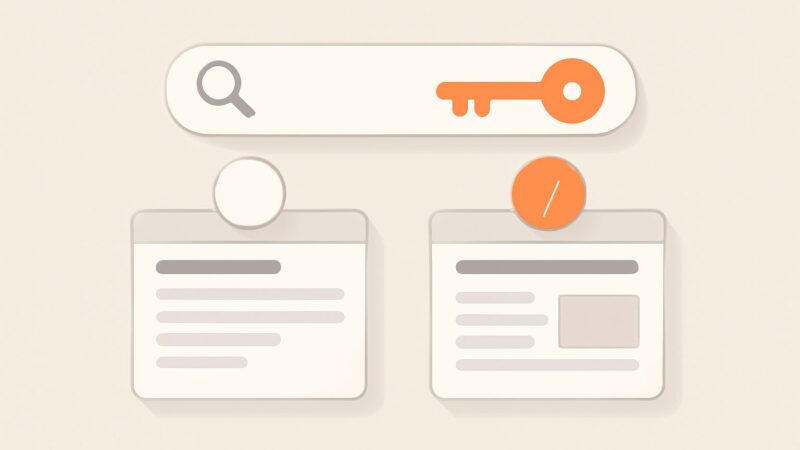
Most advice on featured snippet optimization treats it like a formatting hack — wrap a list in bullets, sprinkle a question as a heading, and Google hands you the box above the results. That framing misses what is actually happening. A featured snippet is not something Google generates for you; it is something Google extracts from a page it has already decided is a good answer. Your job is not to trick the extractor. It is to make the single best answer on the query trivially easy to lift out of your page — and to first earn a spot in the small pool of pages Google will lift from at all.
Featured Snippets Are an Extraction Problem, Not a Trick
Position zero exists because Google is trying to answer a query directly in the results, and it does that by scraping a concise passage — a paragraph, a set of steps, a table — from a page that already ranks well. Understanding this reframes the whole exercise. You are not writing “for the snippet” as a separate deliverable; you are structuring your existing page so the most quotable 40-to-60 words sit in a clean, self-contained block the algorithm can grab without ambiguity. The pages that win are the ones where the answer is unmistakable, complete on its own, and matched to the format the query invites.
This is why formatting-only tactics disappoint so often. If your page does not genuinely contain the best short answer, no amount of bullet-point styling changes the outcome. Snippet optimization is downstream of content quality, not a substitute for it.
You Almost Always Need Page One First
The uncomfortable prerequisite: the overwhelming majority of featured snippets are pulled from pages already ranking on page one, with published analyses repeatedly putting the share around 99%. Practically, that means featured snippet optimization is an amplifier for pages that already rank in roughly the top ten — not a shortcut for a page sitting on page three. If you are not on page one, the first move is the ordinary work of getting there: matching intent, covering the query completely, and earning the links and authority to compete.
The good news is that the snippet does not require the number one organic position. Pages ranking anywhere from position two to position eight frequently win the box by having the cleanest extractable answer, which is exactly why it is worth chasing — it lets a mid-page-one result leapfrog the visual hierarchy without out-ranking the leader outright.
The Four Snippet Types and What Each Rewards
Google draws snippets in four broad shapes, and each maps to a different query intent:
- Paragraph snippets — the most common by far. Triggered by “what is,” “why,” “how does,” and definitional queries. Google lifts a concise 40-60 word passage that reads like a clean, objective answer.
- Numbered-list snippets — triggered by process and sequence queries (“how to,” “steps to”). Google extracts ordered steps, often from your H2/H3 subheadings or a genuine ordered list.
- Bulleted-list snippets — for unordered sets: “types of,” “best,” “checklist.” Ranking or grouping without inherent sequence.
- Table snippets — for comparison and data queries (pricing, specs, “X vs Y”). Critically, Google scrapes tables that already exist in your HTML; it does not assemble one from scattered text, so the data must live in an actual
<table>.
The first rule of format is that you cannot pick it — the query already has one. Search the term, look at what Google currently shows, and match that shape. Answering a “how to” query with a dense paragraph when the SERP wants numbered steps is a losing bet before you write a word.
The Answer-Block Method: A Worked Example
Here is the concrete pattern that wins paragraph snippets. Take a target query — say, “what is keyword difficulty.” Structure the section like this:
- Use the question itself, or a very close variant, as an H2 or H3 immediately above the answer.
- In the first sentence directly under that heading, answer it fully in 40-60 words — no throat-clearing, no “well, it depends,” no first-person. Write it so the passage stands alone if lifted with zero surrounding context.
- Then continue below with the nuance, caveats, and depth that the 40-word block deliberately left out.
So: an H2 reading “What Is Keyword Difficulty?” followed by “Keyword difficulty is a 0-100 score estimating how hard it is to rank on page one for a term, based mostly on the strength of the sites already ranking. It is a third-party estimate, not a figure from Google, so treat it as directional guidance rather than a guarantee.” That is a self-contained, extractable answer. The heading tells the algorithm what the block resolves; the block resolves it in one lift. Everything richer goes underneath, where it deepens the page without diluting the quotable core.
Mine People Also Ask for Snippet-Shaped Queries
The “People Also Ask” boxes are the richest, cheapest source of snippet targets, because they are populated by the same passage-extraction system. Each PAA question is a query Google is actively answering with a lifted snippet right now. Harvest the PAA cluster around your main keyword, group the questions by intent, and give the genuinely relevant ones their own answer block within a single comprehensive page. One well-structured guide can hold ten or fifteen extractable answers, each eligible for its own snippet or PAA slot — which is how a single page becomes a durable traffic surface rather than a one-keyword bet.
Match the Format Google Already Chose
When a query already shows a featured snippet held by a competitor, that is not a closed door — it is a spec sheet. Google has told you exactly what format it wants and roughly how long the answer should be. Study the incumbent: how many words, how many steps, paragraph or table, what sub-points it includes. Then produce a clearly better version of the same shape — more accurate, more current, more complete, tighter. “Steal-able” snippets, where a competitor holds the box from position three or four, are the softest targets, because you are competing on answer quality within a format Google has already validated rather than gambling on an untested one.
The Zero-Click Trade-Off Nobody Warns You About
Here is the honest caveat almost every guide skips. Winning the snippet is not always a win. For some queries — a definition, a conversion, a single number — the snippet answers the searcher so completely that they never click through. If you already rank number one and the query is fully satisfied by the answer itself, capturing the snippet can cannibalize your own clicks: you trade a blue-link click for a zero-click impression. Estimates of a snippet’s share of clicks vary, and for pure-answer queries the box can suppress downstream traffic rather than lift it.
So apply a decision rule. Chase the snippet aggressively when: you rank below number one (the box is a genuine leapfrog), or the answer creates curiosity that pulls the click (“here are the five steps — but the details matter”). Be more cautious when you already hold number one on a query the snippet fully resolves, because you may be donating your best position to a click-free box. Featured snippet optimization is a portfolio decision, not a reflex to grab every box you can.
How to Find Snippets Worth Chasing
The efficient workflow is to filter, not guess. Pull the keywords where you already rank in the top ten, cross-reference which of those SERPs contain a featured snippet, and prioritize the ones where a competitor — not you — currently holds it. Those are the highest-probability wins: you have the ranking, Google has confirmed a snippet exists for the query, and the format is visible. This is exactly the kind of filtering SEO Rocket is built for — its keyword research runs on real Ahrefs data, so you can surface where you rank, where the SERP features live, and where a competitor gap is realistically closeable, with volume and difficulty shown as the third-party estimates they are rather than treated as ground truth.
Layer in intent and effort. A definitional paragraph snippet you can win by tightening one section is worth more of your afternoon than a table snippet that needs a full data build. Sort by “closest to won,” and work down.
Defending and Winning Back a Snippet
Snippets are volatile — Google reassigns them as competitors sharpen their answers, and a box you own can vanish after a core update or a rival’s edit. Treat ownership as a lease, not a deed. Track your snippet-holding pages, and when you lose one, diagnose before you rewrite: did a competitor publish a tighter answer block, change the format, or simply out-rank you into the extraction pool? Winning it back is usually a matter of re-matching the current format and out-concising the new incumbent, not adding more words. More words is the most common way people lose a paragraph snippet, because it buries the 40-word core Google was lifting.
Measuring Featured Snippet Optimization Honestly
You cannot see “snippet owned: yes/no” cleanly in Search Console, which is the honest limitation. What you can do is watch for the signature: a keyword sitting at an average position near the top with a click-through rate that suddenly jumps (you won the box) or drops while position holds (you won a box that answers the query and suppresses clicks — the trade-off in action). Pair rank tracking with GSC’s clicks and impressions to infer snippet movement, and treat daily jitter as noise — snippets flicker, so trend across weeks, not days. Rank tracking inside SEO Rocket surfaces these position-and-visibility shifts over time, and its real-crawler site audit flags the structural issues — missing headings, un-tabled data, buried answers — that quietly keep otherwise-strong pages out of the extraction pool.
What Actually Moves the Needle
Strip away the tactics and featured snippet optimization comes down to three durable moves: rank on page one for the query, structure the single best answer into a clean, format-matched block, and be honest about which boxes are worth winning. There is no formatting trick that substitutes for having the best answer, and there is no guarantee — Google decides, reassigns, and sometimes removes snippets on its own schedule. But the pages built to be the clearest, most complete answer to a real question are the ones that win position zero and keep it. That is the same principle that scaled a playbook across 1,000,000+ ranking pages: earn the ranking, then make the answer impossible to ignore.
Frequently Asked Questions
How long should a featured snippet answer be?
For paragraph snippets, aim for roughly 40 to 60 words — long enough to fully answer, short enough for Google to lift cleanly. Put that block immediately under a heading that matches the question, then expand with detail below. For list and table snippets, match the length and structure of the snippet the query currently shows.
Can I guarantee a featured snippet by optimizing my page?
No. You can meaningfully improve your odds by ranking on page one, matching the query’s snippet format, and providing the clearest self-contained answer — but Google chooses the snippet algorithmically and can reassign or remove it at any time. Anyone promising a guaranteed snippet is overselling; you optimize for probability, not certainty.
Do I need to rank number one to win a featured snippet?
No. The vast majority of snippets come from page-one results, but the source is frequently a page ranking in positions two through eight, not necessarily number one. That is what makes snippets valuable — a mid-page-one result can leapfrog the visual hierarchy by having the most extractable answer, without out-ranking the leader.
Is winning a featured snippet always good for traffic?
Not always. For queries the snippet fully answers, the box can satisfy the searcher so completely they never click — a zero-click result. If you already rank number one on such a query, capturing the snippet may cannibalize your own clicks. Chase snippets hardest when you rank below number one or when the answer leaves the searcher wanting the full detail.