Most predictions about the future of SEO with AI are useless because they’re binary: either “search is dead” or “nothing has changed, keep publishing.” Both are wrong, and both are lazy. Search isn’t dying — it’s being intermediated. An AI layer now sits between the query and your page, and it changes which clicks you get, how your content gets found, and what “ranking” even means. If you understand the mechanism underneath that layer, the future stops looking like a threat and starts looking like a set of concrete, ordered moves. This guide is about the mechanism, not the panic.
What the Future of SEO With AI Actually Means
Here’s the honest framing. The future of SEO with AI isn’t one event — it’s two forces pulling in opposite directions. On one side, AI Overviews and chatbots answer more queries directly, so a slice of informational traffic never reaches your site. On the other, the same AI systems have to source their answers from somewhere, and that somewhere is still web pages they trust. So you lose some clicks and gain a new distribution channel at the same time. The winners aren’t the people who stopped doing SEO. They’re the people who figured out which of their pages feed the machine and which ones get eaten by it.
How AI Answers Actually Get Assembled
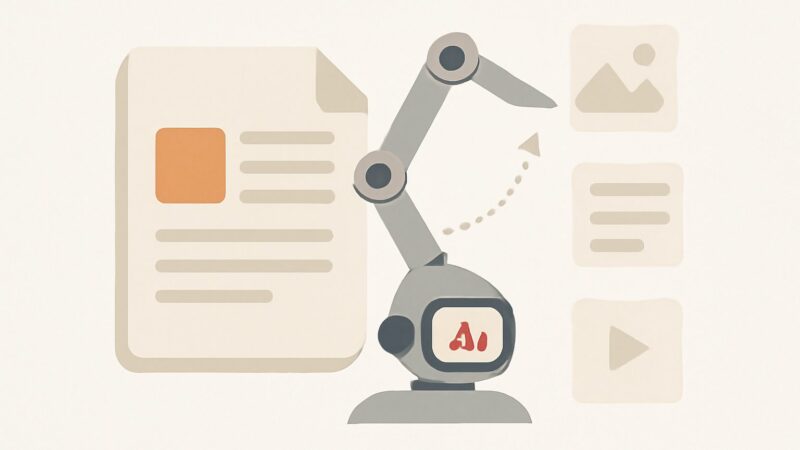
You can’t plan for the future of SEO with AI without knowing how the answer box is built, so here’s the plumbing in plain terms. When someone asks a large language model or an AI Overview a question, the system doesn’t recall your article from memory. It runs a retrieval step: it converts the query into a vector, pulls the most semantically relevant chunks of text from an index (often a live search index plus its own cache), and then generates an answer grounded in those chunks. Citations are chosen from the passages it actually used.
Three consequences fall out of that mechanism directly:
- It retrieves chunks, not pages. A single clear, self-contained paragraph that answers a sub-question can get pulled and cited even if the rest of your page is average. Structure and passage-level clarity now matter as much as the page as a whole.
- It rewards being unambiguous. Models ground answers in text they can extract confidently — a direct definition, a specific number, a labelled step. Vague, hedged prose retrieves poorly.
- It still trusts the same signals search does. Retrieval leans on the underlying search index, so authority, relevance, and crawlability haven’t stopped mattering. They’ve become the entry fee for a second game.
The Durability Test: Which Pages Survive
The single most useful thing you can do this quarter is sort your existing content by a simple rule I call the durability test. Ask of each page: can an AI answer this completely in two sentences without the reader needing to click? If yes, that page is exposed. If answering it well requires judgment, a comparison, a workflow, proprietary data, or an opinion the reader has to weigh, that page is durable.
Pages like “what is a meta description” or “how many words in an H1” are two-sentence answers — the AI will swallow them and the click disappears. Pages like “how do I recover from a 40% traffic drop after a core update” or “which link-building tactic fits a new site with no budget” force nuance, and the reader still wants the full argument. The future of SEO with AI belongs to the second category. Reallocate your writing effort accordingly instead of pumping out more definitional glossary posts.
Zero-Click Is Real, but It’s Uneven
Let me make the durability test concrete with a worked micro-example. Say you run a small accounting site with two pages. Page A targets “what is a tax invoice” — 2,000 searches a month, purely definitional. Page B targets “tax invoice vs receipt for a sole trader” — 400 searches a month, genuinely confusing, with edge cases that depend on jurisdiction.
Post-AI, Page A’s click-through can fall sharply because the Overview states the definition and most searchers never scroll. Page B loses far less, because the comparison has enough conditional logic (“it depends whether you’re registered for GST, whether the buyer is a business…”) that readers click to see their specific case handled. The lesson isn’t “avoid high-volume keywords.” It’s that raw volume is now a worse predictor of traffic than answer complexity. A smaller keyword with a durable intent can out-earn a big keyword the machine has already eaten.
Getting Cited: The Second Ranking Game
Traditional ranking gets you the blue link. Citation gets you named inside the AI answer — and increasingly that’s where trust and clicks originate, because being the source the model quotes is its own form of authority. Optimising for citation overlaps with good SEO but adds a few specific moves: answer the exact question in the first sentence of a section, put the number or definition in extractable form (a sentence, a short list, a small table), and keep each passage self-contained so it survives being lifted out of context.
This is also why AI-visibility tracking is becoming a standard metric alongside keyword rankings. You want to know not just where you rank in Google, but whether ChatGPT, Gemini, and AI Overviews mention you for the queries you care about. SEO Rocket tracks both — traditional rank plus AI-visibility — so you can see the two games on one dashboard instead of guessing whether the machine has noticed you.
Content Production Stops Being the Bottleneck
For twenty years the constraint on SEO was throughput: how many good pages can you ship per month. AI collapses that constraint. A competent operator can now draft in minutes what used to take a day. But when everyone’s production floor rises, throughput stops being an advantage and becomes table stakes. The new bottleneck moves upstream to judgment — knowing which pages are worth making, what angle earns a citation, and where the current top results are thin enough to beat.
This is the trap most teams fall into: they use AI to publish more mediocre pages faster, and the 2024–2025 helpful-content signals quietly demote the lot. The fix is a validation gate between the model and publish. SEO Rocket’s AI writer runs hard checks — minimum length, title and meta limits, section structure, and an automatic repair loop that catches thin or broken output before it reaches a draft. The gate isn’t compliance theater; it’s the thing that stops AI volume from turning into an algorithmic liability.
The Quality Floor Rose, So Information Gain Is the Moat
Because anyone can generate a competent 1,200-word article, competent is now the baseline, not the goal. Google’s systems increasingly reward information gain — the page that adds something the existing top results don’t: original data, a first-hand test, a sharper framework, a non-obvious caveat. That’s the one thing an AI writing off the existing web can’t manufacture, because by definition it’s synthesising what’s already there.
So the durable strategy in the future of SEO with AI is counter-intuitive: use AI for the parts that are commodity (structure, drafting, cleanup) and spend the human hours you saved on the parts that aren’t (running the experiment, gathering the proprietary number, taking the position). A page that says something true and specific that no competitor says is the only asset both Google and the AI answer layer reliably prefer.
Technical SEO Gets More Important, Not Less
Counter to the “AI makes SEO easy” narrative, the technical layer is now more load-bearing. If a retrieval system can’t crawl, parse, and confidently extract your content, you’re invisible to both the SERP and the AI answer. That means clean HTML semantics, fast rendering, content that isn’t buried behind JavaScript the crawler skips, sensible internal linking so authority flows to your durable pages, and structured data that labels what your passages mean. A real-crawler site audit — one that fetches pages the way a bot does, not a surface HTML grep — catches the issues that quietly keep you out of the index. This is deterministic, unglamorous work, and it’s precisely what the AI hype cycle tempts people to skip.
Keyword Research Changes Shape, Not Purpose
Research isn’t going away; it’s becoming clustering. Instead of chasing individual phrases, you map the entities and sub-questions around a topic, then decide which clusters are durable (judgment-heavy) versus exposed (definitional). The winning workflow pulls real search data — volume, difficulty, intent — and groups it by the job the searcher is trying to do, not by exact-match string. SEO Rocket runs AI keyword research on live Ahrefs data and clusters it by intent, so you’re prioritising the pages that will still earn a click after the answer box takes its cut, instead of optimising for keywords the machine now handles for free.
Your Twelve-Month Playbook
Here’s the concrete sequence, in order:
- Run the durability test across your top 50 pages. Mark each exposed or durable.
- Stop publishing pure definitional content unless it feeds a durable hub as a supporting page.
- Rewrite exposed-but-important pages to add judgment, comparison, or proprietary data — information gain the answer box can’t replicate.
- Restructure for extraction: lead each section with the direct answer, put numbers in liftable form, keep passages self-contained.
- Track both games: keyword rank and AI visibility, so you know when a page has been eaten versus when it’s being cited.
- Fix the crawl layer with a real audit so nothing durable is accidentally invisible.
- Use AI for volume, humans for gain — gate every AI draft through a validation step before publish.
None of this is speculative. Every step is something you can do this month, and it’s the same discipline behind a playbook proven across 1,000,000+ ranking pages: benchmark the real competition, add something genuinely new, validate before publishing, and track the trend rather than the daily jitter.
Honest Caveats
A few things nobody can promise you, because the truth is genuinely uncertain. We don’t have reliable public data on exactly how much click-through AI Overviews remove, and it varies wildly by query type — transactional and local queries are far less affected than informational ones. Being cited by an LLM doesn’t guarantee a click either; sometimes the citation is the whole interaction. And the platforms are changing their answer formats every few months, so any specific tactic tied to today’s UI is fragile. What’s durable is the mechanism: retrieval rewards clarity and authority, and information gain beats commodity content. Bet on the mechanism, not the UI.
Frequently Asked Questions
Will AI make SEO obsolete?
No. AI changes where the clicks land and adds a second ranking game (citation), but it still sources answers from crawlable, authoritative web pages. The skill shifts from producing more content to producing content the machine can’t replicate — original data, judgment, and information gain.
Should I stop targeting high-volume keywords?
Not blanket-stop, but re-weight. High-volume definitional keywords are the most exposed to zero-click answers. Smaller keywords with complex, judgment-heavy intent often now earn more actual traffic per search. Prioritise by answer complexity, not raw volume.
How do I get cited in AI Overviews and ChatGPT?
Answer the exact question in the first sentence of a section, put facts and numbers in extractable form, keep each passage self-contained, and maintain the underlying authority signals (crawlability, relevance, real backlinks). Then track AI visibility so you can see whether it’s working.
Is AI-written content penalised by Google?
Not for being AI-written — for being thin, unedited, or adding nothing new. AI content that passes a real validation gate and carries genuine information gain ranks fine. AI content published at volume with no editorial judgment is what the helpful-content signals demote.