Learning how to do a content gap analysis is one of the highest-leverage things you can do for organic traffic, because it stops you guessing. Instead of brainstorming topics and hoping they matter, you look at the keywords two or three competitors already rank for, subtract the ones you cover, and you’re left with a concrete list of pages the market rewards and you don’t have yet.
The work itself is not complicated. What trips people up is doing it in a way that produces a real publishing queue instead of a spreadsheet nobody opens again. Below is the exact process, in the order I run it, with honest notes on how long each step takes and where the data will lie to you.
What a content gap analysis actually is
A content gap is any search topic your competitors earn traffic from and you don’t — either because you have no page on it, or the page you do have is too thin to compete. The analysis is simply the disciplined way of finding those topics by comparing keyword footprints rather than opinions.
It’s worth being clear about what this is not. It won’t tell you what to write about brand-new topics nobody ranks for yet, and it won’t fix a page that’s already competing but stuck on page two — that’s an on-page and links problem, not a gap. Gap analysis answers one question well: what proven demand am I completely absent from?
The reason it works is that ranking is a rough proxy for effort and validation. When a competitor holds a top-five position for a term, someone decided that topic was worth a page, wrote it, and the market kept it there. You get to skip the guesswork and inherit their research. That’s why gap analysis beats a blank-page brainstorm nearly every time — you’re mining decisions competitors have already tested for you, then choosing which of those bets to match and beat.
Step by step: how to do a content gap analysis
Here’s the full sequence. Steps one through four are research; five through seven are where the value actually gets captured.
- Pick three real competitors. Not the biggest brand in your space — pick sites at roughly your level that rank for the terms you want. Include at least one weaker page-one rival, because their gaps are the ones you can realistically close this quarter. Ten minutes.
- Pull each competitor’s ranking keywords. Export the organic keywords each domain ranks in the top 20 for. You want position, monthly search volume, and keyword difficulty for every term. This is the raw material for everything that follows.
- Subtract your own keywords. Overlay your domain against the three competitors and keep only the terms where they rank and you don’t rank at all — or rank below position 20. That intersection is your literal gap list.
- Filter for relevance and intent. Kill anything off-topic, branded to a competitor, or informational when you need commercial (and vice versa). A gap you’d never sensibly write about is not a gap. Expect to cut 40–60% of the raw list here.
- Cluster the survivors into pages. Twenty keywords rarely mean twenty articles — they mean five or six, because many are variations of the same intent. Group them so each cluster becomes one page targeting a primary keyword plus its supporting terms.
- Score and prioritize. For each cluster weigh volume against difficulty against business value. A 300-search term you can rank for and that converts beats a 9,000-search term you can’t. Sort so the winnable, valuable clusters sit at the top.
- Turn the top clusters into briefs. Write the working title, primary keyword, supporting keywords, and target intent for each. Now you have a queue a writer can start on Monday, not a spreadsheet.
Done manually across three competitors, this is a half-day of work the first time and an hour or two once you’ve done it before. The slow parts are the exports and the deduping — which is exactly the part software should handle. If you find yourself spending most of the afternoon reconciling spreadsheets rather than thinking about which topics matter, you’ve inverted the value: the reconciling is mechanical, and the thinking is the whole point. Automate the first and protect your attention for the second.
Doing it faster inside SEO Rocket
The seven steps above are the same whether you run them by hand or let a tool do the heavy lifting. In SEO Rocket, the Content Gap feature collapses steps two through four into one request: you name your site and up to three competitors in plain language, and it returns the keywords they rank for that you don’t, already merged and de-duplicated, with monthly volume and keyword difficulty on every row. The data underneath is Ahrefs-grade, so the numbers line up with what a standalone research tool would show.
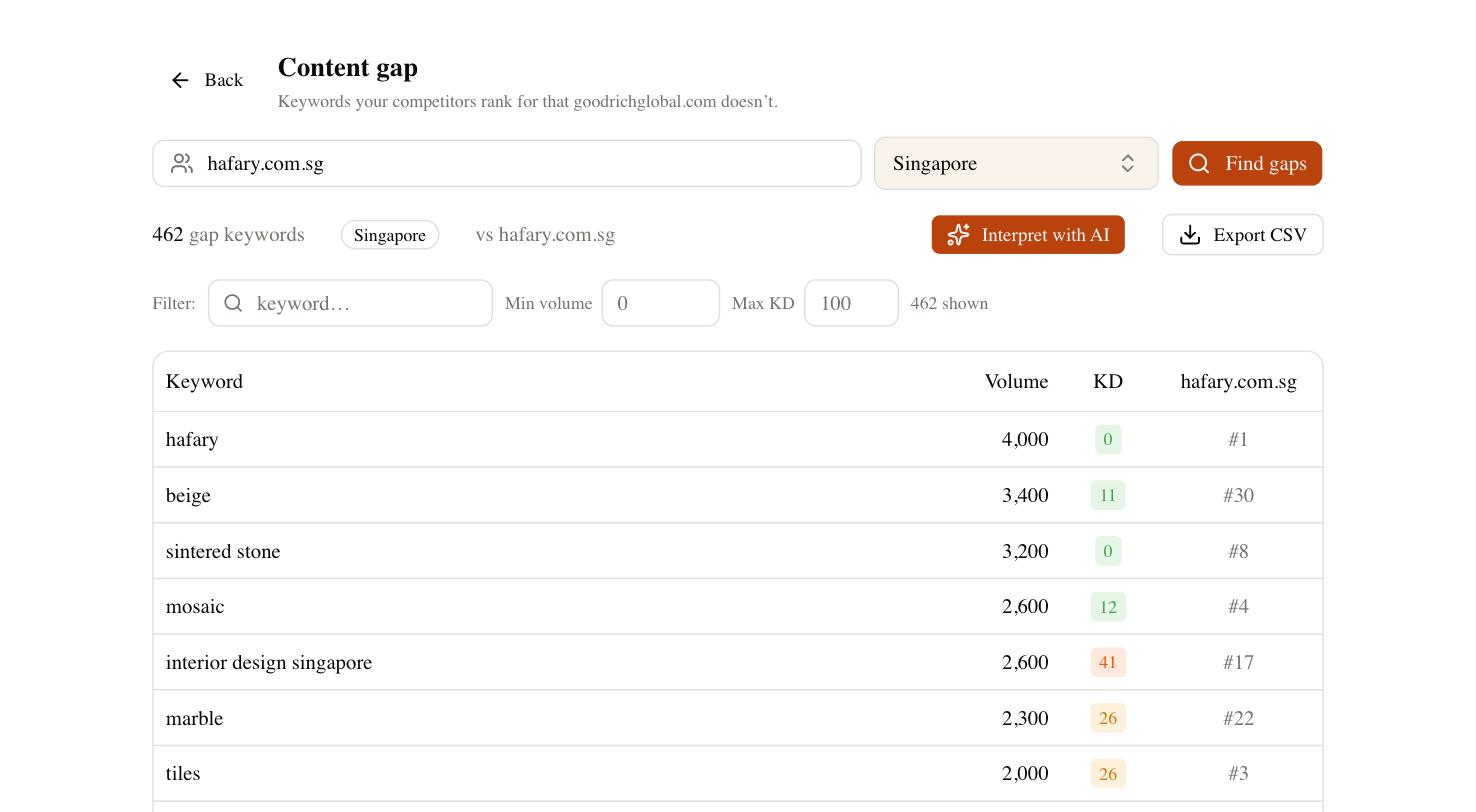
What that saves you is the tedious middle — no exporting three CSVs and reconciling them by hand. You still make the judgment calls that matter: which clusters fit your business, what intent each one serves, and what order to publish in. The tool does the subtraction; you do the strategy. That division is deliberate, because the prioritizing in step six is where experience actually earns its keep, and no amount of automation replaces knowing which of your keywords are worth money.
One practical tip when you run it: choose competitors that overlap with you but aren’t identical. If all three are near-clones of your site, the gap list will be short and obvious. Mix in one adjacent player who serves the same buyer from a slightly different angle, and you’ll surface topics your direct rivals also missed — which is where the genuinely uncontested opportunities tend to hide.
How to read difficulty and volume without fooling yourself
Two honest cautions. First, keyword difficulty is a modeled estimate, not a promise — it approximates how strong the ranking pages’ backlink profiles are, and it says nothing about whether their content is beatable. A “hard” keyword sitting above three thin, outdated pages is often easier than an “easy” one defended by genuinely great content. Always eyeball the actual page-one results before you trust the number.
Second, search volume is a rounded average pulled from historical data, so treat it as a range, not a figure. A term listed at 1,000 might really swing between 400 and 2,000 across the year, and seasonal terms swing far harder than that. Use volume to sort roughly, not to forecast traffic to the decimal. When two tools disagree on these metrics — and they will — the difference is estimation noise, not one of them being right. The practical move is to stop optimizing the numbers past two significant figures and spend that energy on the content instead, where the real variance lives.
Turning the gap list into a publishing plan
A list is not a plan. The step most people skip is committing the prioritized clusters to a calendar with owners and dates, and that’s the step that decides whether any of this produces traffic. A gap list that lives in a tab you never reopen has zero value; the same list with a name and a date next to each row becomes a quarter of work. Take your top-scored clusters and slot them into the next eight to twelve weeks, one brief at a time.
- Start with the winnable middle. Skip both the zero-difficulty scraps and the flagship terms you can’t touch yet; publish the medium-value, medium-difficulty clusters first to build momentum and topical depth.
- Batch by cluster, not by keyword. One strong 1,500-word page covering a whole cluster outperforms six thin pages splitting the same intent and cannibalizing each other.
- Re-run the analysis quarterly. Competitors publish, you publish, and the gap moves. A quarterly refresh keeps the queue honest.
Be honest about the timeline
The analysis takes an afternoon. The payoff does not. New content typically takes three to six months to reach its stable position, and competitive terms can take longer, so a gap you fill in August may not move revenue until winter. That lag is normal and it’s why prioritizing well matters — you can’t afford to spend the first three months of that wait on a page that was never going to rank.
Knowing how to do a content gap analysis gives you a defensible reason for every page you commission, which is worth far more than the traffic from any single article. You stop writing on instinct and start writing against demand you can see. Run it against three competitors, close the most winnable gaps first, re-check it each quarter, and give the pages a full ranking cycle before you judge them — that’s the whole discipline, and it compounds.