Learning how to do an ai visibility audit matters because a growing share of your buyers now ask ChatGPT, Perplexity, or Google’s AI Overviews instead of scrolling a results page. You can rank first in classic search and still be completely absent from the answer an AI hands your customer — and unless you check, you will never know it is happening.
An ai visibility audit is simply a structured check of whether, where, and how often AI answer engines mention your brand for the questions your customers actually ask. It is not magic and it is not instant, but it is concrete work you can start today. Below is the exact process, the steps in order, and an honest read on what it can and cannot tell you.
What an AI visibility audit actually measures
Traditional rank tracking answers one question: where does my page sit in the blue links? AI visibility answers a different one: when an answer engine writes a paragraph for my buyer, does it name me, link me, or ignore me entirely? Those are not the same thing. AI systems synthesize from many sources, cite a handful, and often skip the page that ranks number one in favor of a clearer, more quotable one.
So the audit measures three things. First, presence — are you mentioned at all for a given prompt? Second, citation — does the answer link to your site as a source, or just name you in passing? Third, sentiment and accuracy — is what the model says about you correct and favorable, or is it repeating an old price, a wrong founder, or a competitor’s talking point? Presence without accuracy is not a win.
It is worth separating this from the older idea of “brand mentions” monitoring. A media monitoring tool tells you when a blog or news site writes your name. An AI visibility check tells you when a machine that answers questions for buyers decides whether to include you in its recommendation — a decision made fresh, per prompt, from whatever sources the model trusts that week. The stakes are higher because there is often no second result to scroll to. In classic search a buyer sees ten links; in an AI answer they frequently see one paragraph and three names. If you are not one of those names, you did not lose rank four, you lost the whole conversation.
Before you start: define your prompt set
The single biggest mistake is auditing the wrong questions. AI answers are prompt-specific, so your results are only as good as the prompts you test. Do not test “best CRM software” and call it done; test the phrasings your buyers really type.
Build a list of 20 to 40 prompts across four intents:
- Category prompts — “best project management tools for agencies,” “top email marketing platforms.”
- Problem prompts — “how do I reduce cart abandonment,” “cheapest way to track keyword rankings.”
- Comparison prompts — “X vs Y,” “alternatives to [competitor].”
- Branded prompts — “is [your brand] any good,” “what does [your brand] cost.”
Branded prompts catch accuracy problems; the other three tell you whether you show up when nobody has named you yet. That unbranded discovery is where the real money sits.
How to do an AI visibility audit: the steps
Here is the sequence. You can run steps 1 through 4 by hand with nothing but browser tabs — it is tedious but honest — or automate them with a tool, which I cover after.
- List your engines. At minimum, test ChatGPT, Perplexity, Google AI Overviews, and Google Gemini. Each pulls from different sources, so a mention in one guarantees nothing in the others.
- Run every prompt in each engine. Use a clean session — logged out or in a temporary chat — so personalization and memory do not skew what you see. Personalized history quietly inflates your own visibility.
- Record the raw answer. For each prompt, note whether your brand appears, whether it is cited with a link, which competitors are named, and which source URLs the engine used. A simple spreadsheet with one row per prompt-and-engine pair works fine.
- Score presence and accuracy. Mark each result: cited, mentioned only, or absent. Flag any answer that says something wrong about you — those are the fastest wins, because correcting a factual error is easier than earning a brand-new mention.
- Map the sources being cited. Look at which pages the engines quote. You will usually see a pattern — comparison articles, Reddit threads, review directories, and a few authoritative guides. Those are the surfaces you need to influence.
- Repeat on a schedule. One snapshot is a data point, not a trend. Re-run the same prompt set every two to four weeks so you can tell real movement from the day-to-day noise these models produce.
Run the manual version once and you will understand exactly what the audit captures. Run it twice and you will want to automate it, because doing 40 prompts across four engines by hand is roughly an afternoon of copy-paste every cycle.
Doing it faster with SEO Rocket
The job SEO Rocket handles here is the one that eats your afternoon. Its AI Visibility feature — Brand Radar — runs your prompt set across ChatGPT, Perplexity, Google AI Overviews, and Gemini on a schedule and tracks whether each one cites you, mentions you, or leaves you out. Instead of copy-pasting into four chat windows and hand-scoring a spreadsheet, you ask for the check in plain language and read the result.
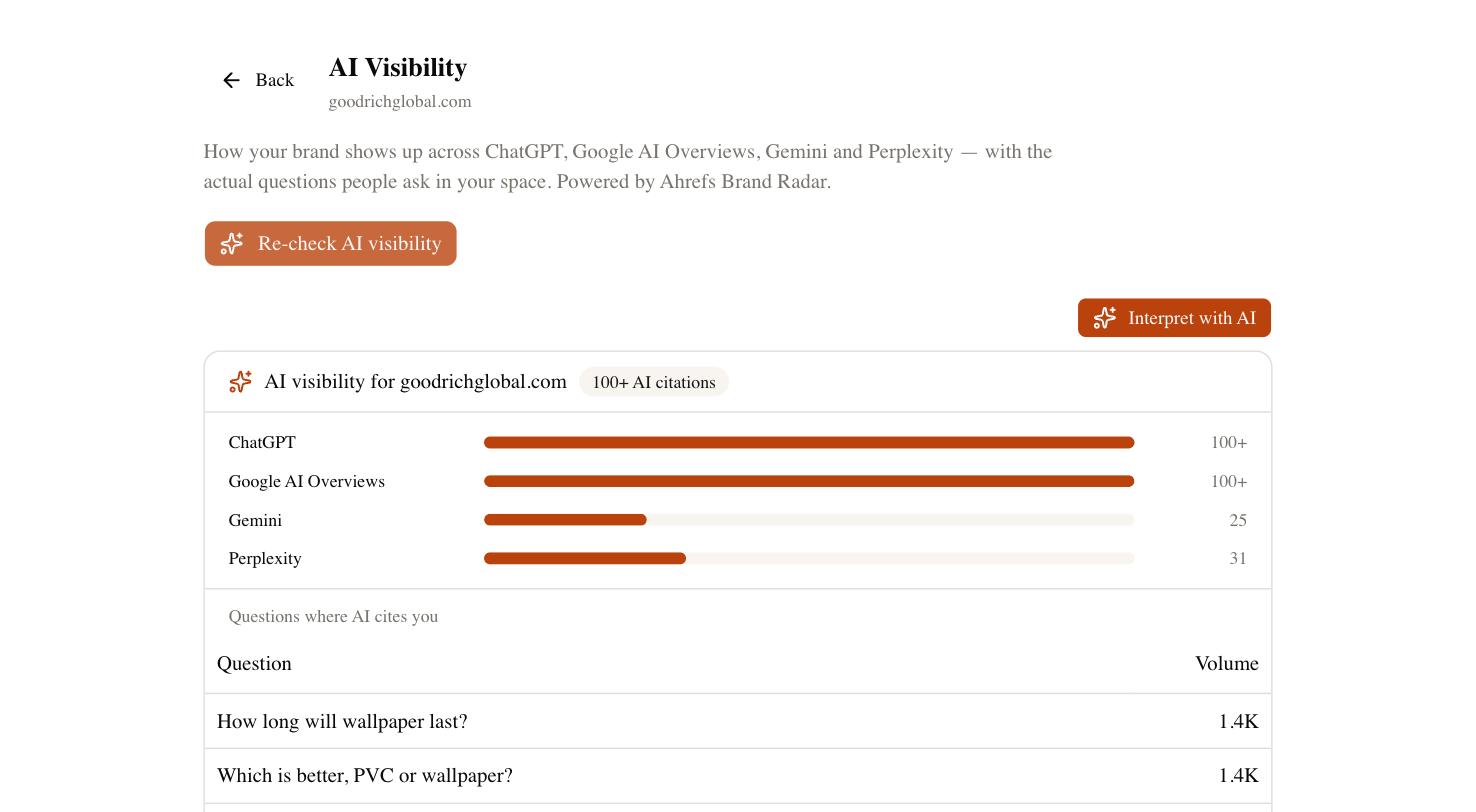
What makes it useful for an audit specifically is the trend line. Because it re-runs the same prompts over time, you can see share of voice against named competitors, catch the moment a model starts citing a new source, and tie a jump or drop to a piece of content you published. It sits in the same workspace as the keyword, rank-tracking, and content tools, so when the audit shows a gap you can draft the answer-shaped page that fills it without switching tools. That is the practical value — not that it invents visibility, but that it turns a manual chore into a repeatable measurement you will actually keep doing.
Turning audit findings into fixes
An audit is only worth the time if it changes what you publish. The patterns tend to repeat, so here is where to aim first.
If competitors are cited and you are not, study the exact pages the engines quote and match their structure: clear headings, direct answers in the first sentence, comparison tables, and specifics over adjectives. AI systems favor content that is easy to lift a clean sentence from. If your brand is mentioned but the facts are wrong, fix the sources feeding the error — your own outdated pages, stale directory listings, old third-party reviews. If you are absent everywhere for a whole intent, that is a content gap, not a ranking problem; you likely have no page that answers that question in a quotable way at all.
Prioritize ruthlessly, because you cannot chase every prompt. Rank your gaps by how close the buyer is to a decision — a “best tool for X” prompt sits nearer the sale than a broad how-to, so it earns your attention first. Then weigh effort against the source pattern you already mapped: if three of your four target answers cite the same review directory, getting listed there once may move more than four separate blog posts. Fix the cheap accuracy errors this week, plan the content gaps over the next quarter, and let the recurring audit tell you whether any of it worked.
A short working checklist for each gap:
- Does a page on your site directly answer this prompt in its opening lines?
- Is the answer structured with headings, lists, or a table an engine can extract?
- Are the facts current everywhere they appear online, not just on your homepage?
- Are you present in the third-party sources — roundups, directories, forums — the engines already trust?
Be honest about timelines and limits
This is where most guides oversell, so here is the straight version. AI answers are non-deterministic: ask the same question twice and you can get two different source lists, so treat any single result as directional and rely on the repeated pattern, not one screenshot. Coverage moves slowly, too — after you publish or fix a page, expect weeks, not days, before models that crawl and retrain reflect it, and some surfaces update on their own opaque cadence you cannot control.
No tool, SEO Rocket included, can promise a citation. What an audit gives you is measurement and direction: a clear picture of where you stand today, which competitors own the answers, and which gaps are worth the effort. That is genuinely valuable, because the alternative is optimizing blind for a search surface you have never actually looked at. Start with 20 prompts, run them by hand once so you trust the method, then automate the repeat and check the trend monthly. Do that consistently and you will be ahead of nearly every competitor who still assumes ranking first is the same as being recommended.