If you want to learn how to do keyword research without drowning in jargon, the honest version is simpler than most guides pretend. Good keyword research is just a disciplined way of writing down what your buyers type into a search box, then deciding which of those searches you can realistically win. Everything else — the metrics, the tools, the spreadsheets — is in service of those two questions.
This guide walks you through the exact steps you can run today, in order, with a real example. It also tells you where the numbers lie, how long ranking actually takes, and where a tool like SEO Rocket saves you an afternoon. No fluff, no promises of overnight traffic.
Start with the searcher, not the keyword
Before you open any tool, spend ten minutes writing down how your customers describe their problem in their own words. A plumber’s customers don’t search “hydronic remediation” — they search “water heater leaking from bottom.” The gap between how you talk about your work and how buyers talk about their problem is where most keyword research goes wrong.
Write a plain list of five to ten “seed” topics: the core things you sell or solve. These are not final keywords, just starting points. If you run a bookkeeping service, your seeds might be “small business bookkeeping,” “catch up bookkeeping,” and “bookkeeping vs accounting.” You will expand each of these into dozens of real searches in the next few steps.
A fast way to find these words is to mine sources where customers already talk. Read your own support inbox, the questions people ask on sales calls, the reviews on competitor listings, and the “People also ask” box in Google. Those phrases are gold because they are the exact language of someone with a wallet open, not the polished terms a marketing team invents in a meeting.
The step-by-step process
Here is the sequence I use for every new site or client. Work through it once per seed topic, and you will have a keyword plan by the end of the day.
- Expand each seed into real searches. Drop a seed topic into a keyword tool and pull the full list of related terms, questions, and long-tail variations. One seed like “bookkeeping” easily becomes 300 to 500 real queries.
- Pull the metrics for each term. You want two numbers at minimum: monthly search volume (how many people search it) and keyword difficulty (how hard the first page is to crack). Most tools show both side by side.
- Check search intent by actually looking. Google your candidate keyword and read the top five results. If they are all product pages and you planned a blog post, your content type is wrong. Intent beats volume every time.
- Filter down to what you can win. Cut anything with brutal difficulty or intent you can’t serve. For a newer site, favor lower-difficulty, longer-tail terms — they convert better and rank faster anyway.
- Group the survivors into topics. Cluster related keywords that share the same intent into a single page. “Catch up bookkeeping,” “overdue bookkeeping help,” and “behind on books” are one article, not three.
- Map each cluster to a page and a priority. Assign every cluster to a URL — new or existing — and rank them by the blunt formula of value times winnability.
That’s the whole method. The steps never change; only the tools and the speed do. A beginner doing this by hand across a browser, a spreadsheet, and three free tools might spend a full day per seed. The same work runs in minutes once the lookups are automated.
Where SEO Rocket fits in this process
Steps one and two are the slow, mechanical part — the copy-paste-into-spreadsheet grind. This is exactly the job SEO Rocket’s Keywords Explorer does. You give it a seed topic in plain language, and it returns the full expanded list of related keywords with real, Ahrefs-grade Volume and Keyword Difficulty pulled in the same view, so you’re not stitching data across tabs.
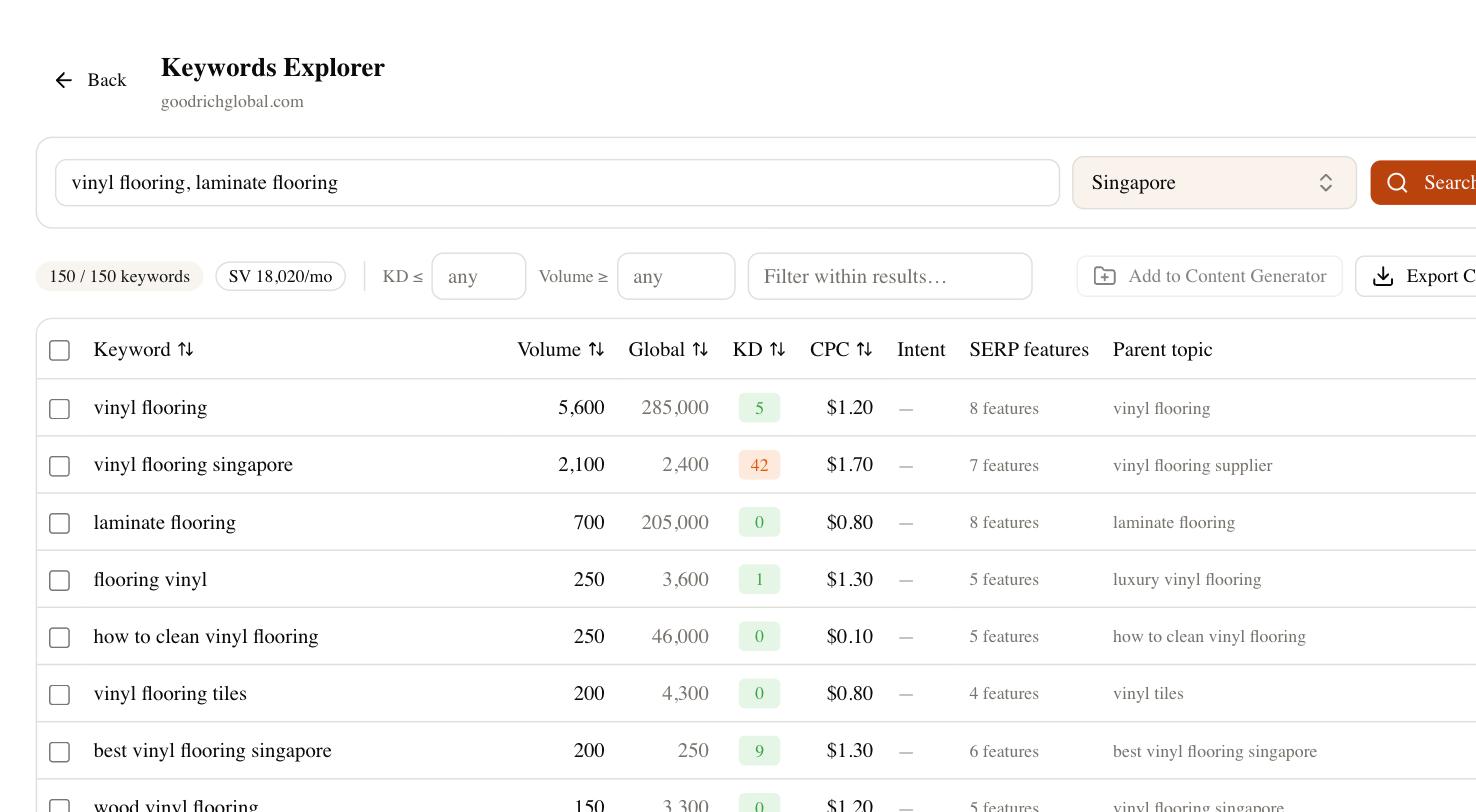
The part I lean on most is that it’s chat-first. Instead of learning a dashboard, you can ask it to show low-difficulty keywords under a certain volume for your topic, or to find the terms a specific competitor ranks for that you don’t. That competitor-gap view collapses steps one through four into a single question. It won’t judge intent for you — you still have to open the results and look — but it removes almost all the manual data-wrangling, which is where beginners burn the most time and make the most mistakes.
How to read volume and difficulty without fooling yourself
Two honest warnings about the numbers, because they trip up nearly everyone. First, search volume is an estimate, not a meter reading. Every tool models it differently, so the same keyword might show 1,200 searches in one and 2,900 in another. Treat volume as a rough order of magnitude — “hundreds” versus “thousands” — not a precise forecast of traffic.
Second, keyword difficulty is a guide, not gospel. A difficulty score mostly reflects how strong the linking pages are on the current first page. It says nothing about whether those pages actually answer the query well. I regularly find “medium difficulty” keywords where the weakest page-one result is a thin, outdated article you can beat with one genuinely useful page. Always benchmark against that weakest competitor on page one, not the site sitting in position one.
A quick rule for new sites
If your site is under a year old or has few backlinks, ignore high-volume head terms entirely for now. Chase specific, longer questions with lower difficulty. “How to do keyword research” is competitive; “keyword research for a local bakery” is not, and the person searching it is far closer to needing you.
Turn keywords into a content plan
A list of keywords is not a plan. The step most people skip is clustering — grouping terms that would be satisfied by the same page. Google ranks pages for hundreds of related queries, so one strong article targeting a cluster of twenty related keywords will out-perform twenty thin pages each chasing one term.
For each cluster, note the primary keyword, the intent, the content format the top results use, and a rough priority. Then sequence the work by what moves the needle soonest: pages where the reward is high and the competition is beatable go first. This mapping step is what separates keyword research that gathers dust from research that turns into rankings.
Keep the plan in one document you’ll actually reopen — a simple sheet with a row per cluster and a status column is enough. The goal isn’t a beautiful spreadsheet; it’s a queue of pages ranked so that when you sit down to write, the next target is already chosen and justified. That removes the single biggest reason content calendars stall: not knowing what to write next.
Be honest about timelines
Here is the part few guides say out loud. Keyword research takes an afternoon; ranking for the keywords takes months. Even with a clean plan and good content, a new page typically needs three to six months to settle into its true position, and rankings jitter a few spots day to day the whole time. That daily wobble is normal — do not rewrite a page because it dropped from four to seven overnight.
Keyword research also has limits it can’t overcome. It tells you what to write, not whether your content is good enough to win, and no amount of research fixes a page that fails to answer the search better than the current results. Links, site health, and genuine usefulness still do the heavy lifting. Research just points you at the right targets so that effort isn’t wasted.
A repeatable checklist
Once you’ve done this a few times, the whole thing becomes a habit you can run quarterly. Keep this short list somewhere you’ll see it, and you’ll never stare at a blank content calendar again.
- List five to ten seed topics in your customers’ own words.
- Expand each seed into real queries and pull Volume plus Difficulty.
- Open the top results to confirm intent before you commit.
- Filter to terms you can realistically win, favoring long-tail on newer sites.
- Cluster related keywords into single pages, not many thin ones.
- Map clusters to URLs and prioritize by value times winnability.
- Revisit the list every quarter as your site earns authority.
That is genuinely all there is to knowing how to do keyword research well. The method is simple and the discipline is the hard part. Start with one seed topic today, run it through the steps, and you’ll have a real, ranked plan before you close your laptop.