
The fastest way to learn how to find backlink opportunities is to stop guessing and start copying. Every competitor ranking above you already has a list of sites that were willing to link out in your niche — resource pages, directories, roundups, supplier lists, journalist mentions. Finding backlink opportunities is mostly the work of reverse-engineering those links, filtering out the junk, and going after the ones a stranger could realistically earn.
This guide gives you a concrete process you can run today, the quality filters that separate a link worth chasing from a waste of an afternoon, and honest timelines so you know when to expect movement. No black-hat shortcuts, no “just publish great content and links will come.” Just the repeatable steps.
Why the link gap beats cold outreach
Most people start backlink research by brainstorming sites they’d love to be featured on. That’s backwards. You end up pitching outlets that have never linked to a site like yours, and your reply rate reflects it. A far better starting point is the link gap: the set of domains that already link to two or three of your competitors but not to you.
Those domains are pre-qualified. They operate in your topic, they’ve demonstrated they will link out, and the fact that they link to several of your rivals means the link is likely a repeatable type — a category directory, a “best tools” roundup, a partner page — rather than a one-off favor. Chase those first and your outreach stops being a cold pitch and becomes a reasonable ask: “you list three of my competitors; here’s why the list is incomplete without us.”
There’s a second advantage that’s easy to miss. When the same domain links to all three competitors, you’ve found a pattern, not a coincidence, and patterns scale. Uncover why that pattern exists — an association members page, an integration partner list, a regional supplier directory — and you’ve often unlocked a whole category of near-identical targets you can work through methodically instead of one at a time.
A step-by-step process you can run today
Here is the exact sequence. Block out two hours, pick your three closest competitors, and work through it in order.
- Pick three real competitors. Not the biggest brand in your space — the sites that outrank you for the keywords you actually want. Two or three is plenty; more than that and the list gets noisy.
- Pull their referring domains. Export the list of domains linking to each competitor, along with each domain’s Domain Rating (DR) and how many of your competitors it links to. A domain that links to all three is a stronger signal than one that links to a single site by accident.
- Subtract your own links. Remove any domain that already links to you. What remains is your gap list — the shortlist of sites proven to link in your niche that you haven’t earned yet.
- Sort by opportunity, not by DR. A DR 80 news site is exciting and usually unreachable. Prioritize the DR 20-50 directories, resource pages, and niche blogs where a real human reads email and can add a link without an editorial committee.
- Inspect the actual link. Open the specific page linking to your competitor. Is it a resource list you could join? A guest post? A supplier directory? A broken link you could replace? The page type tells you the exact ask.
- Write the ask that fits the page. For a roundup, point out you’re missing. For a resource page, offer the resource. For a broken link, flag the dead URL and offer your live equivalent. Match the pitch to what the page already does.
Run that once and you’ll have 20-40 concrete, replicable targets — each one a page you’ve already seen, with a clear reason it might link to you. That beats a spreadsheet of 500 aspirational domains you’ll never contact. Keep the list in a simple tracker with three columns: the target page, the pitch angle, and the date you last followed up. Most links land on the second or third touch, not the first, so a system that reminds you to nudge again is worth more than a bigger prospect list.
Which links are actually worth chasing
Not every gap domain deserves your time. Before you add a target to the outreach list, run it through a few quick filters so you’re spending effort where it converts.
- Relevance first. A moderately authoritative site in your exact niche beats a high-DR link from an unrelated one. Topical fit is what search engines reward.
- Reachability. Editorial links from major publications are worth pursuing occasionally, but your bread and butter is the mid-authority site where one email reaches a decision-maker.
- Dofollow and in-content. A link buried in a footer or marked nofollow passes little. Favor links inside the body of a relevant page.
- Repeatability. If a domain links to several competitors the same way, that’s a link type you can systematize — and one link becomes a template for ten.
Where SEO Rocket fits in this workflow
The steps above are all doable by hand, but the exporting, deduping, and cross-referencing is where an afternoon disappears. SEO Rocket collapses that into a single request. You ask it, in plain language, which domains link to your competitors but not to you, and its backlink-gap analysis returns the named list — each domain with its DR and how many of your rivals it links to — on real, Ahrefs-grade data underneath.
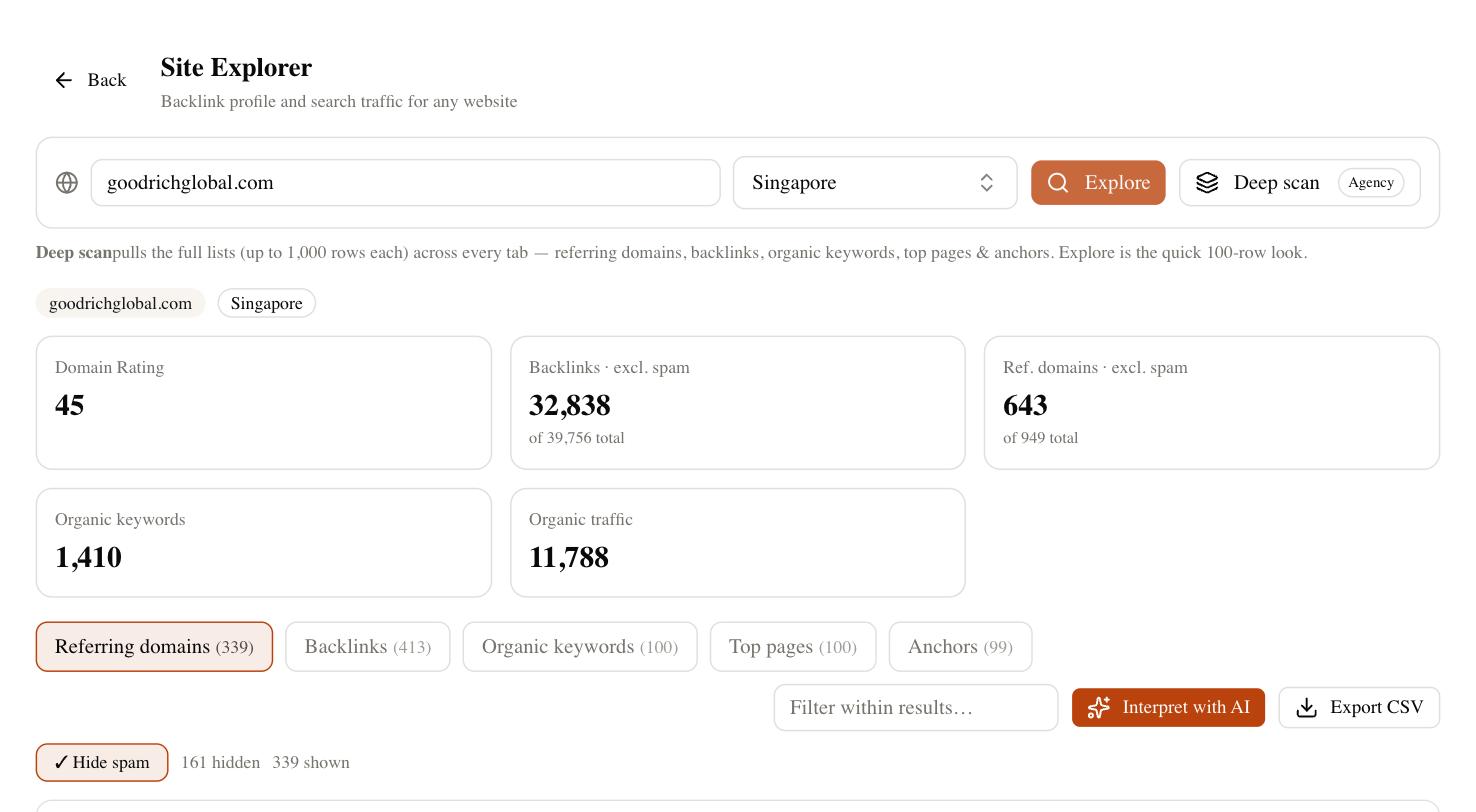
From there you can ask it to pull the exact backlinks behind any competitor, so a “target domain” becomes a specific page: the directory listing, the resource page, the article, with the anchor text and dofollow status shown. That’s the difference between knowing a site links to a rival and knowing precisely which page to pitch and what to say. The same chat can size up how many links you’d realistically need to match a competitor’s profile, so you set expectations before you start rather than after. It’s the research engine; the outreach and the relationships are still yours to build.
What this really saves you is the tedious middle. Manually exporting three competitors’ link profiles, aligning them in a spreadsheet, and stripping out the domains you already have is an hour of mechanical work that has nothing to do with judgment. Handing that to the tool means the hour you do spend goes into the part only you can do — reading each target page and writing the pitch that fits it. That’s the trade worth making.
The outreach types that convert
Once your gap list is filtered, most winnable links fall into a handful of buckets. Niche directories and industry listings are the lowest-friction — many just want a real business and a short description. Resource and “best of” pages are next: if your competitor is listed and you offer something comparable, you have a legitimate case to be added. Broken-link building works when a competitor’s link has rotted and you own the replacement. Guest contributions and expert quotes take longer but earn in-content links on relevant pages.
Skip the tactics that age badly: bulk comment links, private blog networks, and paid link packages. They either do nothing or actively risk a manual penalty, and cleaning that up costs more than the links ever returned.
A quick checklist to keep you on track
When you’re heads-down in outreach it’s easy to drift toward vanity links. Run each prospect against this short list before you spend an hour on it, and you’ll keep the campaign pointed at links that actually move the needle.
| Check | What good looks like |
|---|---|
| Topical relevance | The site covers your niche, not just high DR |
| Link source | It already links to a competitor the same way |
| Reachability | A real person reads the inbox you’re emailing |
| Link quality | In-content and dofollow, not footer or nofollow |
| Repeatable | The link type can be templated across many sites |
None of these checks are complicated, but skipping them is how outreach campaigns quietly stall. A prospect that fails two or more of them isn’t worth your best pitch — park it and move to the next one that passes clean. The discipline of qualifying before you write keeps your reply rate up and your morale higher, because you’re only ever emailing people with a real reason to say yes.
Honest timelines and limits
Set expectations before you start. Outreach reply rates in most niches sit in the low single digits to low teens, so a list of 40 targets might yield three to eight links over a few weeks of follow-up. Those links then need to be crawled and factored in, and ranking movement from new links typically shows over four to twelve weeks, not days. Positions also jitter a few spots daily on their own, so judge progress over a full ranking cycle rather than reacting to a Tuesday dip.
Links are necessary but not sufficient, too. If the page you’re building links to is thin or off-intent, authority won’t save it — you’ll rank a weak page slightly higher and still lose the click. Fix the content first, then earn the links, and give the whole process a couple of months before you decide it’s working. Done in that order, knowing how to find backlink opportunities becomes a steady, compounding channel rather than a one-time scramble.