Learning how to find low competition keywords is the highest-leverage skill in SEO for anyone without a huge domain or a fat link budget. It is the difference between publishing into a wall of established competitors and publishing into a gap where a well-made page can rank in weeks rather than years.
The good news: this is a process, not a talent. You do not need to guess. Below is the exact sequence I use to find low competition keywords that real people search for, with honest notes on where the shortcuts break and how long the results actually take.
What “low competition” really means
Competition is not a single number. Most tools give you a Keyword Difficulty (KD) score from 0 to 100, and it is a useful first filter, but it mostly reflects how many links the current top pages have. It does not know that a page-one result is a thin forum post, an outdated 2019 article, or a giant brand ranking on authority alone for a query it barely answers. Those are the openings you are hunting for.
A genuinely low-competition keyword usually has three things at once: a modest difficulty score, at least one weak or off-target page already ranking on page one, and enough search volume to be worth the effort. Miss any of the three and you either can’t rank, or you rank for something nobody searches. The rest of this guide is about checking all three fast. Think of the difficulty score as a smoke detector — useful for a first pass, but no substitute for actually walking into the room and looking around. The tools that promise a magic list of “easy” keywords are selling you the score alone, and the score is the least reliable of the three signals.
The step-by-step process
Work through these in order. The early steps are cheap and fast; the later ones cost more time, so you only spend that time on candidates that already survived the filter.
- Start from a seed topic, not a single word. Pick something specific to your business — “cold plunge maintenance,” not “wellness.” Broad seeds return broad, brutal keywords. Narrow seeds surface the long-tail phrases where competition thins out.
- Expand the seed into hundreds of ideas. Feed the seed into a keyword tool and pull every related phrase, question, and modifier it returns. You want volume of ideas here — most will be useless, and that is fine.
- Filter by difficulty and volume together. Set KD to a low ceiling (start around 20 or below if your site is new) and set a floor on volume so you are not chasing phrases with 10 searches a month. This one filter usually cuts a list of 500 down to 30 or 40.
- Sort for intent you can serve. A low-KD keyword is only useful if you can actually satisfy the searcher. Group the survivors into informational (“how,” “what,” “best way to”), commercial (“best,” “vs,” “review”), and transactional (“buy,” “near me,” “price”). Match them to pages you can realistically build.
- Manually open the top results for your best candidates. This is the step people skip, and it is the one that matters most. Search the keyword and look at page one. If you see weak pages — thin content, no direct answer, ancient dates, or results that miss the intent — that is your opening, even if the KD looked borderline.
- Check the SERP for traps. If page one is all giant brands, or dominated by a big AI Overview, video carousel, or product listings, walk away no matter how low the KD reads. The difficulty score can’t see those layout signals; your own eyes can.
- Save the winners into a small, buildable list. Ten to twenty solid low-competition keywords is more useful than a spreadsheet of 400. Assign each one to a single page and a rough publish order.
How to read difficulty without fooling yourself
KD scores are directional, not gospel. Two tools will hand you different numbers for the same phrase because they measure different link indexes, so treat a “12” and an “18” as roughly the same thing, not a precise ranking. What the score cannot tell you is whether the intent is winnable, and that is where manual SERP checks earn their keep.
Benchmark yourself against the weakest page-one result, not the strongest. You are not trying to beat the domain that has ranked for a decade — you are trying to be better than the flimsiest page currently holding a top-ten spot. If the tenth result is a 400-word blog post from 2020 with no images and a vague answer, you can outrank it with a genuinely helpful page, even on a young site. That single reframe changes which keywords look reachable.
Where SEO Rocket fits in this workflow
The slow part of everything above is the expand-and-filter loop, and that is the job SEO Rocket’s Keywords Explorer is built for. You give it a seed topic in plain language and it pulls keyword ideas from real, Ahrefs-grade data — the same class of index the expensive tools use — then shows Volume and KD side by side so you can filter to your ceiling in one pass instead of exporting CSVs and sorting by hand.
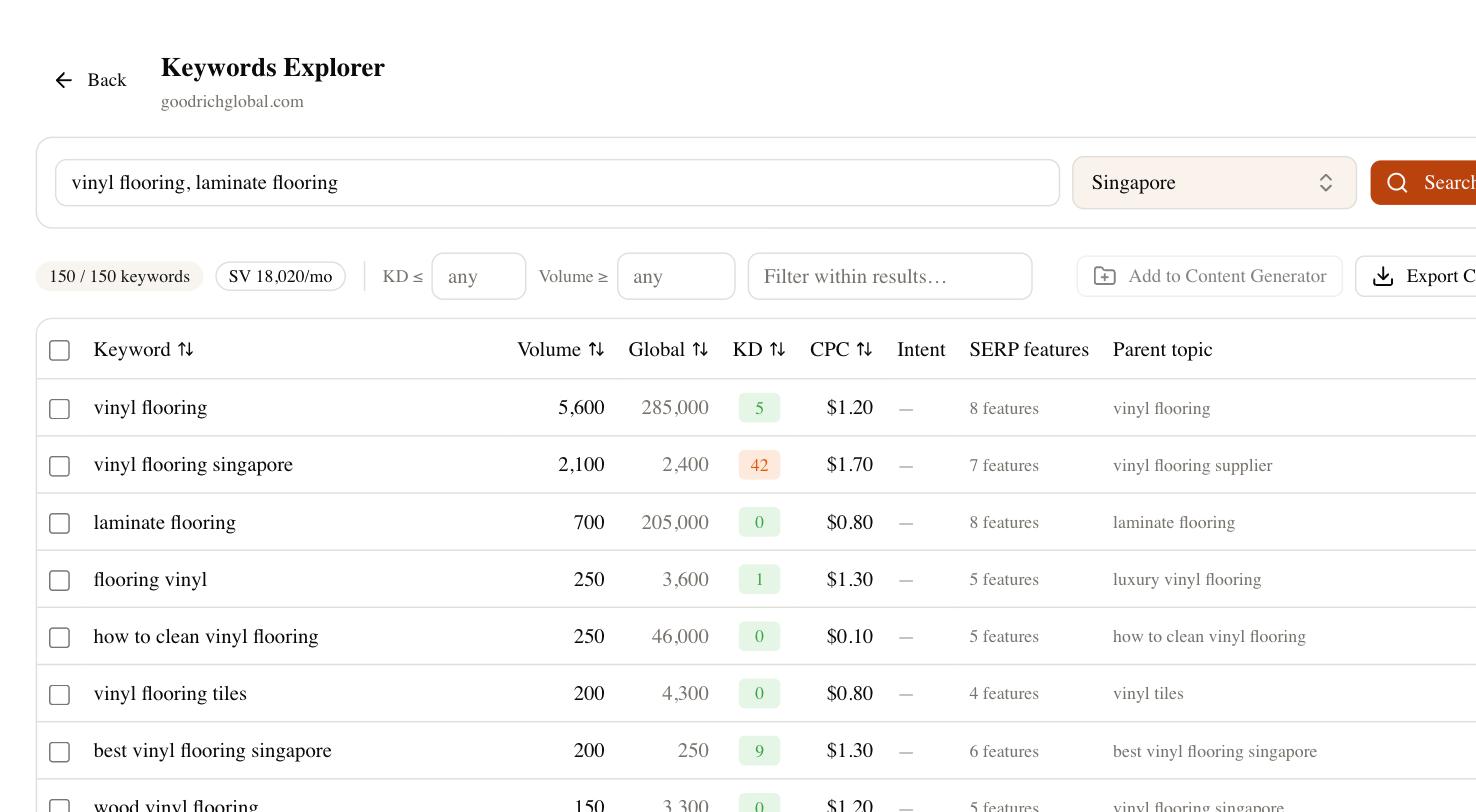
Because it runs chat-first, you can just ask for “question keywords about cold plunge maintenance under KD 20 with at least 100 searches” and get the shortlist back without touching a filter menu. It won’t do step five for you — you still open the real SERP and judge the pages with your own eyes — but it removes the busywork between having a seed and having a vetted list, which is where most people quietly give up. The point is not that the tool finds magic keywords; it is that it makes the honest, repeatable process fast enough that you actually do it every week.
A quick vetting checklist
Before a keyword earns a spot on your content calendar, run it through these five checks. A phrase should pass all of them, not just the difficulty score.
| Check | What good looks like |
|---|---|
| Difficulty | KD at or below your ceiling (≈20 for a new site, higher as you age) |
| Volume | Enough monthly searches to matter, but not so high it draws every big brand |
| Weak result present | At least one thin, dated, or off-intent page in the top ten |
| Intent match | You can build the exact type of page the searcher wants |
| No SERP trap | Not buried under brand dominance, product listings, or a heavy AI Overview |
How long these keywords take to rank
Here is the honest part most guides skip. A low-competition keyword is easier, not instant. On a brand-new domain, even easy phrases typically take three to six months to climb, because Google needs time to trust the site as a whole before any single page moves. On an established site with some authority, a well-built page targeting a genuinely weak SERP can reach page one in a few weeks. Either way, positions jitter a few spots day to day, so judge a keyword over a full ranking cycle of several weeks, not on Tuesday’s screenshot.
Expect a hit rate, not a guarantee. If you vet twenty keywords properly, a good chunk will rank, a few will stall because a competitor you underrated defends the spot, and one or two will surprise you by ranking for something adjacent you never targeted. That spread is normal, and it is why you build a small list rather than betting everything on one perfect phrase. The volume of well-chosen attempts is what compounds, which is exactly why speeding up the finding process pays off. Publish, wait a full cycle, check what actually moved, and feed those lessons back into your next batch of seeds.
When low competition isn’t worth chasing
Low difficulty is a means, not the goal. A keyword with KD 3 and eight searches a month will rank easily and change nothing about your business. Chase the phrases where low competition overlaps with real commercial value — the questions your buyers ask right before they need what you sell. Those are rarer and slightly harder, but one of them beats fifty zero-volume wins.
Watch the trend too. Some low-competition keywords are low because interest is fading, and ranking first for a dying query is a hollow victory. When you can, favor phrases that are flat or growing over ones quietly sliding down. Knowing how to find low competition keywords is only half the skill; the other half is the discipline to pass on the easy ones that lead nowhere and spend your limited hours on the openings that actually move revenue. Do that consistently and a small site can out-publish rivals ten times its size, one honest gap at a time.