If you want to know how to improve domain rating, the short version is this: earn links from more independent, higher-authority websites, and stop chasing the number itself. Domain Rating (DR) is Ahrefs’ 0–100 estimate of how strong your backlink profile is relative to every other site in their index. It is a third-party score, not a Google ranking factor, so treat it as a useful proxy for link authority rather than a goal in its own right.
That distinction matters, because most of the advice on how to improve domain rating skips it and sells you shortcuts. This guide gives you the concrete steps that actually move DR, honest timelines for each, and the limits worth knowing before you spend a dollar or an hour on link building.
What domain rating actually measures
DR is driven by two things: the number of unique domains linking to you (referring domains, not total links), and how strong those linking domains are themselves. One link from a DR 80 news site outweighs fifty links from DR 5 directories. The scale is logarithmic, too, which is why climbing from 20 to 30 is quick and climbing from 60 to 70 is brutally slow — the sites already sitting at 70 have thousands of quality referring domains you have to rival.
Because it is logarithmic and index-relative, your score can wobble a few points even when you do nothing, as Ahrefs recrawls the web and competitors gain or lose links. Do not panic over a two-point dip. Watch the trend over months, not the reading on any single day.
Set your expectations before you start
Link authority compounds slowly. A brand-new domain with genuine effort can reach the 20s within a few months, because the first handful of quality referring domains move a low score fast. Getting into the 40s and 50s is a year-plus of consistent work, and the top of the scale is reserved for established brands with years of press. Anyone promising DR 50 in 30 days is selling link-network spam that will not last a Google update.
Keep one more limit in mind: DR measures links, and links alone do not rank pages. You can raise DR and still lose to a weaker-authority competitor who has better content and cleaner on-page signals. Authority opens the door; relevance and content walk through it.
A useful reality check is to benchmark against the weakest site currently on page one for your target term, not the strongest. If that page sits at DR 25 and you are at DR 30, your authority is already competitive and your effort is better spent on content and internal links than on chasing more backlinks. Domain rating tells you whether you are in the game; it rarely decides the match on its own.
How to improve domain rating, step by step
Work these in order. The early steps cost nothing and prevent you from wasting the later ones — there is no point buying outreach until you know which links you already own and which are dragging you down.
- Audit what you already have. Pull your current backlink profile and list your referring domains. You cannot grow what you have not measured, and you will often find links you did not know existed — or toxic ones dragging you down.
- Fix or disavow the junk. Spammy, low-quality referring domains rarely help and occasionally hurt. Remove links you control, and disavow the clearly manipulative ones. This alone will not raise DR much, but it cleans the base you build on.
- Reclaim unlinked mentions. Search for places that mention your brand without linking — journalists, forums, partners. A quick email asking them to make the mention a link is the highest-conversion link building there is, because the relationship already exists.
- Build linkable assets. Original data, free tools, a genuinely useful guide, or a template pack earn links passively for years. This is the engine of durable DR growth; everything else is manual outreach that stops the moment you stop.
- Do targeted outreach. Guest posts on relevant sites, expert roundups, digital PR, and reclaiming broken links that point to dead competitor pages. Prioritize relevance and authority over volume — ten strong referring domains beat a hundred weak ones.
- Earn internal-team and partner links. Supplier pages, industry associations, local chambers, and partner “customers we work with” listings are easy, legitimate wins most sites forget to claim.
- Track referring domains monthly. Measure the metric that causes DR — new referring domains — not DR itself. If that line climbs steadily, DR follows on its own delay.
Notice that only two of these steps — building assets and outreach — actually earn new links. The rest are measurement and cleanup, and they are what separate steady growth from a year of guessing. Treat the list as a repeating cycle, not a one-time project: audit, clean, reclaim, create, reach out, then measure and start again next month.
Where SEO Rocket fits in the workflow
Steps one, two, and seven all depend on seeing your backlink profile clearly, and that is the job SEO Rocket’s backlink profile tool does. You ask, in plain language, to see your referring domains, and it returns them on real, Ahrefs-grade data — each domain with its own DR, so you can instantly separate the authority links worth protecting from the junk worth disavowing.
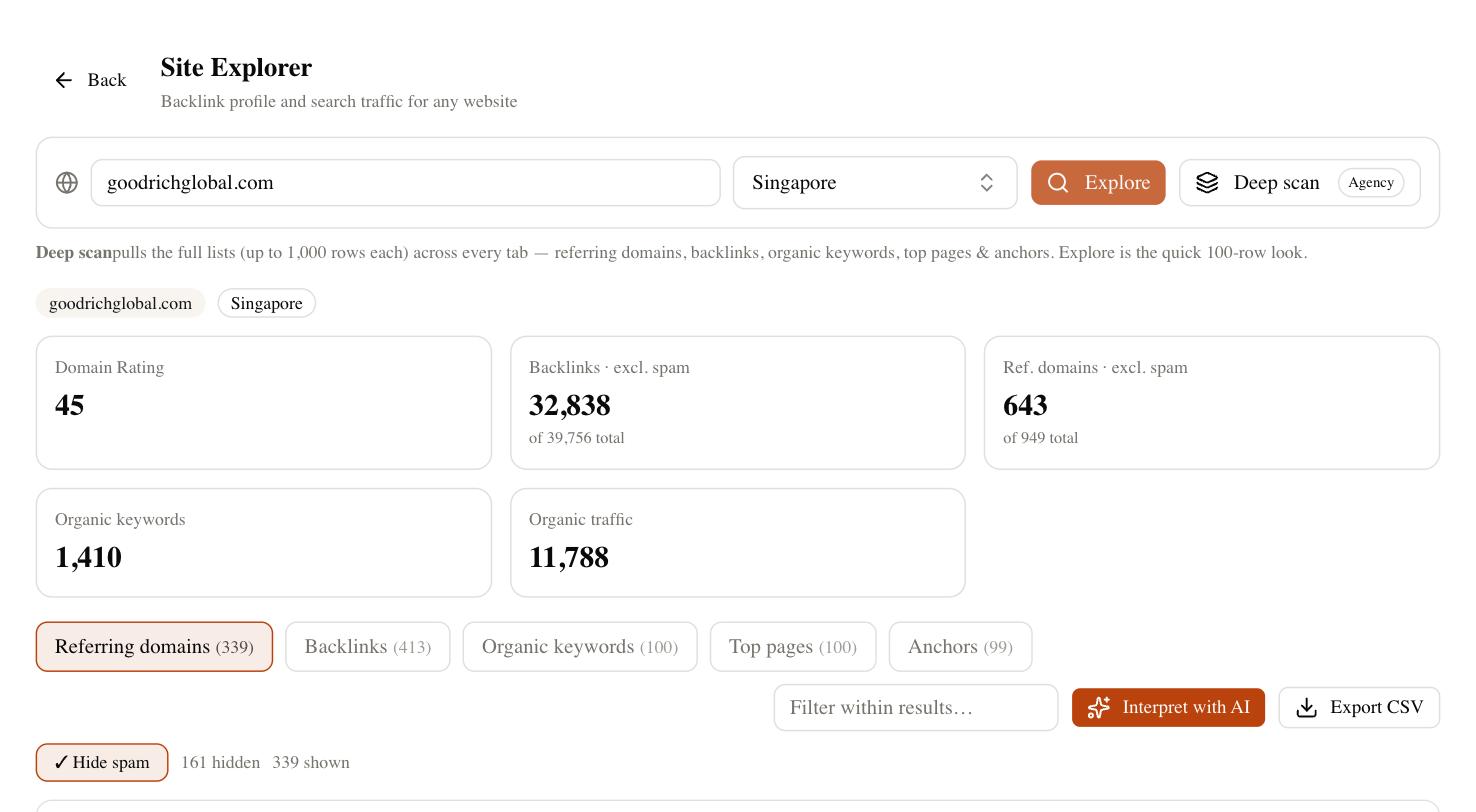
The same data feeds the competitor-gap view, which is where outreach targets come from. Point it at two rivals ranking above you, and it lists the referring domains linking to them but not to you. That is a ready-made prospect list of sites already willing to link within your niche — far higher-yield than cold-emailing strangers. Because the backlink and rank-tracking data live in one place, you can watch new referring domains land and your positions respond without exporting anything or juggling a second subscription.
A simple monthly DR checklist
You do not need a complex system, a spreadsheet with forty columns, or a paid agency retainer to keep DR moving. Run this short loop once a month and the number takes care of itself, because you are managing the inputs instead of staring at the output.
- New referring domains — are you adding quality ones each month? Aim for a steady climb, not a spike.
- Lost links — did any strong link drop? Reclaiming a lost link is cheaper than earning a new one.
- Toxic links — anything new and spammy to disavow?
- Competitor gap — which domains link to rivals but not you? Add three to your outreach list.
- Content pipeline — is at least one linkable asset in progress? Assets are what keep growth passive.
Common mistakes that stall DR
The fastest way to waste a year is buying links from a private blog network or a fiverr “DR booster” package. These inflate the number briefly on cheap, irrelevant domains, then evaporate — or trigger a manual penalty — the moment Google or Ahrefs cleans house. Cheap link volume is the one shortcut that reliably backfires.
Impatience causes the second-most-common failure: giving up at month three because the score has not moved. Links take weeks to be crawled, indexed, and credited, so the work you do in January often shows up in your March reading. If you quit before that lag plays out, you conclude that link building does not work when it simply had not landed yet. Commit to two quarters before you judge the results.
The subtler mistake is chasing high-DR links that have nothing to do with your topic. A DR 90 link from an unrelated site passes little relevant authority and looks unnatural at scale. Relevance is the multiplier: a DR 40 link from a site in your exact niche often does more for your rankings than a DR 70 link from a random blog. And do not neglect the content those links point to — links to a thin, unhelpful page are wasted leverage.
The honest bottom line
Improving domain rating is not complicated, but it is slow and it does not have a hack. Clean up your existing profile, earn links from relevant and independent sites, build assets that attract links on their own, and measure referring domains every month. Do that consistently and DR climbs on its own schedule — a few months to escape the teens, a year or more to reach the middle of the scale.
Keep the metric in perspective. A higher DR makes it easier to rank and easier to earn the next link, but it is a proxy, not a payday. The sites that win long-term treat authority and content as one job: strong links pointing at pages people actually want to read. Get both moving in the same direction and the score becomes a side effect of doing the work well.