Learning how to track keyword rankings is less about buying a tool and more about building a habit you can trust. Anyone can look up where a page sits today; the value comes from watching the same terms, in the same place, over enough weeks that a real trend separates itself from daily noise. Do that well and you stop guessing whether your work moved the needle.
This guide walks through how to track keyword rankings in a way you can start on this afternoon. It is a numbered process, not a theory lecture, and it is honest about what the numbers can and cannot tell you. Where SEO Rocket’s rank tracker saves you steps, I will say so plainly — but every step here works no matter which tool you land on.
Why manual checking fails
Your first instinct is usually to open an incognito tab and search your term. That feels free, and it lies to you. Google personalizes results by your history, your device, and above all your location, so the position you see is not the position most of your visitors see. Refresh twice and you may get two different answers.
There is also a scale problem. Checking five keywords by hand once is fine. Checking forty keywords across three locations every week is an hour you will quietly stop spending after the second week. Consistent tracking has to be automated, or it does not happen — and inconsistent data is worse than none, because it invites confident conclusions from a sample of one.
Step 1 — Choose the right keywords to track
Resist the urge to track everything. A focused list of terms that actually map to revenue beats a sprawling list you never read. Aim for somewhere between fifteen and fifty to start, and pick them across three buckets.
- Money terms — the two or three phrases a buyer types right before they convert. These matter most even if volume is modest.
- Primary content terms — the head keywords each important page is built to rank for.
- Rising and long-tail terms — specific, lower-competition phrases where you can realistically reach page one within a quarter.
If you already run keyword research in SEO Rocket, you can push a shortlist straight into tracking from the same chat rather than retyping it, which keeps your tracked set tied to the terms you actually researched.
Step 2 — Set location, device, and language
This is the step most people skip, and it quietly ruins their data. A ranking only means something once you pin down where it is being measured. A plumber in Austin does not care about their national position; they care about Austin, on a phone. Set the country, and where local intent matters, the city. Choose mobile or desktop deliberately, because the two often differ by several spots. Set the language to match your audience.
Get this right once and every future reading is comparable. Get it wrong — say, tracking a Singapore business against the United States index — and you will chase phantom drops that were never real. Lock these settings before you record a single number.
Step 3 — Record your baseline
Before you change anything, capture where you stand today. This baseline is the reference every later reading is judged against, so take it on a normal day, not right after a big publish or a Google update. Note the position of each keyword, and ideally the exact URL that ranks, because Google sometimes swaps which of your pages it shows.
A rank tracker does this automatically the moment you add your keywords — it logs positions on day one and keeps checking on a schedule. If you are doing it by hand, drop the numbers into a spreadsheet with the date. Either way, the point is the same: you cannot claim progress without a starting line.
Step 4 — Automate the daily checks
Now hand the repetitive part to software. A good tracker re-checks each keyword on a set cadence, from a clean location-accurate environment, and stores the history so you can see the shape of a trend rather than a single dot. Daily checks are plenty; anything more frequent just captures noise.
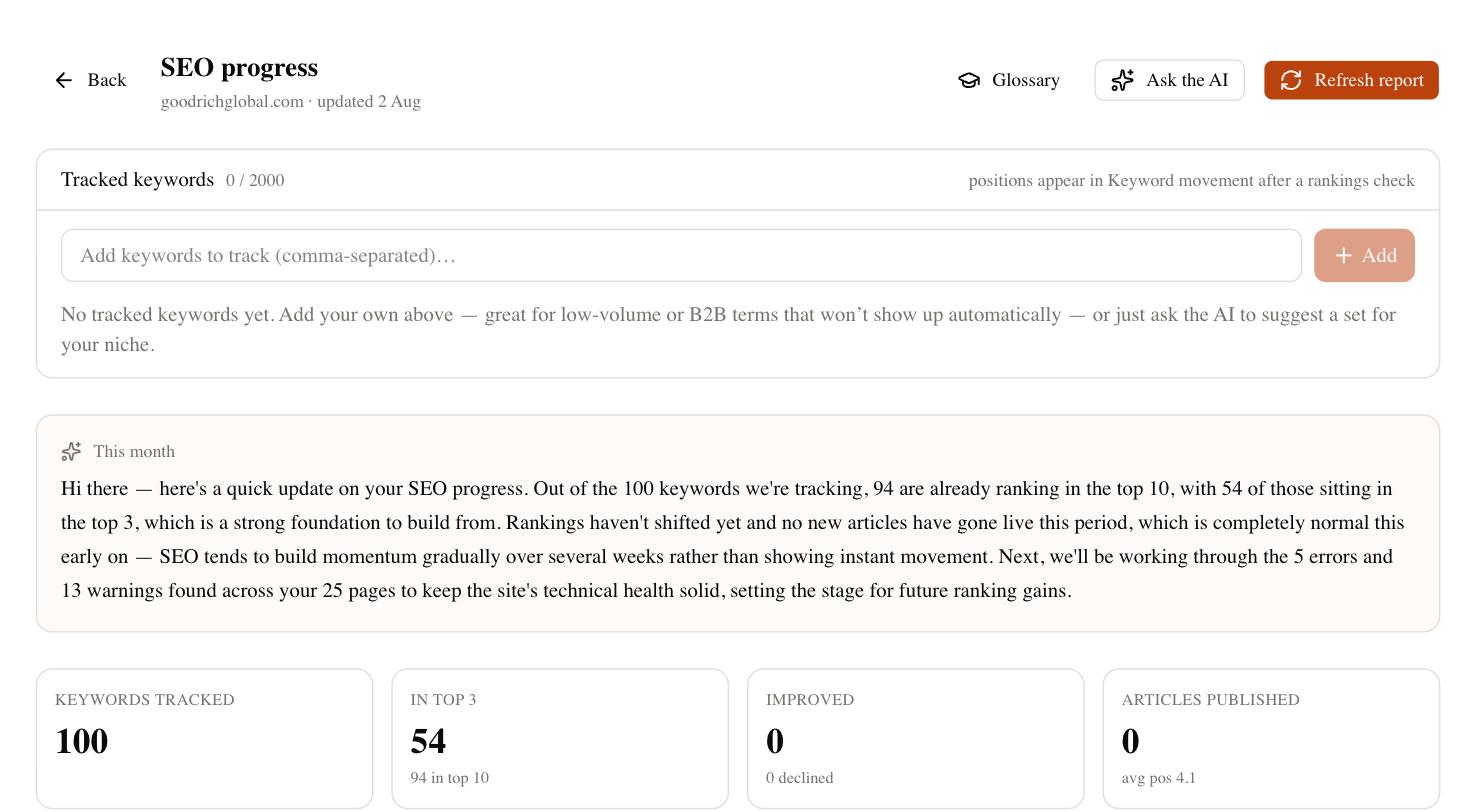
In SEO Rocket, this lives in the rank tracking view. You ask it to track a set of keywords for your domain and market, and it returns positions with the change since last check, the URL that ranks, and estimated traffic for each term — laid out the way you would expect Ahrefs’ organic positions to look, without you refreshing anything. The job of a tracker is to make the boring part invisible, and that is the part worth paying for.
Step 5 — Read the trend, not the day
Here is the discipline that separates operators from panickers: positions jitter. A keyword can sit at four in the morning and seven by evening with nothing changed on your site — that is normal fluctuation, not a penalty. Judge movement over weeks, not hours.
A simple rule keeps you sane. Treat any swing of roughly three spots or fewer as noise and ignore it. Look instead at the direction of a two-to-four-week rolling view: is the line drifting up, flat, or down? Group your keywords so you can watch the whole set at a glance rather than obsessing over one term. And expect new content to take real time — a fresh page often takes several months to settle into its true position, so early wobble tells you very little.
What a healthy tracking rhythm looks like
- Daily — let the tracker run; do not look.
- Weekly — scan for genuine multi-spot moves and note anything that crossed onto or off page one.
- Monthly — compare against your baseline, tie gains to the work you shipped, and prune keywords that no longer matter.
Step 6 — Connect rankings to what you changed
A position number on its own is trivia. It becomes useful the moment you can link a move to a cause. Keep a short log of what you shipped and when — a rewritten intro, three new internal links, a batch of backlinks, a technical fix — and lay it beside your ranking history. When a keyword climbs two weeks after you expanded a page, you have a repeatable lever. When it drops after a site migration, you know where to look first.
This is also how you spot the difference between correlation and cause. Rankings move for reasons outside your control too: a competitor publishes something better, Google runs a core update, seasonal demand shifts. Your change log will not explain every move, but it turns most of them from mysteries into decisions.
Be honest about the limits
No rank tracker sees the exact result every one of your users sees, because true personalization is unknowable from the outside. What a good tool gives you is a stable, location-accurate proxy that is consistent from day to day — which is precisely what you need to measure change. The absolute number matters less than whether it is trending the right way against a fixed method.
Two more honest caveats. Estimated search traffic attached to a keyword is a model, not a meter, so treat it as directional. And ranking first is no longer the whole game — some of your buyers now ask an AI assistant instead of scrolling Google, so a term you rank one for can still go unmentioned in an AI answer. Position tracking remains the backbone of measuring SEO, but pair it with a look at your AI-search visibility if that is where your audience is drifting. Track the same keywords, in the same place, week after week, and let the trend — not any single afternoon — tell you whether your SEO is working.