
Done well, programmatic SEO with AI is how a two-person team publishes thousands of genuinely useful pages from one template, one clean dataset, and a model that fills the gaps a human writer could never cover at that volume. Done badly, programmatic SEO with AI is the fastest route to a manual action you’ll see all year. The line between the two is thinner than most tutorials admit, and this guide is about which side you land on.
The core idea is old. You take a repeatable page pattern — “SEO tools for [city],” “[product] vs [product],” “how to [task] in [software]” — pair it with structured data, and generate one page per row. What’s new is that AI can now write the connective prose that used to make these pages read like a spreadsheet with a headline. That’s genuinely useful, and it’s also exactly why the technique is being abused right now.
What makes programmatic SEO different from normal SEO
Regular content SEO is a series of individual bets: you research a keyword, write a page, and try to make it the best result for that query. Programmatic SEO is a systems bet. You’re not optimizing a page — you’re optimizing a template and a dataset, then trusting that structure to hold across hundreds or thousands of URLs at once.
That changes what matters. A single great article can carry a weak paragraph. A template can’t: any flaw — a thin section, a repeated sentence, a data field that’s blank for 40% of rows — is instantly multiplied across every page you ship. The unit of quality control moves up a level, from the page to the pattern. Get the pattern right and scale is a superpower. Get it wrong and you’ve mass-produced the same mistake ten thousand times.
The other difference is intent density. Programmatic pages win when each row maps to a real, distinct search someone actually types. “Best Italian restaurants in Austin” is a query. “Best Italian restaurants in a town of 400 people” is a URL nobody will ever search for. The dataset, not the writing, decides whether the whole project has demand behind it.
The highest-leverage moves
Almost all of the payoff comes from three decisions you make before you generate a single page. Spend your time here, not on prompt-tuning.
- Pick a template with proven search demand across the whole set. Validate a sample of rows against real keyword volume before you commit. If only a third of your planned URLs have measurable demand, cut the set — don’t publish the dead two-thirds and hope.
- Own a dataset a competitor can’t cheaply copy. Public data everyone can scrape produces pages everyone already has. Proprietary numbers, first-hand testing, structured pricing, or an angle you can defend is what makes a programmatic page worth indexing.
- Give every page one thing a human would thank you for. A comparison table, a calculated figure, a local detail, a genuinely useful default recommendation. If a page is only prose that restates the title, it’s filler.
Notice that none of those three is “write better with AI.” The model is the cheapest part of the stack now. Your edge lives in the data and the template, which is precisely where most people underinvest because it’s less fun than watching an AI type.
Where AI actually fits — and where it doesn’t
Use AI for the parts that scale linearly and don’t require judgment: turning a data row into readable prose, generating varied intros so 500 pages don’t share an opening sentence, summarizing a table into a takeaway, drafting meta descriptions and FAQ blocks. Modern models are excellent at this, and it’s the work that used to make programmatic content economically impossible.
Don’t use AI for the decisions. It shouldn’t choose your template, invent your data, or judge whether a query has demand — those are the calls that determine success, and a model will confidently generate 5,000 pages for keywords nobody searches if you let it. The healthiest workflow is AI-assisted, human-decided: you own the dataset and the pattern, AI handles the volume, and you spot-check a real sample of the output before anything goes live.
One honest caveat: AI-written prose at scale tends toward sameness. Two pages built from the same template and the same model often read like near-duplicates even when the data differs. That’s a real deindexing risk, and it’s why the data has to do the differentiating work. If the only thing separating page A from page B is a synonym swap, Google’s spam systems will treat them as one.
Common mistakes that get pages deindexed
The failure modes are predictable, which is good news — you can design around every one of them before launch.
- Thin pages at scale. A title, two generic paragraphs, and a data point isn’t a page worth ranking. This is the single most common reason programmatic sites get hit by a core update.
- Doorway pages. Fifty near-identical “SEO services in [city]” pages that funnel to the same contact form are a textbook Google violation, AI-written or not.
- Fabricated data. If your model fills empty dataset fields with plausible-looking invented numbers, you’re publishing misinformation at scale. Validate that every field is real or the page is suppressed.
- Publishing everything at once. Dropping 8,000 new URLs overnight is a crawl-budget and quality signal you don’t want to send from a young domain. Roll out in batches and watch how each cohort performs.
- No internal structure. Thousands of orphan pages with no hub, no category, and no crawl path get discovered slowly and forgotten quickly.
Benchmark yourself against the weakest page currently ranking on page one for your template, not against some imagined ideal. If the worst result on page one is a thin directory listing and your generated page carries a real table plus a genuine recommendation, you’re competitive. If it isn’t clearly better than that weakest rival, the page isn’t ready.
A pre-launch checklist
Run every batch through this before it ships. It takes minutes and it’s the difference between a durable asset and a liability.
| Check | What “pass” looks like |
|---|---|
| Search demand | A validated sample of rows shows real, non-trivial volume |
| Data completeness | Key fields populated for every row — no blanks, no invented values |
| Unique value | Each page offers a table, figure, or insight a human would keep |
| Prose variety | Intros and structure differ enough to avoid near-duplicate detection |
| Internal linking | Every page sits under a hub with a clear crawl path |
| Rollout plan | Batched publishing with performance tracked per cohort |
How SEO Rocket fits the workflow
Most of this project lives in the pre-generation stage, and that’s where SEO Rocket does the heavy lifting. You can validate demand across a candidate keyword set with real, Ahrefs-grade data instead of guessing which rows deserve a page, and run competitor and content-gap checks to find the templates rivals rank for that you don’t cover yet. That’s the demand-and-dataset work that decides the whole outcome.
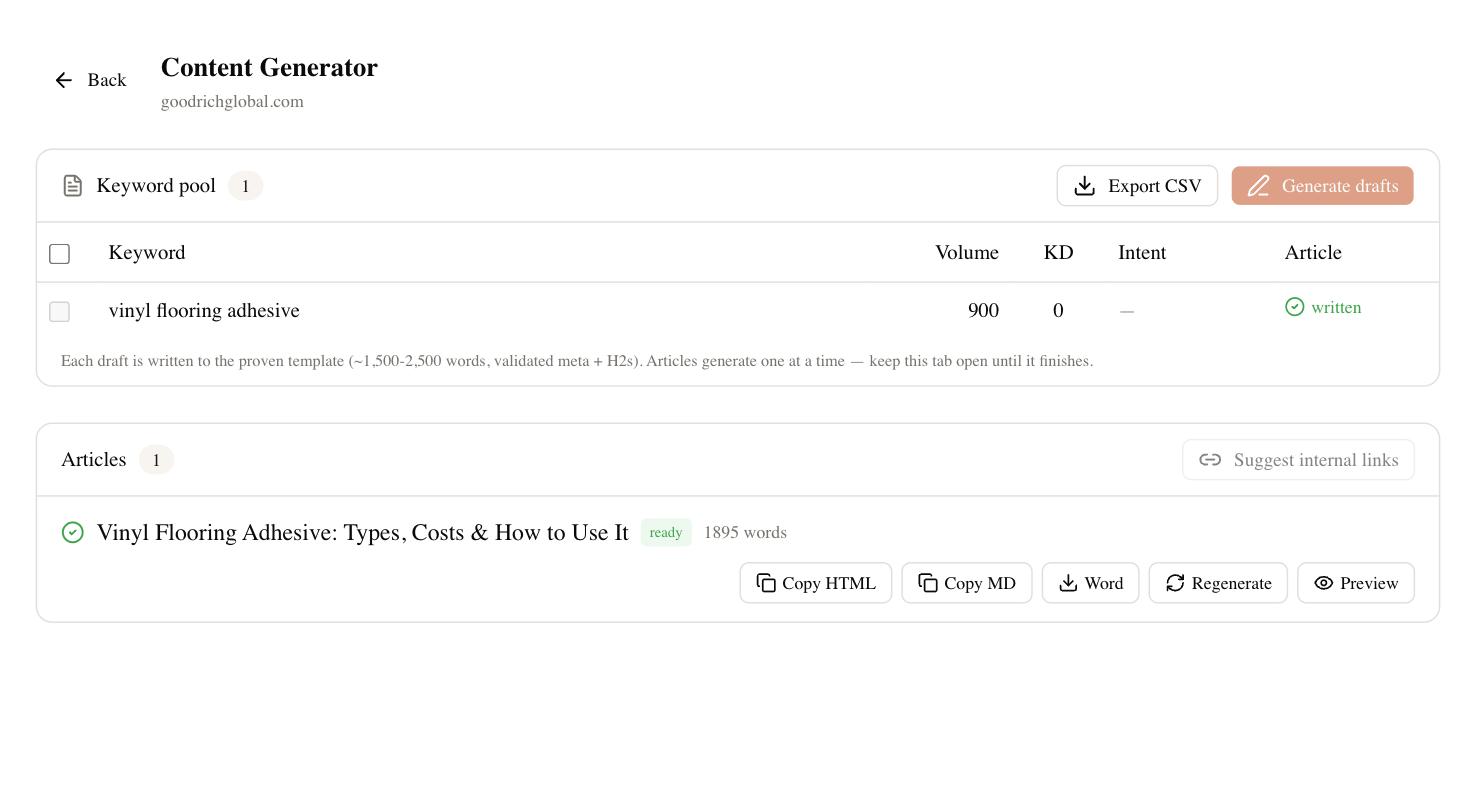
On the generation side, the AI content writer drafts each page from your data with the title, meta, and heading structure built to a real search intent rather than a generic prompt — and because you’re asking in plain language, you can steer variety across a batch instead of shipping 500 clones. Rank tracking then tells you which cohorts are actually earning positions, so you double down on templates that work and quietly retire the ones that don’t. Because search is splitting toward AI answers, its Brand Radar side also shows whether those pages are getting cited in ChatGPT and AI Overviews, not just ranked in the blue links.
Start small, then scale what works
The instinct with programmatic SEO is to launch big because the marginal cost of another page feels like zero. Resist it. Ship 50 pages of one template, give them a full indexing and ranking cycle of four to eight weeks, and read the results honestly. If that cohort earns traffic and holds through an algorithm update, you’ve validated the pattern and can scale it with confidence. If it doesn’t, you’ve lost 50 pages instead of 5,000 and learned the same lesson for a hundredth of the cleanup.
That’s the whole discipline in one sentence: programmatic SEO with AI rewards people who treat scale as a reward for a proven pattern, not as the starting move. Get the dataset and the template right on a small batch, let the AI handle the volume once you’ve earned it, and you’ll build an asset that survives the next core update instead of getting buried by it.