SEO for ecommerce is a different sport from ranking a blog or a service site. You are not optimizing a dozen pages — you are wrangling hundreds or thousands of product URLs, category pages, filters, and variants, most of which fight each other for the same keywords and half of which no human will ever intentionally link to. Get the structure wrong and no amount of content will save you.
That scale is what makes SEO for ecommerce both frustrating and, honestly, more winnable than most niches. The weakest page-one competitor in a lot of product categories is a page with a stock manufacturer description, no reviews, and a slow template. Beat that page consistently across your catalog and the compounding is real. This guide covers what makes ecommerce different, the highest-leverage moves, and the mistakes that quietly cost you traffic.
Why ecommerce SEO is its own problem
Three things separate a store from every other kind of site. First, intent is closer to the wallet — someone searching “waterproof hiking boots size 11” is ready to buy, not to read a 3,000-word essay, so matching intent beats padding word count. Second, you have a duplication machine built into the platform: every color variant, every sort order, every filter combination can spawn a near-identical URL. Third, your most valuable pages — category and product pages — are the hardest to earn links to, because nobody bookmarks a checkout funnel.
So the job splits cleanly. Category and product pages need to win on relevance, internal linking, and technical cleanliness. Your blog and buying guides do the heavy lifting on links and top-of-funnel keywords, then pass authority down to the money pages. Treating those as one undifferentiated pile is the most common reason stores plateau.
Fix architecture before you touch content
Site structure is the single highest-leverage move in ecommerce, and it is nearly free. A shallow, logical hierarchy — home to category to subcategory to product, never more than three or four clicks deep — spreads authority to the pages that convert and helps Google understand what your store is actually about. Category pages are usually your biggest untapped opportunity because they target higher-volume, higher-intent head terms (“running shoes”) that individual products can’t rank for.
Two structural rules pay for themselves. Keep a clean, self-referencing canonical strategy so faceted navigation doesn’t dilute you, and build genuine internal links between related products and their parent categories rather than relying on the template’s automated “related items” alone. If a category has no descriptive copy above or below the grid, add a few honest paragraphs — not keyword soup, just what the category covers and how to choose. That block is often the difference between ranking and not.
Make product and category pages earn their keep
The money pages need substance the manufacturer’s feed doesn’t provide. Unique product descriptions matter, but the higher-leverage additions are the ones your weakest competitor skips: real customer reviews (which generate fresh, keyword-rich text for free and feed review-star markup), a short buying-context blurb, specs in a scannable table, and answers to the questions people actually ask before buying.
- Unique copy — rewrite or expand stock descriptions; duplicate manufacturer text across your site and every competitor’s is dead weight.
- Structured data — Product, Offer, AggregateRating, and BreadcrumbList schema so you’re eligible for price, stock, and star-rating rich results.
- Reviews — the cheapest source of unique, long-tail-rich content on any product page, and a conversion lift on top.
- Intent match — a category page should let people filter and buy fast; don’t bury the grid under a wall of text to hit a word count.
The keyword mapping underneath this matters. One page per intent: the category page owns the head term, individual products own the specific model and long-tail variants, and your blog owns the informational “how to choose” queries. When two of your own pages target the same keyword, you’ve created a competitor inside your own store.
Kill duplicate and thin content at scale
This is where most stores leak. Faceted navigation, session IDs, sort parameters, and pagination can multiply one product into dozens of crawlable URLs, burning crawl budget and splitting ranking signals. The fixes are unglamorous but decisive: canonical tags pointing variants back to a primary URL, careful use of robots directives on parameter combinations that add no unique value, and a considered approach to pagination rather than infinite scroll that hides products from crawlers.
Thin content is the other half. Out-of-stock products, near-empty category pages, and auto-generated tag pages create a long tail of low-quality URLs that drag on your site’s overall quality signals. Decide deliberately for each: keep and improve, consolidate with a redirect, or noindex. A store with 8,000 URLs where 2,000 are thin is often outranked by a tighter catalog of 3,000 strong pages.
Technical wins that compound
Ecommerce sites are heavy — big images, tracking scripts, review widgets, and app clutter — so Core Web Vitals is a genuine differentiator, not a checkbox. Compress and lazy-load images, defer non-critical scripts, and make sure mobile is fast, because most product research now happens on a phone. A page that loads in 1.5 seconds against a rival’s 5-second template wins clicks before content even enters the equation.
Don’t neglect the boring infrastructure either: a clean XML sitemap that excludes noindexed and out-of-stock URLs, a logical robots.txt, HTTPS everywhere, and 301 redirects for every discontinued product so you keep the links and traffic those pages earned. Handling out-of-stock gracefully — keeping the URL live with alternatives, or redirecting to the parent category — protects rankings you’d otherwise throw away.
Find the gaps your competitors already rank for
The fastest path to new revenue in ecommerce isn’t inventing keywords — it’s finding the terms your direct competitors rank for and you don’t, then judging whether you can realistically win them. This is where SEO Rocket’s Content Gap tool earns its place: point it at two or three competitors and it surfaces the keywords driving their traffic, with search volume and keyword difficulty attached, so you can prioritize by opportunity instead of guesswork.
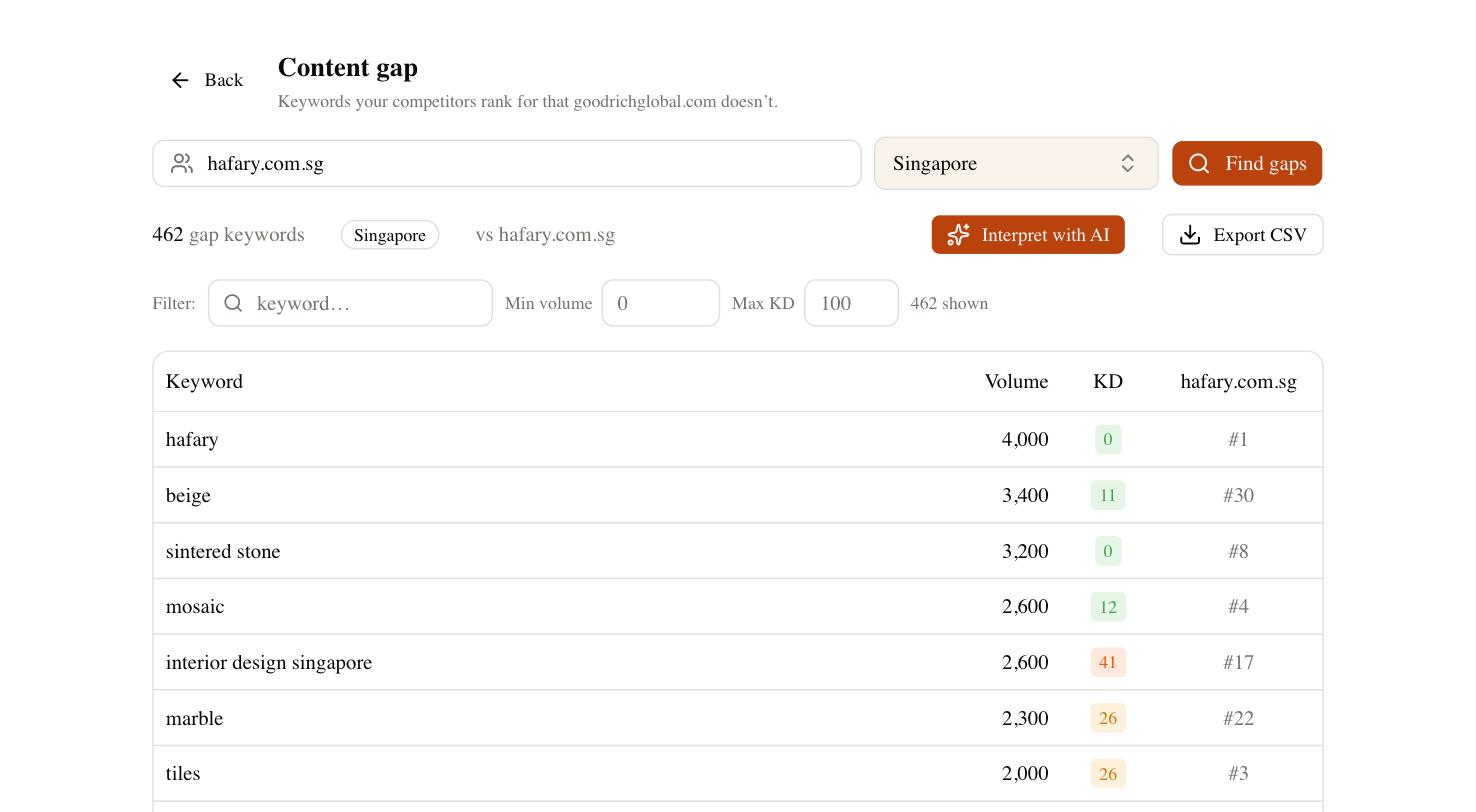
From there the workflow stays in one place. Use the keyword and difficulty data to decide which category pages to build or expand, draft the supporting buying guides with the AI writer, track whether your product pages are actually climbing, and — increasingly important — check Brand Radar to see if your store gets mentioned when someone asks ChatGPT or Perplexity for a product recommendation. That AI-search visibility is a channel most competitors aren’t measuring yet, which makes it a quiet edge for the stores that do.
The ecommerce SEO mistakes to avoid
Most stores lose ground to a handful of repeatable errors. Run this checklist against your own catalog before you spend a dollar on new content.
| Mistake | Why it hurts | Fix |
|---|---|---|
| Manufacturer stock descriptions | Identical to every rival — nothing to rank | Rewrite the top sellers first; let reviews fill the rest |
| Faceted URLs left crawlable | Duplicate content, wasted crawl budget | Canonicals + parameter handling |
| Deleting discontinued products | Throws away links and 404s buyers | 301 to a replacement or the parent category |
| Thin or empty category pages | Drags on site-wide quality signals | Add context copy, consolidate, or noindex |
| Ignoring page speed on mobile | Loses the click before content matters | Compress images, defer scripts, lazy-load |
| No structured data | Misses star, price, and stock rich results | Add Product and AggregateRating schema |
None of this is exotic. The stores that win at ecommerce SEO aren’t the ones chasing every algorithm rumor — they’re the ones that fixed their architecture, cleaned up duplication, made their money pages genuinely better than the weakest page-one result, and kept shipping. Start with the structural and technical fixes, because they lift the whole catalog at once, then work the content gap category by category. Give it a full quarter before you judge results; product rankings jitter day to day and the compounding takes time to show up in revenue.