SEO for Shopify is not the same job as ranking a blog or a lead-gen site, and treating it like one is why most stores stall at a trickle of organic traffic. Shopify handles the hosting, speed, and structured data well enough that SEO for Shopify becomes less about wrangling technical debt and more about a smaller set of high-leverage decisions: how you structure collections, how you write product and category pages, and how you build topical authority around the things people actually search before they buy.
The platform gives you a fast, secure store out of the box. What it does not give you is a reason for Google to rank you above a competitor selling the same SKUs from the same suppliers. That reason is something you build. Here is where the leverage actually sits.
Why ecommerce SEO is a different game
Most SEO advice is written for content sites, where you publish an article, earn links, and rank. Stores work differently. Your money pages are collection and product pages, not blog posts, and they compete in the hardest, most commercial results Google serves. The intent is transactional, the competition includes marketplaces with enormous authority, and a lot of your inventory is near-identical to what a dozen other stores sell.
Three things follow from that. First, keyword volume matters less than commercial intent — “buy” and “best” and specific product-modifier searches convert far better than broad head terms. Second, you are usually fighting duplication, both against competitors and inside your own store, where filters and variants can spawn hundreds of thin, near-identical URLs. Third, category pages, not products, are your real workhorses, because that is where broad commercial searches land. Get those three right and you are ahead of most of page one.
Fix Shopify’s platform quirks first
Shopify is clean, but it has a handful of well-known SEO quirks that quietly cost stores traffic. Clear these before you spend a dollar on content or links.
- Duplicate product URLs. Shopify serves the same product under both
/products/and/collections/.../products/paths. Canonical tags usually point to the clean URL, but confirm it — a broken canonical setup splits your ranking signals across duplicates. - Faceted navigation. Filters for size, color, and price generate crawlable URL variations. Left unchecked, Google wastes crawl budget on thin permutations. Decide which filtered views deserve to be indexed and block the rest.
- Thin or auto-generated collections. Empty or near-empty tag collections create low-value pages. Prune them or add real descriptive content.
- Forced URL structure. You cannot remove the
/collections/and/products/prefixes. That is fine — do not waste time fighting it. Google ranks plenty of Shopify stores with default URLs.
None of this requires a developer. It requires an hour with your theme settings and a crawl of your own store to see what Google is actually finding. A site audit that flags duplicate titles, missing canonicals, and orphaned pages will surface most of it in one pass.
Make collection pages your priority
If you do one thing, make it this. Collection pages target the broad, high-volume commercial terms — “running shoes,” “linen bedding,” “cold brew concentrate” — and most Shopify stores leave them almost blank, just a grid of products under a bare heading. That is a wasted asset. A competitor who adds 200 to 400 words of genuinely useful buying guidance above or below the grid, answers the obvious questions, and links to related collections will outrank the empty version nearly every time.
Write for the shopper who is comparing, not the one ready to check out. What are the meaningful differences between options in this category? What should someone look for? What are the common mistakes buyers make? That copy earns the ranking and lifts conversion at the same time. Keep it above the fold-line of value — Google should not have to hunt for it, and neither should your customer.
Write product pages that rank and convert
Product pages carry the long tail: specific model searches, “size 11 in wide,” “unscented,” “for sensitive skin.” The two failures here are near-universal. The first is using the manufacturer’s supplied description verbatim, which you share with every other retailer carrying the item — pure duplication with nothing to distinguish you. The second is thin pages that answer none of the questions a buyer actually asks before purchase.
Rewrite descriptions in your own words, lead with the specific benefit and the exact use case, and fold in the natural-language phrases people search. Add real specs, honest sizing notes, and answers to the returns-and-fit questions your support inbox already gets. Unique product copy at scale is tedious by hand, which is exactly where AI drafting earns its place — generate a first pass from your specs and bullet points, then edit for accuracy and voice. The goal is a page that reads like you actually sell the thing, not a spreadsheet cell.
Find the topics your competitors rank for and you don’t
Content is where stores build the topical authority that lifts everything else. The blog is not for corporate updates — it is for capturing the research-stage searches that happen weeks before a purchase: comparisons, how-tos, “what size do I need,” “is X worth it.” Each of those articles is a chance to rank, earn a link, and funnel a warm reader toward a collection or product.
The fastest way to build that plan is to stop guessing and look at what already works for the stores beating you. A content gap analysis lines up your site against two or three competitors and surfaces every keyword they rank for that you do not — with search volume and difficulty attached, so you can sort by what is winnable now.
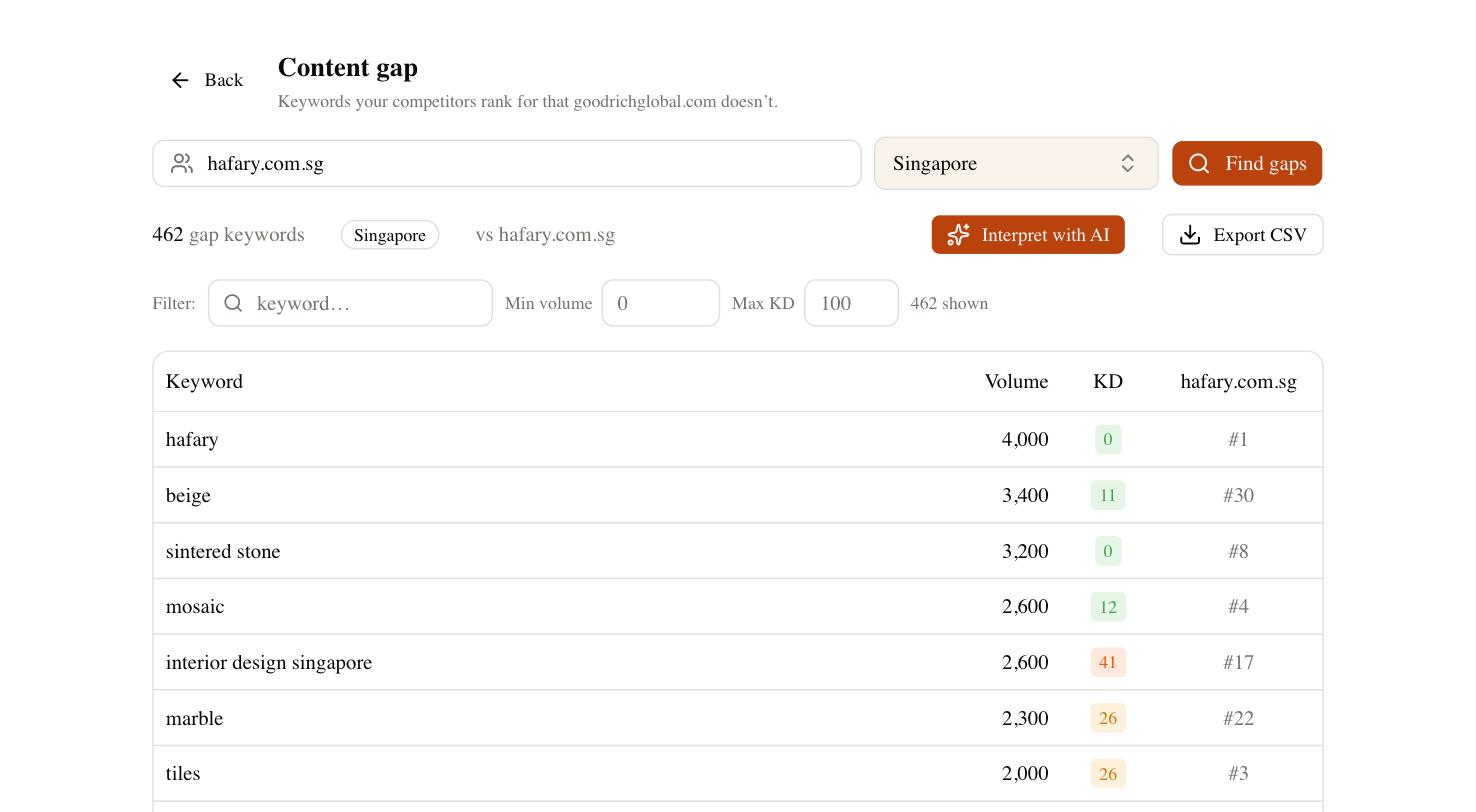
Work that list from the top down: high volume, low difficulty, close to your commercial pages first. Ten well-chosen articles that each answer a real pre-purchase question will do more for a store than fifty thin posts written on vibes. And because you can see the difficulty score before you commit, you stop wasting months chasing terms a new store has no chance of ranking for this year.
The common mistakes that kill Shopify stores
Most struggling stores are not missing some exotic tactic. They are making the same handful of avoidable mistakes.
- Leaving collection pages empty. The single biggest wasted opportunity in Shopify SEO. Add real copy.
- Copy-paste product descriptions. Duplicate content you share with every other seller of that SKU. Rewrite them.
- Ignoring internal links. Products and articles that link nowhere strand ranking signals. Link collections to related collections and articles to relevant products.
- Deleting discontinued products with no redirect. Seasonal and sold-out items leave dead URLs. Redirect them to the parent collection, not the homepage.
- Chasing head terms too early. A store with little authority will not rank for “shoes.” It can rank for a specific long-tail term this quarter. Start there and earn the right to compete bigger.
Fix these before you buy a link package or hire an agency. They cost nothing but attention, and they are the difference between a store that compounds and one that flatlines at a hundred visitors a month.
A Shopify SEO checklist to work through
Run your store against this in order. Each row is something you can verify or fix today, and the earlier rows matter more than the later ones.
| Priority | Task | Why it matters |
|---|---|---|
| 1 | Confirm canonical tags on product URLs | Stops duplicate /collections/ paths from splitting rankings |
| 2 | Add 200–400 words to your top collection pages | Turns your highest-intent pages from grids into rankable assets |
| 3 | Rewrite manufacturer product descriptions | Removes duplicate content shared with every rival store |
| 4 | Control which filtered/faceted URLs get indexed | Protects crawl budget from thin permutations |
| 5 | Run a content gap against two competitors | Reveals winnable topics with real volume, not guesses |
| 6 | Add internal links between related pages | Passes authority to the pages you want to rank |
| 7 | Redirect discontinued and out-of-stock URLs | Recovers lost ranking signals instead of leaking them |
Where to start this week
Pick your three best-selling collections and write real copy for them — that alone will beat the weakest store on page one, which almost certainly left theirs blank. Then run a content gap analysis, choose the five most winnable keywords, and draft product and article content against them. Give it a full ranking cycle before you judge the results, because store positions jitter a few spots day to day and no tool’s estimate is precise.
Good SEO for Shopify is not a growth hack. It is a short list of unglamorous fixes done consistently: distinct pages, useful copy, sane structure, and topics chosen from real data instead of hope. Do the boring version well and you will quietly pass the stores still waiting for a shortcut.