SEO for agencies is a different job than SEO for a single site, and the agencies that struggle are usually the ones who never admit that. When you run one website, you can afford to be slow and intuitive. When you run twenty client sites, your bottleneck stops being SEO knowledge and becomes process, reporting, and the hours you lose to work that doesn’t move a ranking. Getting SEO for agencies right is mostly about removing that friction so your best people spend their time on strategy, not on assembling screenshots.
This guide covers what actually changes when SEO becomes a service you sell, the moves that give you the most leverage per hour, and the mistakes that quietly kill agency margins. It’s written for the shop doing real work for real clients, not for a theory.
What makes agency SEO different
The core skills are the same — keyword research, on-page work, links, technical fixes. What changes is everything around them. You’re managing many sites in different niches, each with its own history, its own competitors, and a client who wants to know what they’re paying for. You can’t go deep on all of them by hand, so you need systems that make a junior’s output look senior and a report take minutes instead of an afternoon.
The second difference is accountability. Your own site failing to rank costs you nothing but pride. A client site stalling for two months costs you the retainer. That raises the stakes on two things most solo SEOs ignore: setting expectations honestly up front, and being able to show progress even in the months before rankings move. Agencies live and die on the gap between what a client hoped for and what you told them to expect.
There’s a third, quieter difference: switching cost. A client who hired you can fire you, and the sites in your book will not all be winners. Some will be in brutal niches where page one is owned by national brands with budgets you can’t match. Part of doing SEO for agencies well is knowing which accounts to invest in, which to keep steady, and which to have an honest conversation with before they churn on their own terms. That portfolio view — treating your client roster like an investor treats holdings — is something no single-site operator ever has to learn.
The highest-leverage moves
A handful of activities produce most of an agency’s results. Spend your hours here before anything else.
- Competitor gap analysis first. Before writing a word, pull the keywords a client’s page-one rivals rank for that the client doesn’t. This is the fastest way to build a content plan that’s grounded in what already works in the niche, and it’s far more reliable than brainstorming topics from scratch.
- Standardize content production. The margin in agency work comes from producing good pages quickly. A repeatable brief-to-draft process — real search data in, an AI-assisted draft out, a human editor to sharpen it — lets you scale volume without hiring in lockstep.
- Track rankings weekly, not daily. Positions jitter three or four spots day to day; that noise means nothing and panicking clients over it wastes everyone’s time. Weekly snapshots show the trend that actually matters.
- Prioritize by cost-to-rank. Not every keyword is worth chasing. Estimate what it will realistically take to reach page one before you commit a client’s budget, and steer them toward the terms where the effort pays back.
Notice what isn’t on that list: chasing every algorithm rumor, rebuilding a site because a metric dipped, or spending a week on a single hero page. Agency leverage comes from doing the boring, proven work consistently across every account, not from one clever trick on one site. The moment you find yourself hand-crafting something for one client that you couldn’t repeat for the next ten, ask whether it’s really worth the hour or whether it just feels productive.
Reporting that clients actually read
Reporting is where agencies bleed the most hours and lose the most trust. A client doesn’t want a 40-tab spreadsheet; they want to know whether the money is working. The agencies that retain clients longest are the ones whose reports are simple, honest, and delivered without a scramble at month-end.
The practical answer is a live, read-only dashboard the client can open any time, branded as yours rather than a third-party tool’s. It removes the monthly export ritual, it stops the “can you send me an update” emails, and it quietly reinforces that you have nothing to hide. When a client can see their own rankings and traffic trend on demand, your monthly call shifts from proving you did work to discussing what to do next.
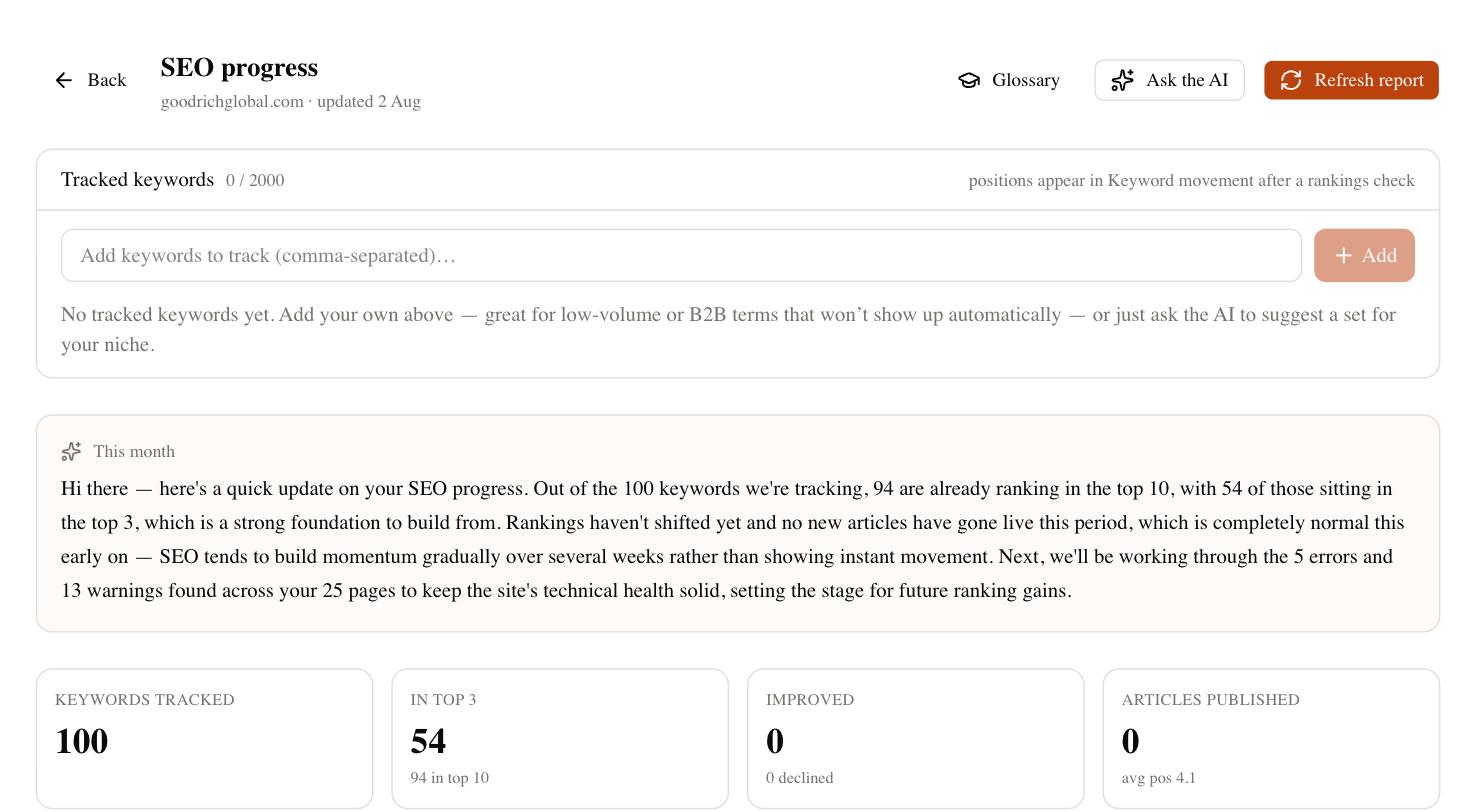
One warning: a dashboard that only ever shows good news trains clients to distrust it. Show the terms that slipped as well as the ones that climbed. An honest report that occasionally admits a bad month builds more retention than a glossy one that pretends everything is perfect.
Pricing the work and proving ROI
Most agency churn traces back to a client who never understood what they were buying. SEO is slow — meaningful movement usually takes three to six months, longer in competitive niches — and if you don’t say that on day one, the client’s clock starts at day one anyway. Set the timeline honestly, tie the retainer to a defined scope, and revisit the plan quarterly.
Proving ROI is easier when you frame it in the client’s language: not “domain rating up four points” but “these twelve pages now bring in traffic that would cost this much through ads.” Estimating the ad-equivalent value of organic traffic, and the realistic cost to rank for a target term, turns a vague service into a business case a client can defend to their own boss. That single reframing renews more contracts than any ranking win.
Be careful how you price, too. Undercharging to win a logo leaves you no room to do the work properly, and a client paying below cost is the first one you resent and the last one you serve well. It’s usually better to charge what the work needs and take on fewer accounts than to spread a thin retainer across a roster you can’t service. Clients rarely leave because you cost too much; they leave because they stopped seeing the value, and value is far easier to deliver when the budget actually covers the hours.
Common mistakes that cost agencies margin
The same errors show up across struggling agencies, and none of them are about SEO skill.
- Over-promising to close the deal. Guaranteeing page one by a date you can’t control is the fastest route to a refund and a bad review. Under-promise the timeline and let the results beat it.
- Manual reporting. If a team member spends a day each month building decks, you’re paying senior wages for copy-paste. Automate it and reclaim the strategy time.
- Ignoring AI search. Buyers increasingly ask ChatGPT, Perplexity, and Google’s AI Overviews instead of scrolling results. A client can rank first and still be invisible in the answer their customer actually reads. Track whether your clients get cited, because they’ll ask about it soon if they haven’t already.
- Chasing vanity keywords. Ranking a client for a high-volume term that doesn’t convert feels good and pays nothing. Match keywords to buying intent, not to the biggest number.
A repeatable client onboarding workflow
Consistency is what lets you take on the next client without dropping the last one. A tight, documented sequence means quality doesn’t depend on which person happened to do the work, and it protects you when a key team member leaves. Write the workflow down, then follow it for every account whether the client pays you a few hundred a month or several thousand.
- Run a full site audit and fix the technical blockers first — no content plan survives a site that can’t be crawled.
- Pull competitor gaps and rank-track the client’s current positions to set an honest baseline.
- Build a prioritized content plan ranked by cost-to-rank and buying intent.
- Produce pages on a standardized brief-to-draft-to-edit line.
- Report weekly through a live client dashboard, and review scope every quarter.
Where SEO Rocket fits
Most of the leverage above comes down to doing more client work with fewer tools and fewer hours, which is exactly what SEO Rocket is built for. Instead of stitching together a keyword tool, a writer, a rank tracker, and a reporting deck, you ask for what you need in plain language and it runs on real, Ahrefs-grade data underneath — competitor gaps, cost-to-rank, rankings, site audits, and AI-search visibility through Brand Radar. The white-label client dashboards mean you hand a client a read-only report without exporting anything, and the AI writing keeps content production moving. For an agency, the win isn’t a single feature; it’s that one subscription covers the workflow that used to need four, so your margin stops leaking into busywork and your team spends its time where it’s actually worth paying for.