
A good SEO content brief template is the difference between a draft that ranks and a draft you have to rewrite twice. It forces you to decide — before a single word is written — what the page is for, who it beats, and what “done” looks like. This page gives you the actual template, not a description of one.
Below is a copy-paste SEO content brief template as a table, a fully filled example so you can see it in use, and a short checklist your writer can run before hitting publish. Take the whole thing, drop it into a Google Doc or Notion page, and adapt the field names to how your team works.
Why most briefs fail
The briefs that produce weak content usually fail in the same way: they list a keyword and a word count and stop there. A writer handed “target keyword: best running shoes, 1,500 words” has almost no information. They don’t know the search intent, they don’t know which competitor page sets the bar, they don’t know what subtopics Google expects to see, and they have no way to tell whether their draft is finished or just long.
A real brief closes those gaps. It answers the questions a writer would otherwise guess at, and it does so with specifics — the exact secondary terms to cover, the two or three pages currently ranking that the draft has to beat, the internal links to include, and the angle that makes your version worth reading. Fill those in and the draft mostly writes itself. Skip them and you pay for the guessing in revision rounds.
There is a cost angle too. Every field you leave blank becomes a decision the writer makes on instinct and the editor unwinds later. A brief that takes fifteen extra minutes to build routinely saves an hour of back-and-forth, because the disagreements happen up front over a shared document rather than after the draft, when opinions have hardened around 1,800 words nobody wants to throw away. The brief is where you argue about direction cheaply.
The SEO content brief template (copy this)
Here is the template as a table. Every row is a field to fill; the right column tells you what belongs there. It covers the fundamentals a search-focused draft needs without ballooning into a form nobody completes. Keep it to one screen so it actually gets used — a brief that runs to three pages is one your team will start skipping.
| Field | What goes here |
|---|---|
| Working title | The draft headline — you can refine it later, but give the writer a starting point |
| Focus keyword | The one primary phrase the page targets |
| Search intent | Informational, commercial, transactional, or navigational — and the underlying job the reader wants done |
| Target audience | Who is searching this and what they already know |
| Secondary keywords | 3-8 related terms and questions to cover naturally |
| Competitors to beat | The 2-3 URLs currently ranking that your draft must outdo, with what each does well and badly |
| Word count range | A band, not a hard number — usually within range of the weakest page-one result |
| Suggested H2s | The section outline, based on subtopics the ranking pages cover |
| Angle / unique value | The one reason this page deserves to exist over what already ranks |
| Internal links | 2-4 relevant pages on your own site to link to |
| Meta title & description | Draft SERP snippet, keyword near the front, description 140-155 characters |
| Call to action | What the reader should do at the end |
A filled example
A blank template is easy to misread, so here is the same structure filled for a real target. Notice how specific each answer is — that specificity is the whole point. Vague fields produce vague drafts. “Competitors: some blog posts” tells a writer nothing; naming two ranking URLs and what each gets wrong tells them exactly where the opening is.
- Working title: “How to Do Keyword Research for a New Site (Step by Step)”
- Focus keyword: keyword research for new website
- Search intent: Informational — a beginner who just launched a site and wants a repeatable process, not theory
- Target audience: Solo founders and first-time bloggers with no SEO budget
- Secondary keywords: long-tail keywords, search volume, keyword difficulty, free keyword tools, low-competition keywords
- Competitors to beat: Two guides ranking in positions 4-6 — both thorough but generic, neither shows the actual tool screens or gives a starter keyword list
- Word count range: 1,600-2,000 (weakest page-one result is ~1,700)
- Suggested H2s: Start with a seed list, expand with a tool, judge difficulty honestly, group by intent, pick your first ten targets
- Angle: A genuinely no-budget path — every step doable free — with a downloadable starter sheet
- Internal links: On-page SEO checklist; how search intent works
- Meta: “Keyword Research for a New Website: A Free Step-by-Step Guide”
- CTA: Grab the free keyword tracker and run your first ten terms
The pre-publish checklist
The brief tells the writer what to make. This checklist tells them whether they made it. Run it before the draft leaves the writer’s hands, so editing catches structure problems rather than typos. None of these items are about polish — they are the load-bearing checks that decide whether a page has a real shot at ranking.
- Focus keyword appears in the title, the first paragraph, one H2, and the meta description — used naturally, never stuffed
- Every suggested H2 is covered, or you can defend why one was cut
- Search intent is satisfied in the first screenful — a how-to opens with the how, not a history lesson
- The draft covers something the competitor pages miss (that is the angle)
- Secondary keywords and related questions are addressed somewhere in the body
- Internal links are placed with descriptive anchor text
- Meta title is under 60 characters; description is 140-155
- Claims are specific and honest — real numbers, real trade-offs, no invented statistics
How SEO Rocket fills the brief for you
Building a brief by hand is the slow part. You are hopping between a keyword tool for volume and difficulty, a SERP scan to see who ranks, and a spreadsheet to hold it all together — twenty minutes of assembly before anyone writes a sentence. SEO Rocket collapses that into a request. Ask it for a brief on a keyword and it pulls the real data underneath: search volume, difficulty, the pages actually ranking, the subtopics they share, and the gaps they leave open.
Because the numbers come from Ahrefs-grade data rather than a guess, the competitor and word-count fields reflect what is really on page one, not a round number someone picked. The tool proposes the H2 outline from what ranking pages cover, flags the secondary terms worth including, and drafts the meta title and description to length. You review and adjust — you stay in control of the angle, which is the field no tool should decide for you.
That last point matters more than it sounds. Automated briefs are only as good as the data behind them, and a brief built on a bad SERP read sends the whole draft in the wrong direction. Grounding the fields in live ranking data instead of a model’s best guess is what keeps the shortcut trustworthy — you are speeding up assembly, not outsourcing judgment. The half-hour you save is spent where it counts: on the argument and the angle, not on copying numbers between tabs.
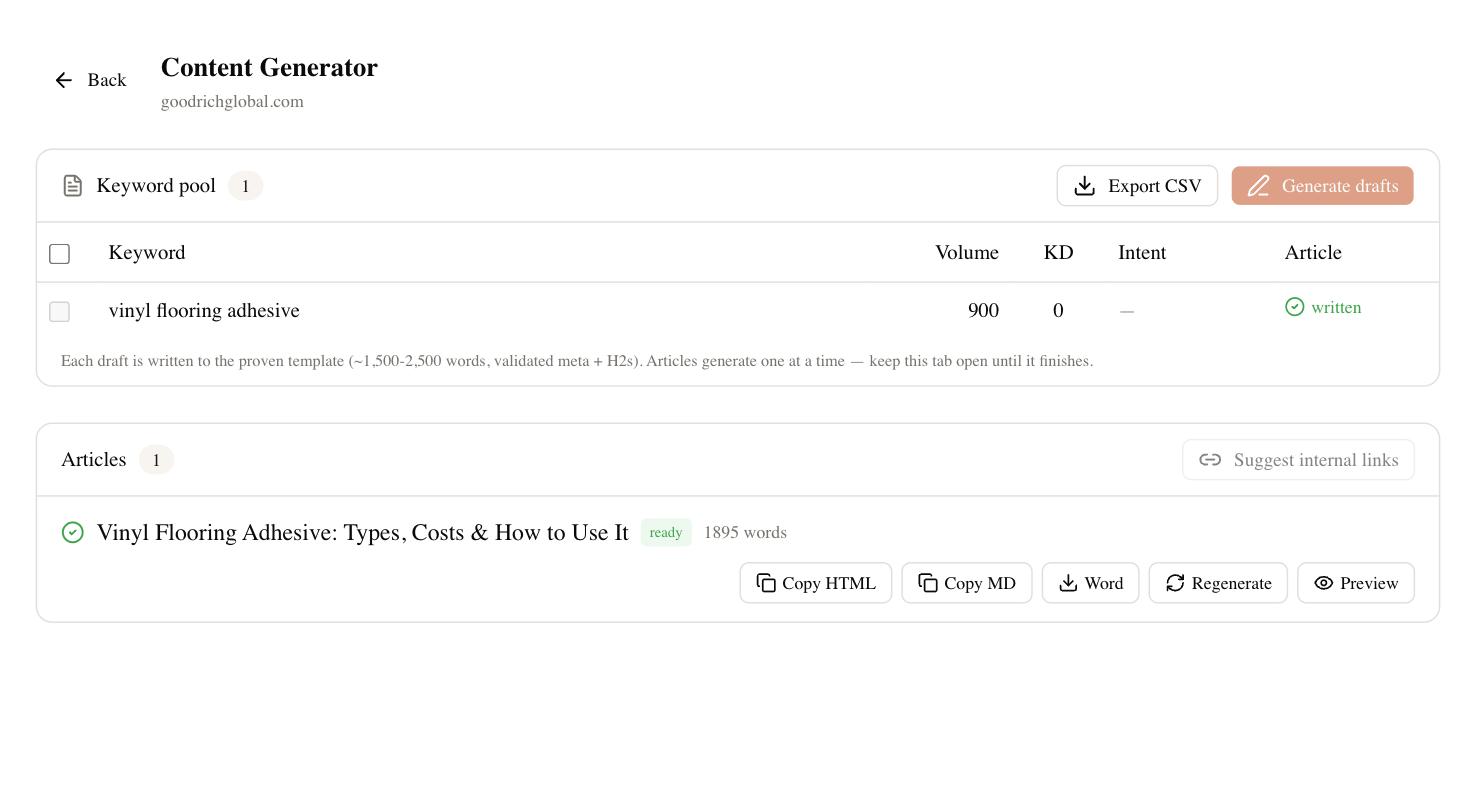
From there the same tool can take the brief straight into a draft, writing against the outline you approved and citing the data it used. It also shows whether your published pages get surfaced in AI answers from ChatGPT, Perplexity, and Google’s AI Overviews — so a brief can target the search that is actually happening, not only classic blue-link rankings. The brief stops being a document you maintain and becomes a step the tool runs on the way to a finished page.
Adapt it, don’t worship it
Treat this template as a floor, not a cage. A comparison post might add a “products or tools to feature” row; a local page might add “location and service area.” A thin blog on a low-competition term does not need twelve fields — a title, intent, three secondary terms, and one competitor to beat is enough to get moving. The goal is to remove guesswork from the draft, not to build paperwork the team quietly abandons after a month.
Whatever you keep, keep the four fields that do the heavy lifting: intent, competitors to beat, the H2 outline, and the angle. Those four answer the questions a writer would otherwise guess at, and getting them right is what turns a brief from a formality into the reason a page ranks. Copy the template, fill those first, and your next draft starts from a much stronger position than a keyword and a word count ever could.