
Most articles about an SEO audit checklist describe one without ever handing it over. This one gives you the real thing — a checklist you can paste into a doc, work through line by line, and use on your own site this afternoon. Below is the full SEO audit checklist as a table you can copy, grouped the way an experienced auditor actually works: crawlability first, then indexing, on-page, content, links, and the handful of technical signals that still move rankings.
Treat it as a template, not scripture. Not every row applies to every site, and a small business page does not need the same depth as a 50,000-URL store. Run the checks that fit, mark each one pass or fail, and write down the specific fix. An audit that ends without a prioritized fix list is just a report nobody reads.
The full SEO audit checklist (copy this)
Here is the template. Copy the whole table, keep the status column blank, and fill it in as you go. The point is to leave every row with a verdict and a next action, not a vague note to “improve later.”
| # | Check | What good looks like | Status / fix |
|---|---|---|---|
| 1 | Site is crawlable | robots.txt allows key sections; no accidental Disallow on important paths | |
| 2 | XML sitemap exists & is submitted | Valid sitemap, only 200-status canonical URLs, referenced in robots.txt | |
| 3 | Important pages are indexed | Money pages return “Indexed” in Search Console coverage | |
| 4 | No accidental noindex | Templates and key pages are not blocked by a stray noindex tag | |
| 5 | HTTPS & single canonical host | One version (https, www or non-www) with the rest 301-redirected | |
| 6 | Titles & meta descriptions | Unique, under ~60 / ~155 chars, primary keyword near the front | |
| 7 | One H1 per page | Single clear H1 that matches search intent, logical H2/H3 order | |
| 8 | Internal linking | Money pages linked from relevant content; no orphan pages | |
| 9 | Broken links & redirect chains | No 404s in navigation; redirects resolve in one hop | |
| 10 | Image alt text & file size | Descriptive alt on meaningful images; compressed files | |
| 11 | Core Web Vitals | LCP under 2.5s, INP under 200ms, CLS under 0.1 on mobile | |
| 12 | Mobile usability | Readable text, tap targets spaced, no horizontal scroll | |
| 13 | Thin / duplicate content | No near-identical pages; every URL earns its place | |
| 14 | Content matches intent | Page format fits the SERP (guide, comparison, product, local) | |
| 15 | Structured data | Valid schema for articles, products, FAQs, or local business | |
| 16 | Backlink profile health | Steady referring domains, no obvious spam or lost-link cliff | |
| 17 | Ranking & traffic trend | Positions and clicks flat or rising, not quietly sliding | |
| 18 | AI-search visibility | Brand cited in AI Overviews, ChatGPT, and Perplexity answers |
Start with crawling and indexing
Nothing else on the list matters if search engines cannot reach or store your pages, so the first four rows come first for a reason. Pull up your robots.txt and confirm you are not blocking a folder you actually want ranked — an accidental Disallow line is one of the most common and most damaging problems I find, and it can silently sink a whole section of a site. Then open Search Console coverage and check that your important URLs report as indexed rather than “Crawled — currently not indexed,” which usually points at thin content or duplication rather than a technical fault.
Check your canonical host next. Pick one version — https with or without www — and make sure every other variant 301-redirects to it in a single hop. Split hosts scatter your link equity across duplicates and confuse reporting. While you are there, look for stray noindex tags in your page templates; a single misconfigured setting can deindex thousands of URLs, and it happens far more often than anyone admits after a site migration or a theme update. Confirm your XML sitemap is submitted and clean too — it should list only canonical, 200-status URLs, because a sitemap stuffed with redirects and dead pages teaches crawlers to trust it less.
On-page and content checks
With the plumbing sound, move to what the searcher and the crawler actually read. Every indexable page needs a unique title tag with the primary keyword near the front, a single H1 that matches the query, and a heading structure that reads like an outline rather than random bold text. Meta descriptions will not rank you, but a sharp one lifts click-through, and click-through compounds over thousands of impressions.
Content is where most audits find the real wins. Look for thin pages that say little, near-duplicate pages competing with each other, and pages whose format simply does not match the intent — a thin blog post trying to rank for a query where Google clearly wants a comparison table or a product page. Benchmark against the weakest result on page one, not the category leader: if the ninth-ranked page is a 900-word guide with two links, you have found a realistic target, not a reason to give up. Fix intent mismatches before you touch anything cosmetic, because they are the changes that actually move positions.
Technical signals and page experience
Page experience is a tiebreaker, not a magic lever, so keep it in proportion. Run your key templates through a Core Web Vitals check and aim for the standard thresholds: Largest Contentful Paint under 2.5 seconds, Interaction to Next Paint under 200 milliseconds, and Cumulative Layout Shift under 0.1, measured on mobile because that is what most of your traffic uses. Confirm text is readable without pinching and that tap targets are not crammed together.
Then sweep for the quiet technical debt: broken internal links, redirect chains that hop three times before resolving, orphan pages nothing links to, and oversized images shipping as multi-megabyte files. None of these alone tanks a site, but together they leak crawl budget and user patience, and they make the whole site feel neglected to a returning visitor. Validate any structured data you rely on too — broken schema forfeits the rich results it was meant to earn, and a product or FAQ markup that silently fails is a common reason a page loses its enhanced listing overnight.
How SEO Rocket fills the checklist for you
Working through eighteen rows by hand across a real site means bouncing between a crawler, Search Console, a Core Web Vitals tool, and a backlink checker, then stitching the findings together yourself. SEO Rocket collapses that into one pass. You ask it to audit a site in plain language, and it crawls the pages, scores overall site health, and returns the on-page issues grouped by severity with the exact URLs affected — the same rows above, filled in, without four browser tabs.
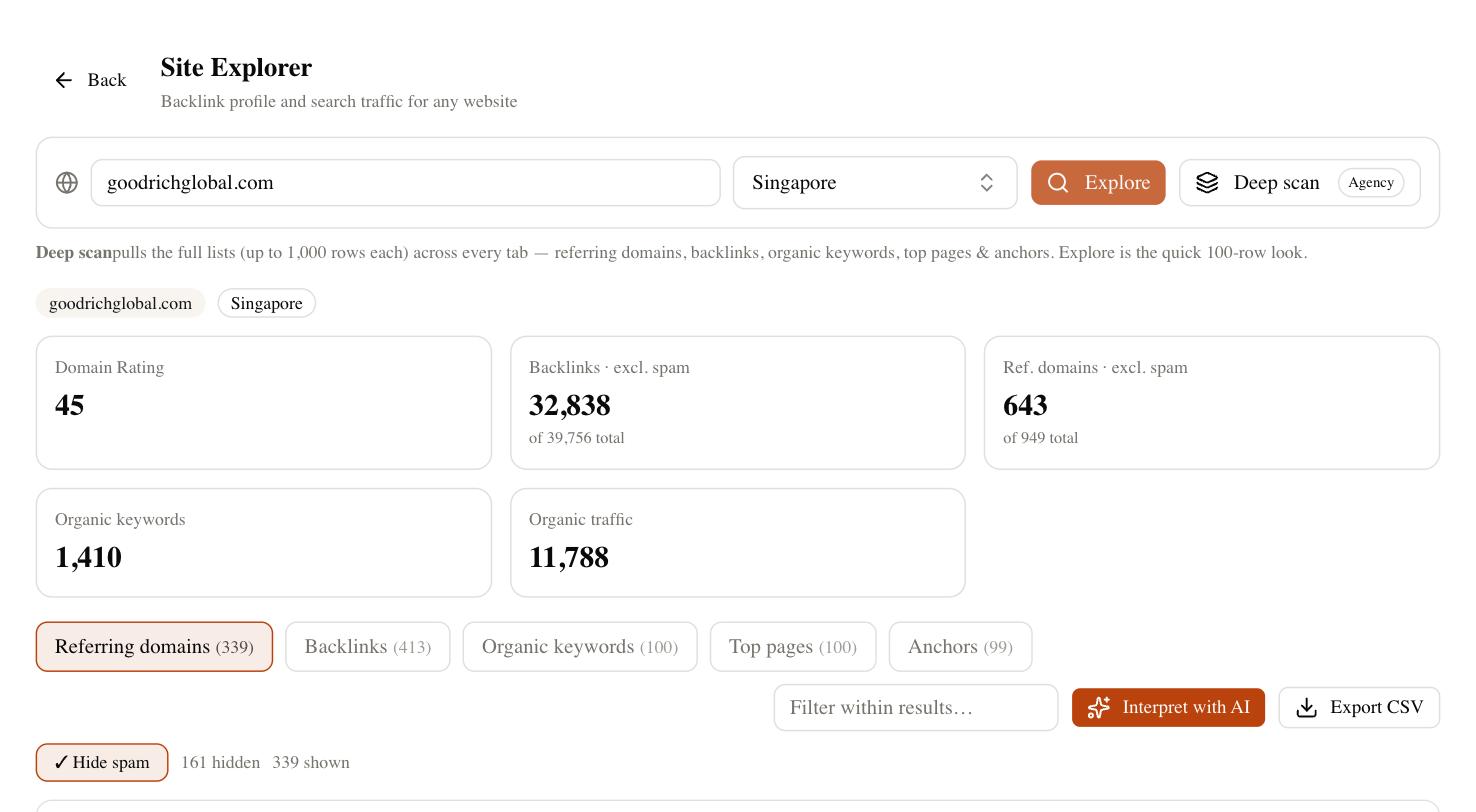
Because the data underneath is Ahrefs-grade, the same audit reaches the rows most checklists skip. It reads your backlink profile for spam or a lost-link cliff, shows whether your rankings are trending up or quietly sliding, and — the row no traditional crawler answers — reports whether your brand is being cited in AI Overviews, ChatGPT, and Perplexity, where a growing share of buyers now search. You still make the judgment calls, but the gathering and the grouping are done, which is where a manual audit usually burns a full day.
Turn the audit into a repeatable habit
A one-off audit ages fast. Content drifts, links rot, a redeploy reintroduces a bug you already fixed, and a competitor rewrites the page that was beating you. Re-run the full checklist quarterly for a stable site, monthly if you publish often or manage the site for a client, and always immediately after a migration, a redesign, or a CMS change — the three events most likely to break something expensive without any visible warning.
The habit matters more than any single row. Keep the completed template, date it, and diff it against the last run so you can see what improved and what slipped. Fix the highest-impact failures first — crawlability and intent before cosmetics — and give each change a full ranking cycle before you judge it, since positions jitter a few spots day to day regardless of what you touch. Do that consistently and the audit stops being a chore you dread and becomes the clearest read you have on why a site wins or loses.