
The reason most people fail at how to write SEO content with AI is simple: they type a keyword into a chatbot, paste the output, and hit publish. That gets you a grammatically perfect page that says nothing a human couldn’t have guessed, and search engines are getting very good at ignoring it. Done well, writing SEO content with AI is not about generating text faster — it’s about doing the research, structuring, and drafting in one pass while you stay firmly in the editor’s chair.
This is a practical, do-it-today guide. It walks through the exact steps a working SEO uses to turn a keyword into a page that ranks and reads like a person wrote it, where AI fits in each step, and — just as important — where it does not.
What AI is genuinely good at, and where it breaks
Be clear-eyed about the tool before you lean on it. Large language models are excellent at structure, first drafts, and volume: outlining, rephrasing, summarizing research you feed them, and turning bullet points into readable prose. They are unreliable at facts, terrible at knowing what is currently on page one, and completely incapable of your first-hand experience. If you skip the parts AI is bad at, you ship a page that is confident, fluent, and wrong.
So the workflow below treats AI as a fast junior writer, not an oracle. You supply the intent, the real data, and the judgment. It supplies speed. That division of labor is the whole game, and it is why two people using the same model can produce a thin listicle and a page that outranks established sites.
It helps to name the failure modes so you can catch them. Models hallucinate statistics that sound plausible, invent quotes and sources, default to a bland middle-of-the-road tone, and repeat the same sentence shape until the whole piece hums at one pitch. Every one of those is fixable in editing — but only if you are reading closely, which means you cannot outsource the reading to the same tool that did the writing.
The step-by-step workflow
Here is the sequence that works. You can run the whole thing in an afternoon once it is familiar; your first attempt will take longer, and that is normal. Notice that only two of the eight steps are the actual drafting — the rest is research and editing, which is exactly where the quality lives. Treat that as a feature, not a chore.
- Start from a keyword and its real intent. Before a single word is written, know what the searcher actually wants. Open the top three ranking pages and ask what job they do — a comparison, a how-to, a definition. Match that format or you will not rank no matter how good the prose is.
- Build the outline from what already ranks. Pull the headings your competitors use, then decide what they missed. Ask the AI to draft an outline that covers the shared subtopics plus two angles nobody else addresses. The outline is where you win or lose; spend real time here.
- Feed the AI your facts, not just the topic. This is the step everyone skips. Paste in your own data, quotes, prices, screenshots, and hard-won opinions. A prompt like “write about email marketing” produces sludge; “here are my five results and three mistakes, write the intro” produces something usable.
- Draft section by section, never the whole thing. Generate one section, read it, fix it, then move on. Whole-article generation buries errors and produces a uniform, sing-song rhythm that readers and reviewers both notice. Short passes keep you in control.
- Edit for truth first, then voice. Delete every claim you cannot verify. Then rewrite the openers so they do not all start the same way, cut the throat-clearing (“In this article we will explore”), and add the specific numbers and short sentences that make writing sound like a person.
- Add the structure search engines read. Clear H2s and H3s, a short answer near the top for featured snippets, descriptive alt text, and an honest meta description. AI can draft all of these, but you confirm they match the page.
- Fact-check and add what only you know. Insert one genuinely first-hand detail per section — a result, a screenshot, a caveat. This is the single biggest signal that a human, not a content mill, made the page, and it is the part no model can fake.
- Publish, then track and revise. Ship it, then watch how it performs over a few weeks and update the sections that underdeliver. SEO content is never finished on publish day.
Where SEO Rocket fits in this workflow
Steps one through three normally mean juggling a keyword tool, a SERP tab, and a separate chatbot. SEO Rocket collapses that into one place. Its Content Generator pulls real, Ahrefs-grade keyword and competitor data, builds the outline from what is actually ranking in your market, and drafts the article with Claude — so the model is working from live search reality instead of its training memory. You are still the editor, but the research and structure arrive already wired to the draft.
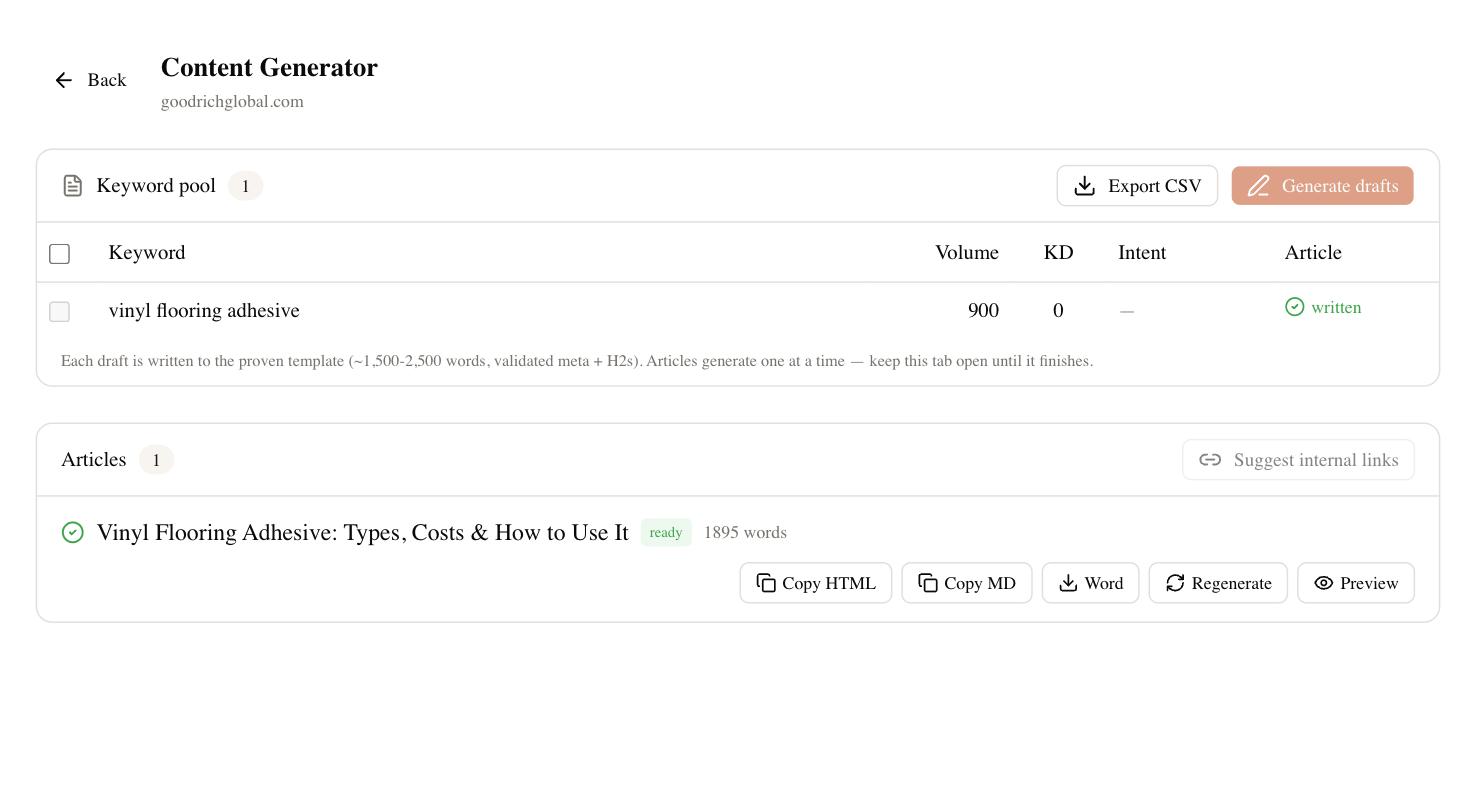
Because it is chat-first, you steer in plain language: tighten a section, add a comparison table, make the intro less formal, pull in a competitor’s angle. The point is not to replace the eight steps above — it is to remove the tab-switching and the copy-paste between tools, so the boring parts take minutes and your attention goes where it belongs, on the facts and the voice. If you would rather keep your own writing stack, the same discipline still applies; the feature just shortens the loop.
A quick pre-publish checklist
Before anything goes live, run the draft against a short list. This takes five minutes and catches the errors that quietly sink AI content — the invented stat, the format that fights the query, the paragraph that could describe any company in your industry. If you cannot tick every box, it is not ready to publish.
- Every factual claim is verified or removed — no exceptions.
- The format matches search intent (how-to for a how-to query).
- At least one first-hand detail, number, or example per section.
- Openers and sentence lengths vary; nothing reads sing-song.
- Headings, meta description, and alt text are written and accurate.
- You would be comfortable putting your name on it.
Be honest about timelines and limits
AI shortens the writing, not the ranking. A page you publish today typically takes anywhere from a few weeks to a few months to settle into position, and that timeline depends on your site’s authority and the competition, not on how fast you drafted. Anyone promising instant rankings from AI content is selling something. Expect positions to jitter a few spots day to day even after you rank; that is normal, not a problem to fix.
There are hard limits worth naming. AI cannot invent expertise, so a page in a field you know nothing about will read hollow no matter how clean the prose. It cannot check today’s facts reliably, so anything time-sensitive needs a human pass. And volume without quality still loses — publishing fifty thin AI pages is a faster way to get filtered than a slow way to grow. The teams winning with AI use it to publish fewer, better pages, not more mediocre ones.
It also pays to set expectations with whoever you report to. AI makes the cost of a first draft close to zero, which tempts clients and managers to expect ten articles a day and instant traffic. Neither is realistic if you care about ranking. A better promise is that you will ship consistently good pages faster than before, and that the compounding shows up over a quarter, not a week. Under-promise on speed and over-deliver on quality, and the AI workflow stays an asset instead of becoming a treadmill.
Putting it into practice
Knowing how to write SEO content with AI comes down to one shift in mindset: you are the writer and the AI is your research assistant and typist, never the other way around. Bring the intent, the data, and the judgment; let the tool handle structure and speed. Do that and you get the best of both — the throughput of automation with the credibility only a person can supply.
Start small. Take one keyword you understand well, run it through the eight steps, and time yourself. Your first article will feel slower than writing by hand because you are learning the loop. By the third, you will be producing pages in a fraction of the time that read better than most of page one — because most of page one is still using AI the lazy way. That gap is your opening.