
Most people searching for a monthly seo report example don’t want a 40-page PDF full of vanity charts — they want a one-page structure they can fill in tonight and send a client in the morning. So this is that: a real, copy-ready template, a filled sample so you can see what “good” looks like, and the honest summary format that keeps clients from panicking when rankings wobble.
Use the monthly seo report example below as a skeleton. Every line earns its place because it answers a question the person paying you is actually asking: is my traffic going up, is the money I’m spending working, and what happens next month.
What a monthly SEO report has to answer
A report is not a data dump. It’s the answer to three questions, and if it doesn’t answer them in the first thirty seconds, the client stops reading and starts worrying. The first is direction — is organic traffic and revenue trending up, flat, or down. The second is attribution — what specifically did we do this month, and did it move anything. The third is the plan — what are we doing next, and why.
Everything else is supporting evidence. Keyword tables, backlink counts, and audit scores exist to back up the story, not to replace it. A good report reads top to bottom like a short memo: headline, proof, plan. Lead with the numbers a business owner cares about, then let the SEO detail sit underneath for anyone who wants it.
The monthly SEO report template (checklist)
Here is the full skeleton. Six blocks, in this order. If you deliver these six every month in the same layout, clients learn where to look and trust builds because nothing hides.
- Executive summary — three or four sentences in plain English: traffic direction, the one win, the one risk, and the headline plan for next month.
- Performance snapshot — organic traffic, clicks, impressions, average position, conversions or leads, each shown against last month and the same month last year.
- Keyword movement — the keywords that gained or lost positions, plus any that broke onto page one or fell off it. Show the ranking URL and search volume, not just the number.
- Content and technical work done — what shipped: pages published, pages updated, fixes deployed, links earned. Concrete, dated, verifiable.
- Site health — audit score, new errors versus resolved errors, Core Web Vitals status, and anything that needs the developer.
- Next month’s plan — three to five prioritized actions with a reason attached to each. No vague “keep optimizing.”
Keep it to two pages of substance. A report that takes an hour to read gets skimmed; a tight one gets acted on.
A filled example you can copy
Abstract templates are easy to nod along to and hard to use. So here is the performance snapshot block filled with realistic numbers for a small services business, formatted exactly as you’d hand it over. Swap the figures for your own and you have a working section.
| Metric | This month | Last month | Same month last year |
|---|---|---|---|
| Organic sessions | 4,180 | 3,760 | 2,910 |
| Organic clicks (Search Console) | 3,540 | 3,190 | 2,480 |
| Impressions | 212,000 | 198,400 | 141,000 |
| Average position | 14.2 | 15.9 | 21.3 |
| Keywords ranking on page one | 63 | 57 | 34 |
| Leads from organic | 28 | 22 | 13 |
Notice what this makes obvious at a glance. The month-over-month change shows momentum; the year-over-year column proves the trend is real and not just a seasonal bounce. Average position dropping from 14.2 to a lower number is progress — lower is better — and pairing rankings with leads keeps the conversation on business outcomes instead of abstract SEO metrics nobody can spend.
For the keyword movement block, a filled row looks like this: “plumber near me — moved from position 11 to 6, 2,400 searches a month, landing on /services/emergency-plumbing.” One line, three facts, zero fluff. Do that for your five biggest movers up and your two biggest drops, and the section writes itself.
Resist the urge to list every keyword you track. A client does not need to scan 300 rows; they need the handful that changed and why it matters. If a term moved from position 30 to 22 it’s technically progress, but it earns no clicks yet, so leave it out or group it under a single “still climbing” line. Report the movement that changes revenue or is close to changing it, and let the rest sit in the raw data for anyone who asks.
How to write the summary clients actually read
The executive summary is the only part most clients read in full, so it carries the report. Write it last, after you’ve seen the data, and write it like you’re texting a smart friend who is not an SEO. Name the direction, the single most important win, the one thing you’re watching, and what you’ll do about it.
A good one reads: “Organic leads are up 27% this month and traffic hit a 12-month high. The new emergency-plumbing page is already on page one and driving calls. Rankings for one commercial term slipped after a competitor refreshed their page, so next month we’re rewriting that page and building two links to it.” That’s honest, specific, and it names a risk instead of hiding it. Clients forgive a dip they were warned about; they fire you for a dip you buried.
Mistakes that make a monthly report useless
The weakest reports fail in predictable ways, and avoiding them puts you ahead of most agencies immediately.
- Vanity metrics with no baseline — “1,200 keywords tracked” means nothing without movement and context. Always show change, not just totals.
- Hiding the bad news — a report with only green arrows reads as either dishonest or asleep. One honestly flagged risk builds more trust than ten wins.
- No next steps — if the reader can’t tell what you’re doing next, the report is a receipt, not a plan.
- Raw tool exports — dumping a 30-tab spreadsheet moves the analysis job onto the client. Your value is the interpretation, not the CSV.
One more, quietly important: don’t overreact to daily rank jitter. Positions bounce three to five spots on their own, so report the monthly trend, not the noise. If you re-explain the same fluctuation every month, clients learn to distrust the whole document.
How SEO Rocket fills the report for you
Assembling all of this by hand — pulling Search Console, checking rankings, diffing the audit, chasing what shipped — is where the hour goes. In SEO Rocket you ask for it in plain language: “build this month’s report for the client,” and it pulls the real, Ahrefs-grade ranking and traffic data, compares it to last month, surfaces the biggest movers, and drafts the summary in the structure above. You edit the story; it does the gathering.
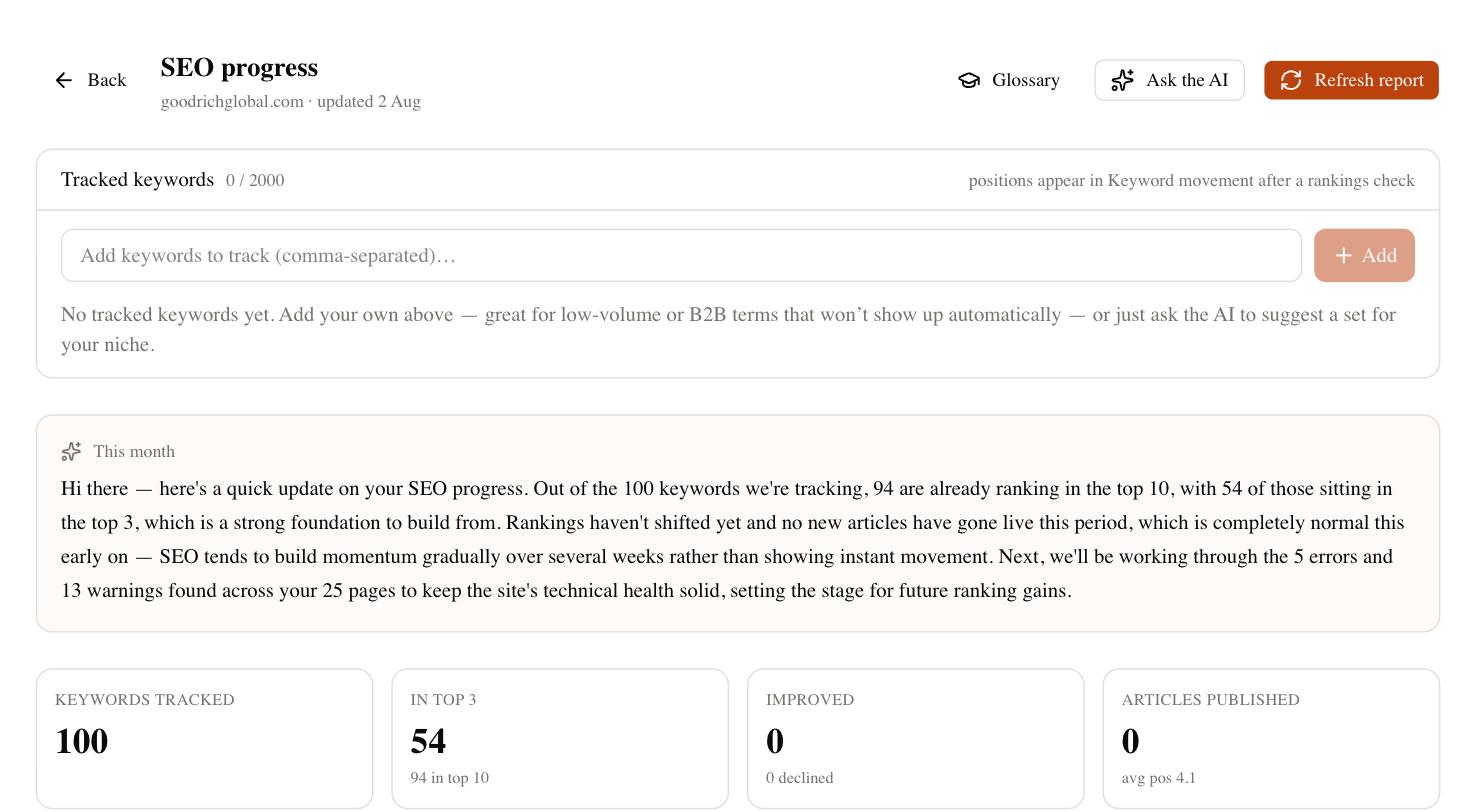
The client side is where it stops being a document and becomes a dashboard. Instead of exporting a PDF, you hand over a read-only, white-label view that stays current between reports, so the client can glance at their own numbers any day without emailing you. The written monthly report still matters — it carries the narrative and the plan — but the underlying data no longer lives in a spreadsheet only you can open.
Make the template yours and ship it
Start with the six-block structure, fill the snapshot table with your own numbers, and write the summary last. That alone puts you ahead of the reports most businesses currently receive, which are either too thin to trust or too dense to read. Keep the layout identical every month so clients learn where to look, and always close with a plan, not just a scoreboard.
The best report is the one you’ll actually send on time, every month, without dreading it. Whether you build it from this template by hand or let a tool assemble the data and draft the story, the discipline is the same: lead with outcomes, prove them with data, flag the risks honestly, and say what’s next. Do that twelve times a year and the report stops being a chore you justify your fee with — it becomes the reason clients stay.