Knowing how to vet a domain before buying is the difference between inheriting a head start and inheriting someone else’s problem. A domain with real history can carry authority, backlinks, and traffic that would take you a year to build from scratch — but the same domain can just as easily hide a Google penalty, a spam-ridden link profile, or a traffic chart that fell off a cliff and never recovered.
The good news is that vetting is a repeatable process, not a gut call. The steps below are the exact checks you can run today, in order, before you send anyone a dollar. None of them require insider access — just the discipline to walk through each one and the honesty to walk away when the data says so.
Why vetting matters more than the price
Most bad domain purchases don’t fail because the buyer overpaid. They fail because the buyer bought a story — “this used to rank for thousands of keywords” — without checking whether that story ended well. A domain that ranked in 2019 and has been dead since 2021 is not an aged authority site; it’s an expired shell, and Google often treats a long-dormant domain as if it were brand new the moment you rebuild it.
The real cost of skipping the vet is time. You can lose the purchase price and shrug, but losing six months building on a poisoned foundation before you discover the penalty is the expensive mistake. Vetting front-loads that risk into an afternoon of research.
There’s a second reason to slow down: sellers know what buyers want to hear. Domain marketplaces are full of listings that lead with a big backlink count or a peak-traffic screenshot from three years ago, because those numbers move product. Your job is to test every claim against independent data rather than the seller’s dashboard. Assume nothing in the listing is a lie and nothing in it is the whole truth — both are usually right.
The 7 steps to vet a domain before buying
Work through these in order. Each one can end the process — if a domain fails an early step badly, you don’t need to finish the list. The sequence matters because the cheap checks come first: you rule out the obvious disasters in minutes before spending real effort on the deeper analysis a promising domain deserves.
- Check the ownership and registration history. Pull the WHOIS record and the drop history. A domain that has changed hands five times in three years, or cycled through privacy shields and different registrars, is a warning sign. Steady, long-term ownership is what you want.
- Read the traffic history, not the traffic today. A single current number tells you nothing. Look at the multi-year organic traffic curve. Healthy domains show gradual growth or stability; a cliff that drops 80% in one month almost always marks a Google update the site never recovered from.
- Audit the backlink profile. Volume is a vanity metric. What matters is quality: are the referring domains real, topically relevant sites, or a farm of casino, pharma, and foreign-language spam links pointed at the domain to manipulate it? A clean profile of a few hundred honest links beats tens of thousands of toxic ones.
- Review the archived pages. Use the Wayback Machine to see what the site actually published over its life. If it was a legitimate blog in your niche, great. If it flipped to pills, loans, or gambling at some point — or was parked and stuffed with ads — that history can follow the domain.
- Look for manual and algorithmic penalties. A brand name that no longer ranks for itself is the clearest tell. Search the domain’s own name; if a site with real history can’t rank for its exact brand, something is suppressing it. Cross-reference the traffic cliff against known algorithm update dates.
- Confirm the anchor text and relevance fit. Even clean links lose value if they point at a topic you’re abandoning. A domain whose backlinks are all about kitchen appliances is a poor foundation for a finance site. The closer the historical topic is to your plan, the more of the authority transfers.
- Value it against what it can realistically earn. Only after the first six checks pass do you talk price. Base your number on defensible traffic and links, not on the seller’s projection. If the honest data supports a fraction of the asking price, that gap is your negotiating room — or your exit.
Doing the heavy lifting with SEO Rocket
Running those seven checks by hand means bouncing between a WHOIS lookup, a backlink tool, an archive site, and a spreadsheet. SEO Rocket’s Buy & Sell Domains feature collapses that into one view: you paste a domain and it pulls the traffic history, the referring-domain quality, the topical profile, and an acquisition verdict on the same screen, using the same Ahrefs-grade data the rest of the platform runs on.
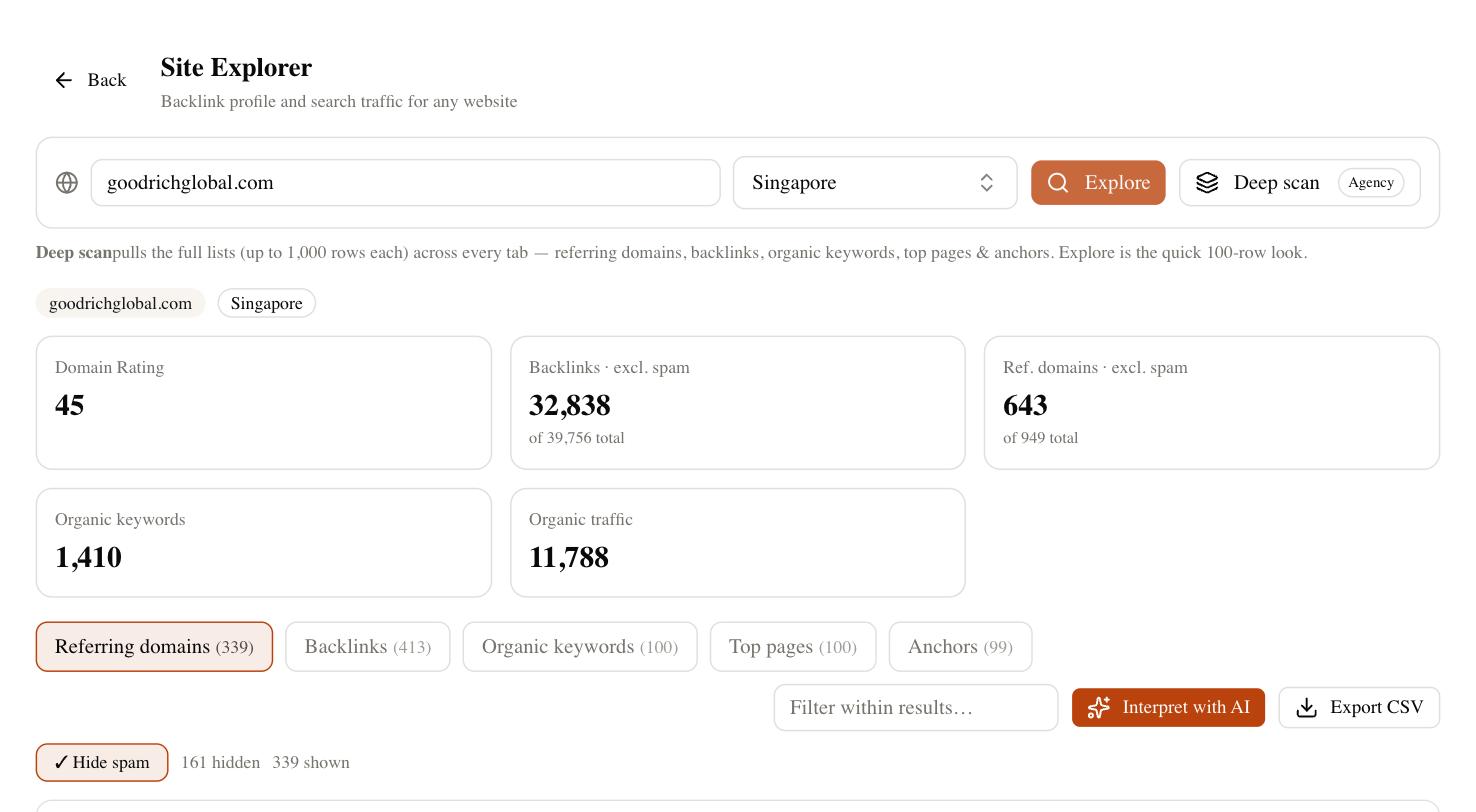
What that saves you is not the judgment — you still decide — but the assembly. The multi-year traffic chart is right next to the link breakdown, so a cliff and a spam-link spike that happened in the same month are impossible to miss. The cost-to-rank estimate then tells you roughly what building the equivalent authority from a fresh domain would take, which is the number that actually justifies (or kills) a price. It’s a research accelerator, not a crystal ball; treat its verdict as a strong opinion to pressure-test, not a guarantee.
The other advantage of pulling everything from one dataset is consistency. When you check backlinks in one tool, traffic in another, and history in a third, you spend half your time reconciling numbers that never quite agree, because every provider models the web differently. Third-party estimates are directional at best, and comparing across tools multiplies the noise. Running each check against a single index won’t make the estimates perfect, but it does mean the traffic figure and the link figure are telling the same story — so when they disagree, that disagreement is a real signal about the domain rather than an artifact of two vendors measuring differently.
Red flags that should stop a purchase
Some findings are dealbreakers regardless of how attractive the rest of the domain looks. Learn to spot them fast, because the more appealing a domain is on the surface, the more tempting it becomes to rationalize a problem away. A great name at a bargain price is exactly the situation where discipline pays off.
- A traffic graph that drops sharply and stays flat — recovery from a core update can take many months and is never guaranteed.
- A backlink profile dominated by irrelevant, foreign-language, or obviously paid links.
- An archive history showing the domain was used for spam, adult, or gambling content.
- Inability to rank for its own brand name, which points to an unresolved penalty.
- A seller who won’t share analytics access or gets vague when you ask about the traffic decline.
A quick vetting checklist
| Check | What good looks like | Walk away if |
|---|---|---|
| Ownership history | Long, stable ownership | Frequent flips between owners |
| Traffic curve | Steady or growing | A cliff with no recovery |
| Backlinks | Relevant, real referring domains | Spam and paid link farms |
| Archived content | On-topic, legitimate pages | Pills, loans, or gambling history |
| Penalty signals | Ranks for its own brand | Invisible for its exact name |
Be honest about timelines and limits
Even a domain that passes every check is not a shortcut to instant rankings. When you point old authority at new content, expect a settling period of several weeks to a few months while Google re-evaluates the site under your ownership. Authority transfers, but relevance has to be re-earned with content that matches the links you inherited.
Budget for the rebuild, not just the purchase. An aged domain with clean links is a foundation, and a foundation still needs a house on it. You’ll need content that serves the topics those links point at, some technical cleanup if the previous owner left a mess, and the patience to let Google re-crawl and re-rank everything. Buyers who treat the acquisition price as the whole investment are usually the ones disappointed a quarter later, wondering why an “authority domain” isn’t ranking on its own.
Understand what vetting can and can’t promise, too. These checks reliably screen out the obvious disasters — penalties, spam, dead traffic — but no tool can see the full private history a registrar and Google hold internally. Vetting dramatically lowers your risk; it never zeroes it. The goal is to make an informed bet with the odds on your side, and to keep the price low enough that even a surprise won’t sink you.
The bottom line
Learning how to vet a domain before buying comes down to trusting the data over the sales pitch. Run the seven steps in order, treat any single red flag as a reason to dig deeper rather than a detail to explain away, and price the domain on what it can defensibly earn — not on what it once did. Do that consistently and you’ll pass on ninety percent of the domains you look at, which is exactly the point. The few that clear every check are the ones worth owning.