
Most people asking how to price SEO services already have a number in their head and they’re quietly worried it’s wrong. That worry is healthy. Price too low and you’ll resent the client by month three; price too high without being able to explain the number and you lose the deal before the work starts. The good news is that how to price SEO services is a solvable problem — it’s a costing exercise dressed up as a confidence problem, and once you build the number from the bottom up, quoting stops feeling like a guess.
This guide gives you a concrete method you can run today. No formulas that only work in theory, no “charge what you’re worth” pep talk. Just the steps, the rate bands people actually pay, and where a tool can shorten the parts that eat your evening.
Why pricing SEO honestly is hard
SEO resists tidy pricing for one simple reason: the work is uncertain and the results are delayed. You’re selling an outcome that depends on Google, on competitors you don’t control, and on a site you often didn’t build. A plumber can quote a job because the pipe is the pipe. Your “pipe” is a moving ranking algorithm and a competitor who might publish forty pages next quarter.
That uncertainty pushes new consultants toward the worst possible move: pricing on gut feel, then discounting the moment a prospect hesitates. The fix isn’t charisma. It’s separating the two questions you’re actually answering — what will this cost me to deliver, and what is it worth to the client — and never letting the second one drift below the first.
The main SEO pricing models
Before you land on a number, pick the shape of the deal. Most work fits one of four models, and the right one depends on scope certainty and the client’s appetite.
- Monthly retainer — a fixed fee for an ongoing scope. The default for most agencies and consultants because it matches how SEO actually works: continuous, compounding, never “done.”
- Project or fixed fee — a defined deliverable like a technical audit, a migration, or a content batch. Great when scope is genuinely bounded and you can name what “finished” looks like.
- Hourly or day rate — best for advisory, one-off consults, or ad-hoc work where you can’t predict the volume. Simple to bill, but it caps your income at your calendar.
- Performance or hybrid — a base fee plus a bonus tied to rankings, traffic, or revenue. Tempting, risky, and only sane once you know the site can move and you trust the tracking.
Retainers win for most people because they smooth cash flow and reward the compounding nature of the work. Keep hourly for the edges. Treat pure performance deals with caution until you’ve delivered enough to know your own hit rate.
How to price your SEO services, step by step
Here is the method. Work through it in order — the sequence matters, because each step feeds the next and skipping the early ones is how people end up quoting a number they can’t defend.
- Scope the actual work. List every deliverable for one month: audit hours, content pieces, links, reporting, calls. Vague scope is the single biggest cause of unprofitable retainers.
- Estimate hours honestly. Put a realistic hour count against each deliverable, then add 20% for the admin, revisions, and “quick questions” that always appear.
- Set your true cost floor. Add your hourly cost, subcontractor fees, and tool subscriptions. This is the number you must never price below.
- Gauge the client’s ceiling. What is a ranking position worth to them? A page-one result for a high-intent commercial term can be worth thousands a month in revenue — that’s your headroom.
- Check the difficulty of the goal. Pull the target keywords and see how competitive they really are before you promise anything. Hard markets need more months and more budget, and your price should say so.
- Pick the model and set the price. Land between your cost floor and the client’s ceiling, choose retainer or project, and round to a clean, confident number.
- Write it down. Put scope, price, timeline, and what’s explicitly excluded in one document. The exclusions protect your margin more than the price does.
Step five is where most consultants either overpromise or undercharge, because judging keyword difficulty by eye is genuinely hard. This is the job SEO Rocket’s cost-to-rank feature does directly: you ask it what it would take to rank for a set of terms, and it estimates the content and links required against real, Ahrefs-grade competitive data. That turns “this feels competitive” into a defensible input for your quote — and it’s the difference between a price you hope covers the work and one you know does.
What real SEO rates look like
Numbers help, so here are honest bands rather than a single figure. Monthly retainers for small-business SEO commonly run from the high hundreds into the low thousands, with established agencies serving competitive niches charging several thousand and up. Freelance hourly rates cluster in a wide range depending on experience and market, and one-off technical audits are often priced as fixed projects rather than by the hour.
Treat those as reference points, not rules. Your local market, your niche’s competitiveness, and your track record move the number more than any benchmark table. A consultant in an expensive city serving legal or finance clients works in a different world than someone doing local SEO for tradespeople, and both can be right. The point of knowing the bands is to catch yourself when you drift far below them for no good reason, and to notice when a prospect’s budget simply can’t fund the outcome they’re asking for. When the gap is that wide, the honest move is to shrink the scope to what the budget buys, not to promise the full result at half the price and quietly absorb the loss.
Turning the number into a quote
A price is only half the sale — the other half is how you present it. Clients don’t buy hours; they buy outcomes and the confidence that you’ll deliver them. So frame the quote around what changes for their business, then let the scope justify the fee underneath. Lead with the goal, show the work that gets there, and put the number last.
Delivery matters here too, because a client who can see progress renews without a fight. This is where SEO Rocket’s client dashboards earn their place: instead of exporting screenshots into a slide deck every month, you hand the client a read-only, white-label report that shows rankings and progress in your branding. It quietly reinforces the price by making the work visible.
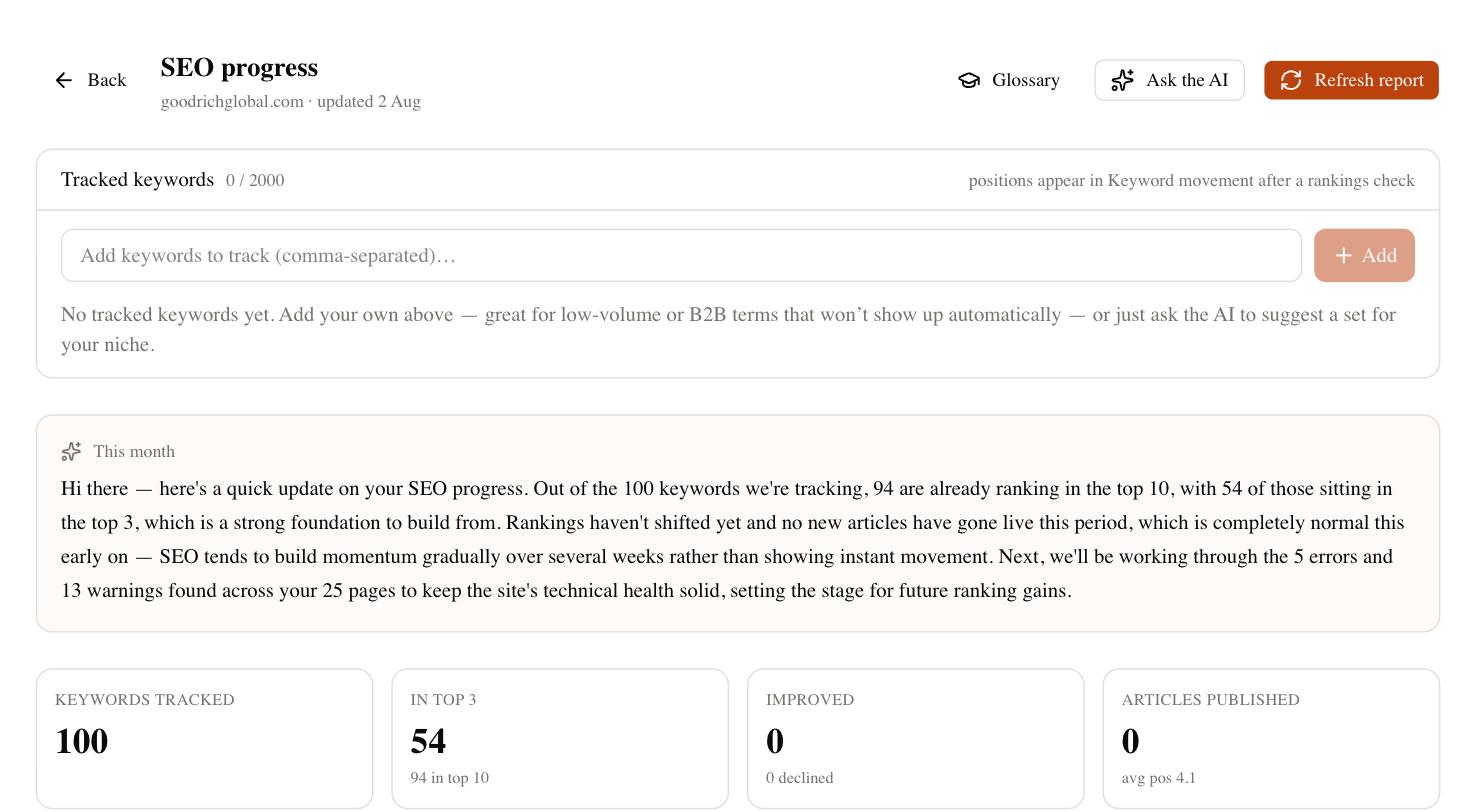
The reporting isn’t a cost center; it’s part of what you’re charging for. A retainer with no visible output feels expensive by month four no matter how good the rankings are, and a clear monthly report is the cheapest retention tool you have.
Be honest about timelines and limits
Whatever you charge, set expectations that match reality or the best price in the world won’t survive contact with results. SEO rarely shows meaningful movement before three to six months, and competitive terms can take a year. Rankings jitter a few positions day to day, so no single screenshot proves anything — trends over weeks do. And links are necessary but not sufficient: a well-linked thin page still loses to better content.
Say all of this before the client signs, not after month two when they ask why they’re not number one yet. Pricing built on honest timelines holds. Pricing built on an implied overnight win collapses the first time reality shows up, and it takes your reputation with it.
A simple pricing checklist
Run every deal through this before you send the quote. If you can’t tick all five, you’re guessing, and a guess is how unprofitable retainers get signed.
| Check | Why it protects you |
|---|---|
| Scope is written and bounded | Stops the slow creep that erodes margin |
| Price sits above your cost floor | Guarantees the work is actually profitable |
| Keyword difficulty is verified | Prices the real effort, not the hoped-for effort |
| Timeline is stated in months | Sets expectations that survive slow early results |
| Reporting cadence is agreed | Makes the value visible so the client renews |
Pricing SEO well isn’t about being the cheapest or the most expensive option in the inbox. It’s about building a number you can explain line by line, tying it to a goal the client cares about, and being straight about how long it takes. Do that consistently and pricing stops being the scary part of the job — it becomes the part where you sound like the professional you are.