Knowing how to track brand mentions is the difference between finding out a frustrated customer posted about you three weeks late and replying the same afternoon. The good news is that how to track brand mentions is not a hard problem to solve — most of a working setup takes about an hour, and you can start for free before you pay for anything.
This guide walks through the exact steps in order, names the tools that do each job, and is honest about what monitoring can and cannot catch. By the end you will have a system that watches the open web, social platforms, and — the part almost everyone misses — AI search engines like ChatGPT and Perplexity.
What actually counts as a brand mention
A mention is any time your brand is named, whether or not anyone links to you. That last part matters, because most tracking tools were built to find backlinks and quietly ignore the mentions that never link at all — which is the majority of them. A useful monitoring setup casts wider than that.
- Linked mentions — a blog or news site names you and links back. These help SEO directly and are the easiest to find.
- Unlinked mentions — a forum, review, or article names you with no link. These are reputation signals and often link-building opportunities.
- Social mentions — posts, comments, and threads on platforms where people tag you, spell your name, or don’t quite spell it right.
- AI-answer citations — the newest category: whether ChatGPT, Google’s AI Overviews, or Perplexity name you when someone asks a buying question in your space.
Decide up front which of these you care about. A local service business mostly wants review and social mentions. A software company selling to a national market needs all four, because a single unanswered thread or a competitor-only AI answer can quietly cost deals for months.
How to track brand mentions in seven steps
Work through these in order. Each step stands on its own, so you can stop after the free ones and still have real coverage.
- List every version of your name. Include the legal name, the trading name, common misspellings, your main product names, and your founder’s name if they’re public. Monitoring only catches what you tell it to watch.
- Set up Google Alerts for the web. It’s free, takes five minutes, and emails you when your terms appear on pages Google has crawled. It misses a lot — social platforms, closed forums, anything crawled slowly — but as a baseline it costs nothing.
- Add social listening. Native search on each platform catches tagged posts; a dedicated social tool catches the untagged ones where someone typed your name without the @. This is where most real-time reputation issues surface first.
- Search your own name manually, once. Run your brand through Google, Reddit, and a couple of review sites by hand before you automate anything. You’ll find months of existing mentions no alert will ever email you about, because they were published before you started watching.
- Track unlinked mentions for link reclamation. Every time a site names you without linking, that’s a polite email away from a backlink. Pull these into a list and work through them — it’s one of the highest-conversion link-building tactics there is.
- Monitor AI search visibility. Ask the questions your buyers ask across ChatGPT, Perplexity, and Google’s AI Overviews, and record whether you’re cited. Doing this by hand is tedious and inconsistent, which is exactly why a dedicated tracker earns its place here.
- Set a response routine. A mention you never act on is just a notification. Decide who replies, how fast, and what a “respond, ignore, or reclaim” call looks like, and the whole system starts paying for itself.
None of these steps costs much on its own. The real cost is attention: a term list you forget to open is worse than no list, because it lends false comfort. Build the smallest version that covers your actual surfaces, run it for two weeks, then widen it only where you keep missing things. Most brands over-configure on day one and quietly abandon the whole setup by the third week, so err on the side of fewer terms you’ll actually read.
Where SEO Rocket’s Brand Radar fits
Steps two through four are easy to cover with free tools. The two that most setups leave uncovered are AI-answer citations and unlinked mentions at scale, and that’s the gap SEO Rocket’s AI Visibility feature — Brand Radar — is built for. Instead of you pasting the same question into three chatbots every week, it runs your prompts across the major AI surfaces and reports back where your brand shows up and where a competitor got named instead.
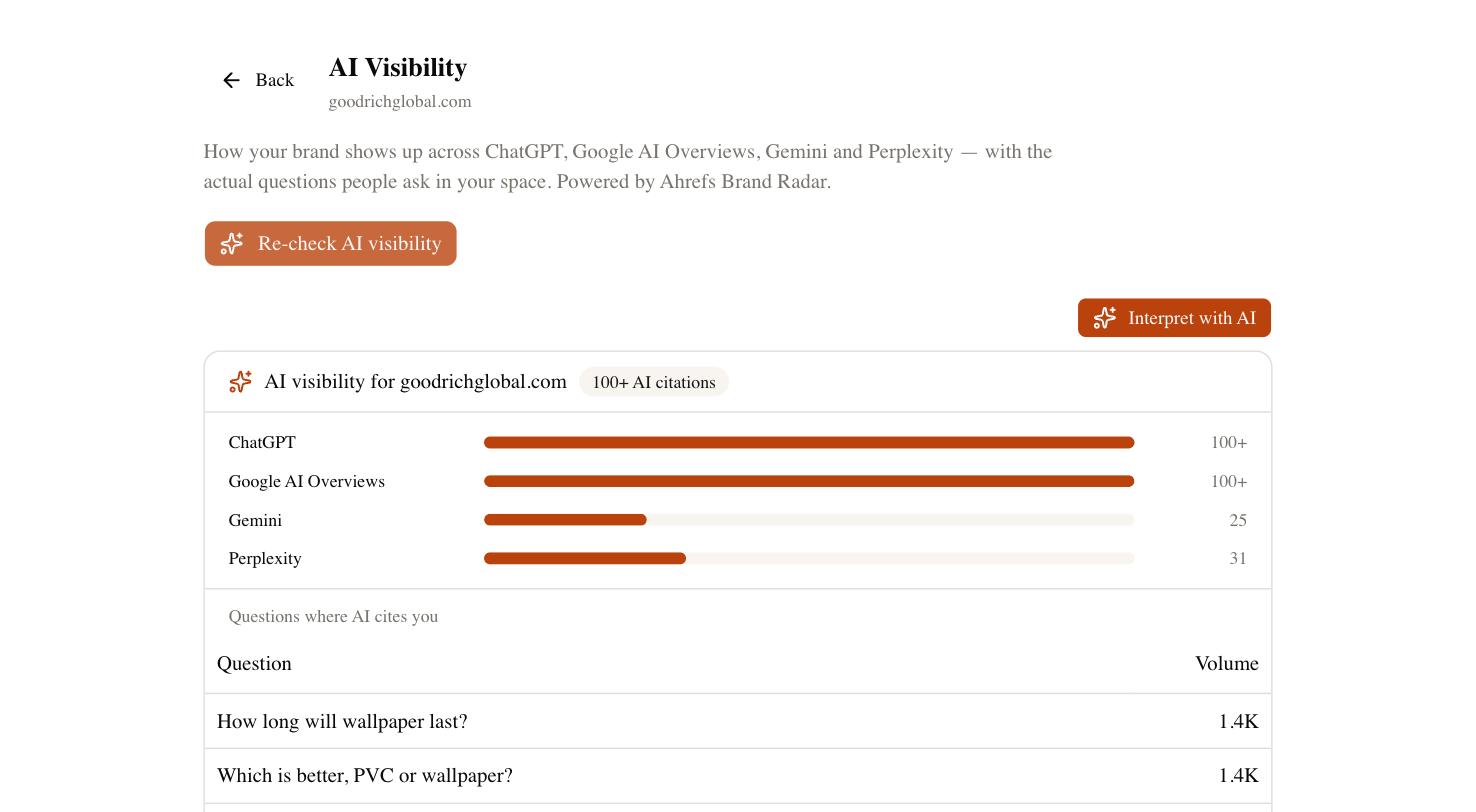
Because it sits alongside SEO Rocket’s Ahrefs-grade backlink data, the same account also surfaces linked and unlinked web mentions, so link reclamation stops being a manual scavenger hunt. You ask in plain language — “who’s being cited for our category in AI search” or “which sites mention us without linking” — and the answer comes back with the sources attached. It won’t replace a dedicated social listening tool for real-time platform chatter, and it’s fair to say Google Alerts is still the cheapest way to cover slow-moving web pages. The point of Brand Radar is the piece traditional monitoring simply doesn’t answer: whether the AI engines your buyers now ask are recommending you at all.
There’s a practical reason to keep this in one place rather than five. Every extra login is a monitoring task you’ll skip when the week gets busy, and skipped monitoring is the same as no monitoring. Folding AI-visibility and web mentions into the tool you already open for keyword and rank data means the checks happen as part of work you were doing anyway, instead of a separate chore that slides down the list until you stop doing it entirely.
Free tools versus paid monitoring
You don’t need to spend anything to start, and you shouldn’t until the free stack shows you where it falls short. Here’s the honest split.
Free tools — Google Alerts, native platform search, and manual checks — cover the basics well enough for a small brand with a handful of mentions a week. The moment you’re getting more mentions than you can read, or you need to prove reputation trends to a client, or you want AI-search coverage, you’ve outgrown them. Paid monitoring earns its keep on volume, history, and the sources free tools can’t reach — closed forums, review aggregators, and AI answers.
A reasonable rule of thumb: stay free until a missed mention actually costs you something. The first time a customer complaint sits unanswered for a week, or a prospect tells you a competitor came up in their AI search and you didn’t, you have your business case for paying. Until then, the free layer plus a disciplined weekly review beats an expensive dashboard nobody logs into. Spend on tools when your volume outgrows your patience, not before.
- Google Alerts — free, decent web coverage, weak on social and slow to fire. Start here.
- Dedicated social listening tools — mid-range monthly pricing; strong real-time social coverage, sentiment scoring, and history.
- SEO platforms with mention tracking — pay for the SEO data and get web mentions plus AI-visibility in the same login, which removes a second subscription.
How often to check, and what’s realistic
Set expectations before you set alerts. No monitoring tool catches everything — private groups, ephemeral stories, and the exact moment a page publishes will always slip through, and any tool claiming total coverage is overselling. What you’re building is strong, timely sampling, not a perfect net.
For most brands, a daily glance at social alerts and a weekly review of web and AI mentions is the right cadence. Reputation issues need same-day attention; link reclamation and AI-visibility trends move slowly enough that weekly is plenty. AI-search citations in particular change gradually — you might not see your position shift for weeks, so checking hourly only breeds anxiety. Give any new setup a full month before you judge whether it’s catching what matters, and expect the first weeks to surface a backlog of older mentions rather than a clean real-time feed.
A simple weekly monitoring checklist
Once your tools are running, the routine is what keeps them useful. Keep it this light and you’ll actually stick to it.
| Cadence | Task | Tool |
|---|---|---|
| Daily | Scan social alerts, reply to anything urgent | Social listening / native search |
| Weekly | Review new web mentions, log unlinked ones | Google Alerts / SEO platform |
| Weekly | Check AI-search citations for your top buying questions | SEO Rocket Brand Radar |
| Monthly | Send reclamation emails, note sentiment trend | Your outreach list |
Notice what’s deliberately missing from that table: hourly refreshes, dozens of near-identical keyword variants, and sentiment charts you’ll never actually present to anyone. Coverage you sustain beats coverage that’s technically thorough but abandoned by month two. If a task doesn’t change a decision you’d make — a reply you’d send, an email you’d write, a page you’d fix — cut it. The checklist should map to actions, not to vanity metrics that only exist to fill a report.
The system that survives is the one you can run in fifteen minutes, so resist the urge to track forty keyword variations you’ll never read. Start with the free layer today, add social listening when the volume demands it, and bring in AI-visibility tracking once you realize your buyers are asking a chatbot the question you used to win on Google. Do that, and you’ll never again find out about a problem — or a missed opportunity — three weeks after everyone else did.