
Most advice on how to optimize content for SEO stops at “add your keyword and write 1,500 words,” which is why so many pages that follow it still never rank. Optimizing content is really about matching what a searcher wants, structuring the page so both people and crawlers can read it, and earning enough trust signals that Google is willing to test you on page one. This guide walks you through the exact steps you can do today, names the one tool inside SEO Rocket that handles the heavy lifting, and stays honest about how long any of this actually takes.
You do not need a big budget or a technical background to start. You do need a repeatable process, because how to optimize content for SEO is less about a single trick and more about doing a handful of unglamorous things well, every time. Here is that process.
Start with search intent, not the keyword
Before you write a word, open the search result you are targeting and read the top five pages. Notice what type of content Google is already rewarding — is it a listicle, a how-to, a comparison, a product page? That format is your brief. If every result is a step-by-step guide and you publish a 400-word opinion piece, you have lost before you started, no matter how good the writing is.
Intent falls into a few buckets: someone wants to learn, to compare options, to buy, or to reach a specific page. Your content has to serve the dominant intent behind the query. The fastest way to get this wrong is to write the article you want to write instead of the one the search results are telling you they want. Read the page-one titles, note the subtopics they all cover, and treat those shared subtopics as the minimum bar you have to clear.
Do keyword research that maps to real questions
Once you know the intent, you need the words real people type. A primary keyword anchors the page, but the pages that hold rankings tend to cover a cluster of related terms and the questions that orbit them. Pull search volume and difficulty so you are not chasing a term three years out of reach, then collect the “people also ask” style questions that belong in your subheadings.
Be realistic about difficulty. A brand-new site should target the weakest page-one competitor, not the strongest — if the lowest-ranked result on page one is a thin, dated post from a site no bigger than yours, that is your opening. Chasing a keyword defended by five enterprise domains with thousands of backlinks is a slow way to learn patience. Sort your list by winnable first, ambitious later.
The step-by-step: how to optimize a page
Here is the core sequence. Work through it in order for any page you publish or refresh.
- Set one primary keyword per page. Two pages targeting the same term compete with each other. One page, one job.
- Put the keyword in the title, first 100 words, and one H2. Naturally — you are signaling relevance, not stuffing. If it reads awkwardly out loud, rewrite it.
- Match the format the SERP rewards. Guide, list, or comparison — build the structure you saw ranking, then do it more thoroughly.
- Cover the subtopics competitors share. These are the questions Google expects the topic to answer. Missing them signals a thin page.
- Write a compelling title tag and meta description. These are your ad in the results. A clear promise lifts click-through, and clicks matter.
- Add internal links to and from related pages. This passes authority and helps crawlers understand how your content connects.
- Optimize images. Compress them, add descriptive alt text, and use real file names — a slow page loses rankings and readers.
- Answer the query in the first screen. Give the direct answer near the top, then expand. Do not bury the payoff under 600 words of throat-clearing.
None of these steps is exotic, and that is the point. Ranking pages are usually the ones where someone did all eight rather than three. The discipline is doing them consistently, not discovering a secret.
Structure the page so it is easy to read
On-page structure does double duty: it helps readers scan and it helps search engines understand your hierarchy. Use one H1 for the title, descriptive H2s for each major section, and short paragraphs — two to four sentences — so the page never turns into a wall of text on a phone. Most of your traffic will read on mobile, and a dense page loses them in seconds.
Front-load value in every section. Lead with the answer, then support it. Use bullet lists for steps and specs, bold sparingly to guide the eye, and add a short summary table or checklist when it genuinely helps someone decide. Format is not decoration; it is how quickly a skimming reader finds what they came for, and that dwell time feeds back into how the page performs.
Where SEO Rocket fits into this
Doing all of the above by hand — reading the SERP, gathering keywords and difficulty, mapping subtopics, drafting to the right structure — is a real afternoon of work per article. SEO Rocket’s Content Generator collapses that into a chat. You tell it the topic and target keyword, and it pulls the real ranking data underneath (the same Ahrefs-grade metrics its research tools use), studies what already ranks, and drafts a piece with the title, meta description, and heading structure already mapped to the intent it found.
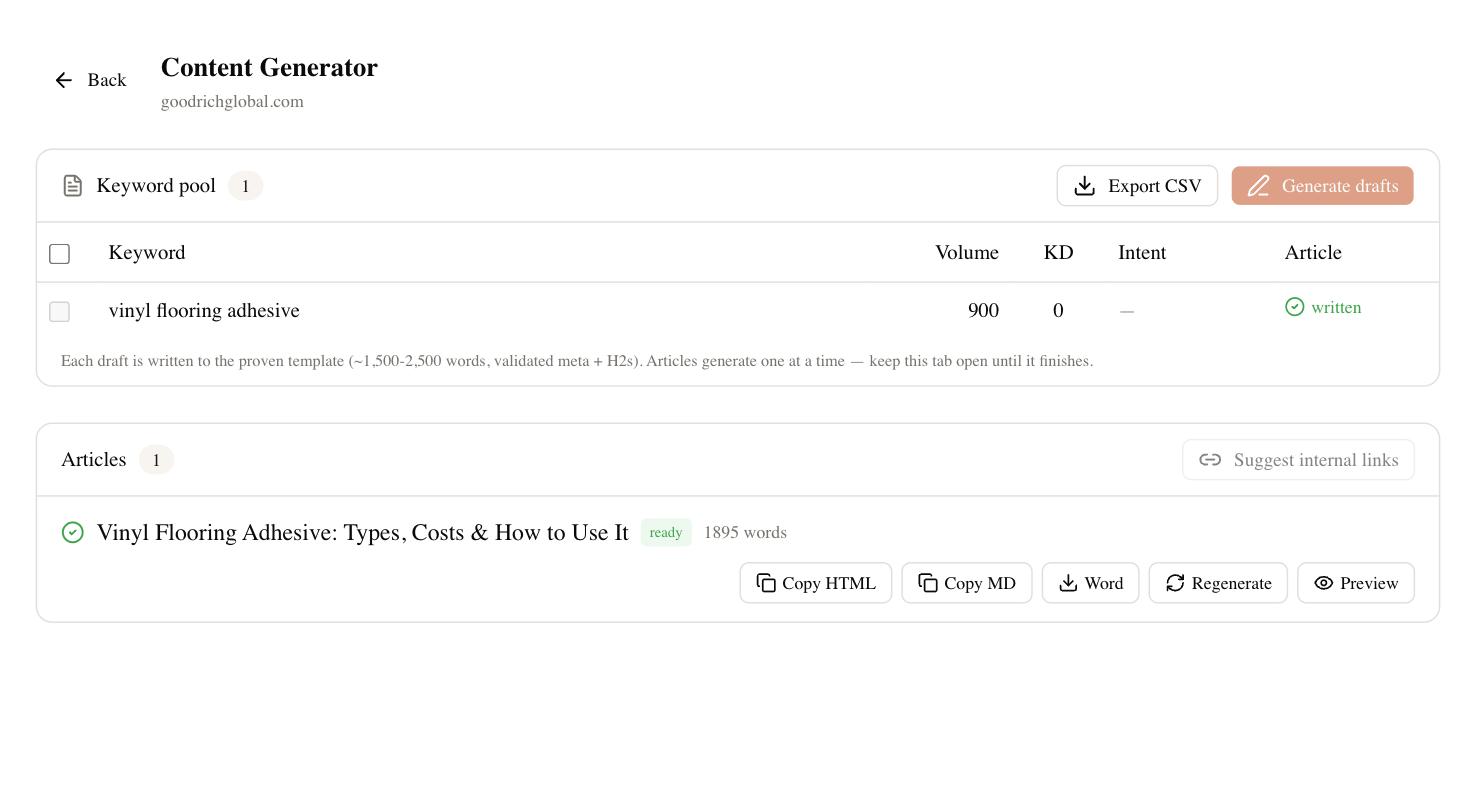
The honest framing matters here: the tool gets you a strong, structured first draft grounded in live search data, not a finished article you should publish blind. You still bring the judgment — your product knowledge, your examples, the claim only you can make. What it removes is the blank page and the hour of manual SERP analysis, so the work shifts from assembling raw material to sharpening a draft. For a solo SEO or a small agency running several client sites, that is the difference between publishing weekly and publishing when you find the time.
Be honest about timelines and limits
Optimized content is necessary but not sufficient, and anyone who tells you otherwise is selling something. A well-optimized page on a new or low-authority site can take three to six months to reach page one, and sometimes longer for competitive terms. Rankings also jitter a few positions day to day for reasons no tool fully explains, so judge a page over weeks, not on Tuesday’s snapshot. If you rewrite something today, give Google time to recrawl and re-evaluate before deciding it did not work.
Optimization also cannot rescue content nobody wants to read. If the underlying piece is thin, derivative, or wrong, no amount of keyword placement or internal linking will hold a top spot once real users start bouncing. Links, technical health, and site authority all still matter alongside the words on the page. Treat on-page optimization as the part you fully control — get it right every time, and let the compounding do its slow work.
A quick pre-publish checklist
Before you hit publish, run the page against this short list. If any line fails, fix it first — a five-minute check now saves a re-crawl wait later.
- Primary keyword in the title, first 100 words, and at least one H2
- Title tag under about 60 characters, meta description that earns the click
- Every subtopic the top results share is covered on your page
- The direct answer appears above the fold, not buried mid-article
- Short paragraphs, clear H2s, at least one internal link in and out
- Images compressed with descriptive alt text and file names
That is the whole discipline of how to optimize content for SEO: understand the intent, cover the topic thoroughly, structure it for humans, and be patient enough to let the ranking cycle play out. Do it consistently across a site and the results compound. Tools like SEO Rocket’s Content Generator shorten the grind, but the process above is what actually moves pages — with or without the software.