Most guides on how to find guest post opportunities hand you a list of Google search strings and stop there. That gets you names, but it doesn’t tell you which of those sites will pass real authority, which will ignore your pitch, and which will quietly harm you. The skill isn’t finding sites that accept guest posts — it’s finding the ones worth the hours you’ll spend writing for them.
This is a practical walkthrough you can start today. Knowing how to find guest post opportunities comes down to three moves: mining the sites that already link to your competitors, filtering that list down to real prospects, and vetting each one before you write a single word. Below is the exact order to do it in, with honest notes on what works, what wastes time, and how long it really takes.
What makes a guest post opportunity actually worth it
A good opportunity does two things at once: it puts your link in front of the right audience, and it passes authority from a page search engines already trust. Plenty of sites will happily publish you and do neither. A brand-new blog with no traffic, or a “write for us” farm that stitches together fifty unrelated posts a month, will take your article and give you nothing back that a search engine cares about.
The strongest prospects are sites in or adjacent to your niche that already rank for terms you care about, publish real editorial content, and link out sparingly rather than to everyone. You want relevance first, then authority, then reach. Get those three roughly right and a handful of placements will outperform fifty scattershot ones.
The step-by-step process
Here is the sequence I run for every campaign. Work through it in order — each step feeds the next, and skipping the middle ones is why most outreach lists convert at under two percent.
- List your real competitors. Not the household names — the sites ranking on page one for the exact terms you’re chasing. Those are the sites whose backlink profiles are worth copying, because they’ve already earned the links you need.
- Pull their backlinks. Export the referring domains for two or three competitors. Any domain that links to more than one of them is a site that publishes in your space and is willing to link out — the definition of a warm prospect.
- Run guest-post search operators. Layer classic footprints on top of your competitor list to catch sites that openly invite contributors (the strings are below).
- De-duplicate and filter. Merge both lists, drop anything you already have a link from, and cut the obvious junk — expired domains, pure directories, sites in the wrong language or country.
- Vet each survivor. Score the remaining sites on relevance, authority, and traffic before anyone writes anything. This is where most of your time should go.
- Find the right contact. Look for a named editor or the person who published recent guest content, not a generic “info@” address. Personalized pitches to the right human clear far higher than blast emails.
The whole point of running it in this order is that step two does most of the heavy lifting. Competitor backlinks hand you sites that have already said yes to someone like you, so you spend your vetting time on qualified names instead of cold-guessing from search results.
Search operators that still work
Search strings are the free, fast way to surface sites that publicly ask for contributors. They’re noisy, but a few minutes with them adds names your competitor data will miss. Swap “your topic” for your niche and work through these:
"your topic" + "write for us""your topic" + "guest post guidelines""your topic" + "contribute" + inurl:blog"your topic" + "become a contributor"intitle:"write for us" "your topic"
Two honest cautions. First, sites that shout “write for us” on a dedicated page are often the least selective ones — the same footprint that helps you find them helps everyone else, so those pages get spammed and the links they hand out are worth less. Treat them as a starting layer, not the prize. Second, operators only surface sites that advertise. The best placements usually don’t; you reach those by pitching a relevant editor an idea they never posted a form asking for.
Mining competitor backlinks with SEO Rocket
The competitor step is where a tool earns its keep, because doing it by hand means paging through hundreds of referring domains and eyeballing each one. In SEO Rocket you just ask, in plain language, for the backlink profile of a competitor’s domain, and it returns the referring domains with domain rating, the linking pages, and the anchor text — the same Ahrefs-grade view you’d normally open a separate tool for.
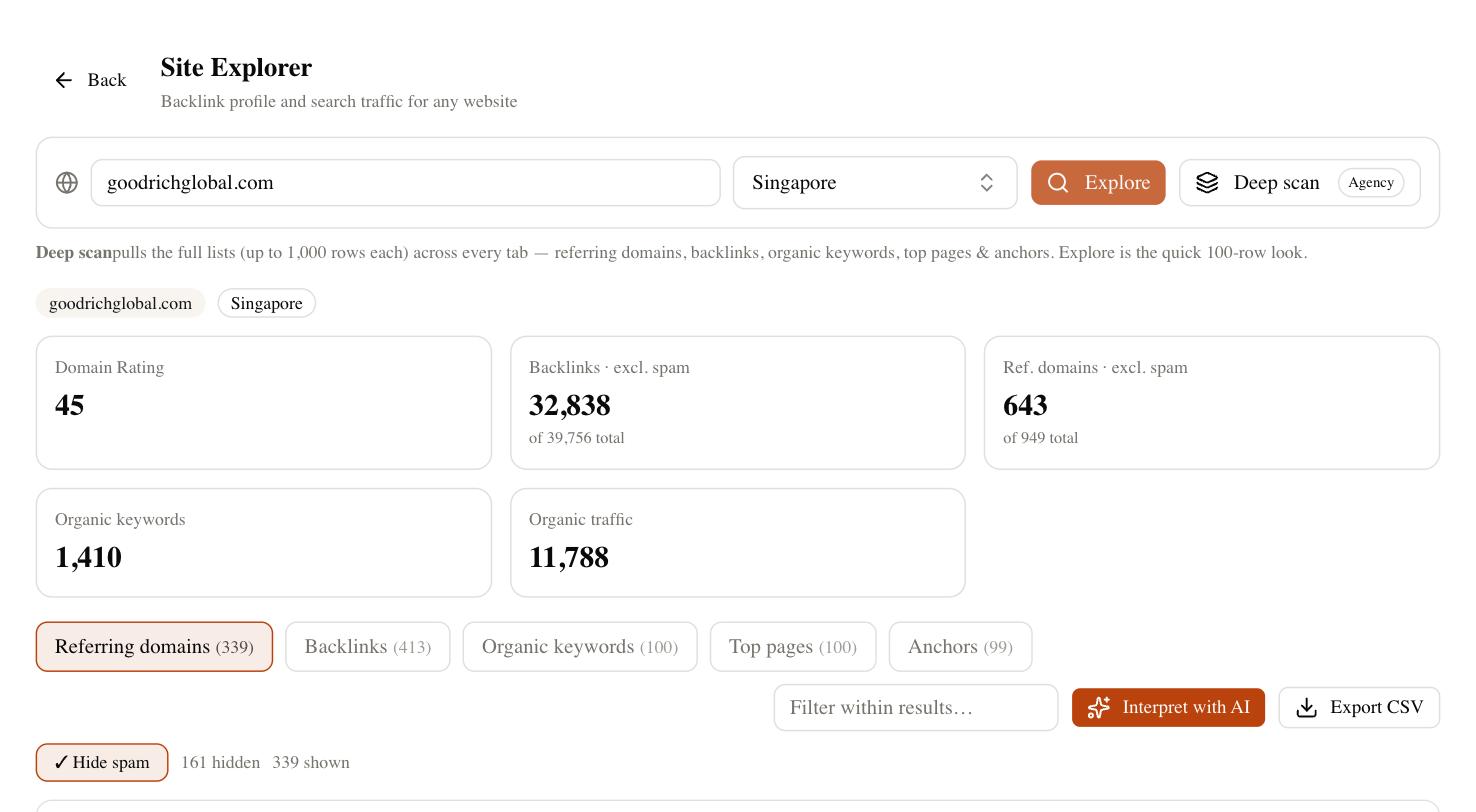
The move that saves the most time is the competitor gap: point it at two or three rivals at once and it surfaces the domains linking to them but not to you. That intersection is your shortlist. A site linking to two competitors in your niche almost certainly publishes relevant content and is open to linking out again — you’re not guessing whether they’d be receptive, you’re reading proof they already were.
Because it’s chat-first, you can keep narrowing without learning a dashboard: ask it to show only referring domains above a certain rating, or only ones with real organic traffic, and the noise drops away. That turns a raw export of hundreds into a working list of a few dozen qualified prospects in a single sitting, which is the difference between a campaign you start today and one you keep meaning to.
Vetting a site before you pitch
Never write a guest post for a site you haven’t checked. A placement on the wrong site is worse than no placement — at best it’s wasted effort, at worst it’s a link from a spammy neighborhood you’d rather not be associated with. Run every survivor through the same quick scorecard before you commit an afternoon to writing.
| Check | What you want to see | Walk away if |
|---|---|---|
| Relevance | Publishes on your topic or a close neighbor | Random mix of unrelated niches |
| Authority | Reasonable domain rating for your space | Rating inflated by spammy links |
| Real traffic | Ranks for keywords, gets organic visits | No traffic despite a high rating |
| Editorial quality | Original, edited articles | Thin posts, dozens of “guest authors” a month |
| Link behavior | Links out selectively, dofollow | Every post stuffed with paid-looking links |
Domain rating on its own is the metric people over-trust. A site can carry a high rating and pull almost no search traffic, which usually means the number was manufactured. Check that the site actually ranks for real keywords before you value its link — traffic is harder to fake than a rating, and it’s the honest signal that a placement will be seen by humans as well as crawlers.
How long this really takes
Set expectations before you start, because guest posting is a slow-burn tactic sold as a quick one. Building a solid prospect list of thirty to fifty vetted sites is a half-day of focused work the first time, faster once you’ve done it. Outreach reply rates sit in the low single digits to low teens even when your pitches are good, so plan on contacting far more sites than you’ll place on.
From a landed link, don’t expect movement for weeks. A new backlink needs to be crawled, and its effect shows up gradually as the linking page’s own authority passes through — figure a month or two before you can fairly judge whether a placement helped, and remember rankings drift a few positions day to day regardless. Guest posting compounds; a steady one or two quality placements a month beats a frantic burst you can’t sustain. Treat it as a habit, not a launch.
Turning this into a repeatable routine
The people who win at this aren’t running a clever one-off hack — they’ve turned prospecting into a weekly rhythm. Pull one competitor’s fresh backlinks, add a search-operator pass, vet the new names against the scorecard, and send a small batch of personalized pitches. Do that every week and your prospect list refills faster than you can work through it.
Knowing how to find guest post opportunities is really just knowing where the qualified names already sit — in the backlink profiles of the sites already beating you — and having a filter honest enough to ignore the ones that look good but pass nothing. Start with two competitors this afternoon, mine their referring domains, and cut the list to the ten sites you’d genuinely be proud to appear on. That short, sharp list will out-earn any thousand-row spreadsheet of “write for us” pages you could scrape.