
Learning how to find competitor keywords is one of the fastest ways to shortcut your own keyword research. Instead of guessing what your audience searches for, you borrow a map that competitors already paid to build — the terms they rank for, the pages that earn their traffic, and the gaps where they’ve missed. Done well, how to find competitor keywords becomes a repeatable hour of work that fills a content calendar for a quarter.
This guide walks through the exact steps, in order, that you can run today. No theory dumps — just a workflow you can copy, plus honest notes on where the data lies to you and how long any of it takes to pay off.
Step 1: Pick the right competitors, not the obvious ones
Your business rivals and your search rivals are rarely the same list. The brand you lose deals to might barely publish; meanwhile a niche blog or a marketplace you’ve never considered a competitor owns the search results for your money terms. Confuse the two and you’ll copy keywords that never convert.
The fix is to define competitors by overlap, not by reputation. Take three or four terms you already want to rank for, run each search, and note the domains that keep reappearing in the top ten. Those recurring sites are your true search competitors. Aim for a shortlist of three to five — enough to find patterns, few enough to stay focused. If a big publisher or an aggregator dominates every result, include one, but weight your list toward sites your own size; their keywords are the ones you can realistically take.
Step 2: Pull every keyword each competitor ranks for
Once you have your shortlist, the goal is a full export of the organic keywords each domain ranks for, along with the position they hold, the monthly search volume, and a difficulty score. Any credible SEO tool does this from a single domain input — you paste the competitor’s URL and it returns their organic footprint from its keyword index.
Two cautions here. First, these numbers are estimates: search volume and difficulty are modeled figures, not measurements from Google, so treat them as directional. Second, a big domain can rank for tens of thousands of terms, most of them irrelevant to you. Raw volume is noise until you filter it, which is the next and most important step.
Step 3: Filter down to keywords that actually matter
A 40,000-row export is useless until you cut it to the few hundred rows worth acting on. Apply filters in this order, and you’ll usually land on a workable list in a couple of minutes:
- Position — keep terms where the competitor ranks in positions 1 through 20. Anything below that they aren’t winning either, so it’s weaker evidence of a real opportunity.
- Difficulty — if your site is young, cap keyword difficulty low (roughly under 20) so you’re chasing pages you can realistically reach this year, not in three.
- Volume — set a modest floor, but don’t chase the biggest numbers. A cluster of 30 low-volume, high-intent terms often beats one 20,000-volume vanity keyword.
- Intent — scan the wording. “Best,” “vs,” “pricing,” and “how to” signal buyers and researchers; single generic nouns often signal browsers who never convert.
What survives all four filters is a list of terms a competitor is winning, that you can plausibly rank for, and that connect to something you sell. That’s the raw material worth building around.
Step 4: Find the gaps — what they rank for and you don’t
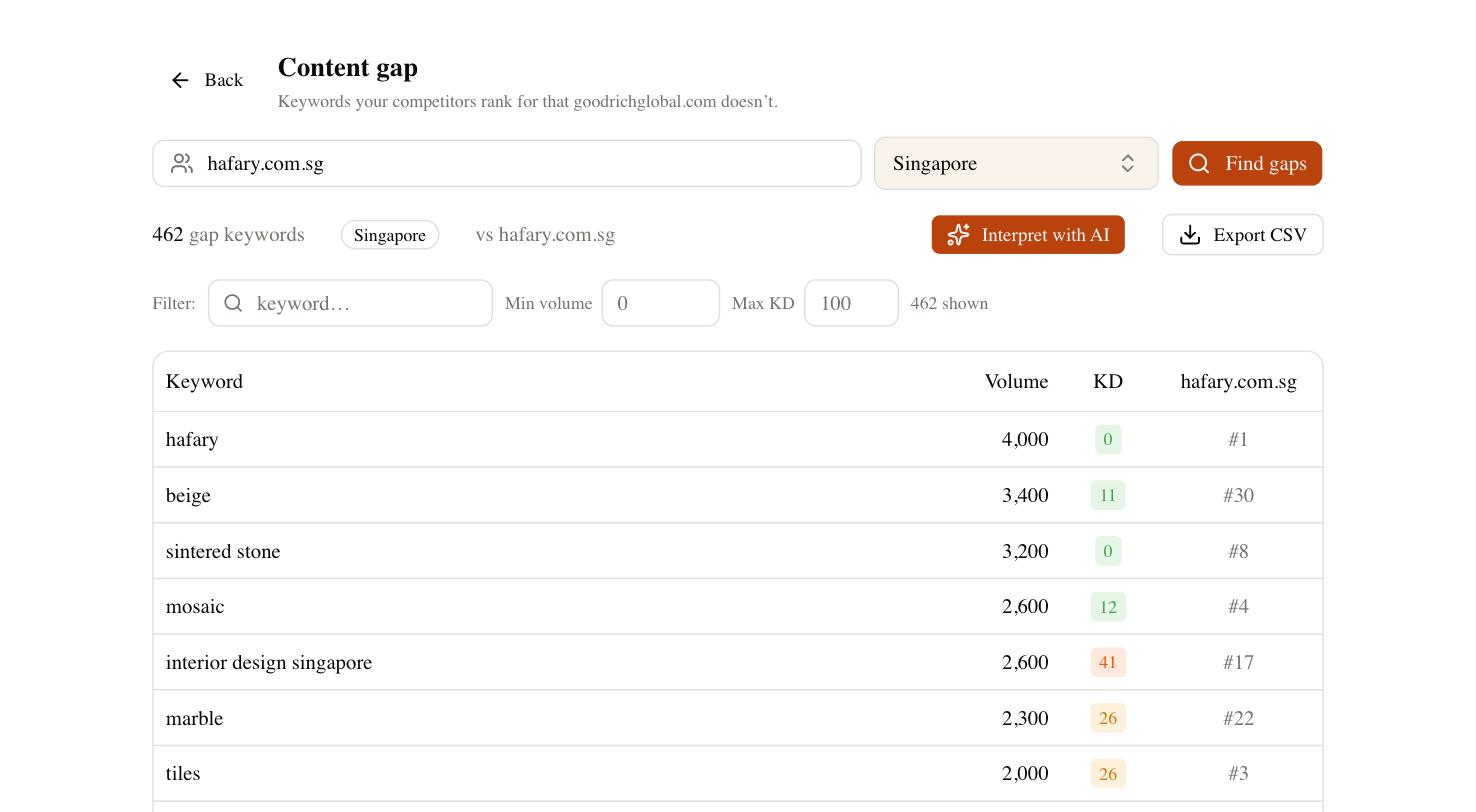
The single highest-value move in competitor research is isolating the keywords one or more rivals rank for that you don’t rank for at all. These gaps are proven demand with a proven playbook — someone has already shown the topic earns traffic — minus the competition of a term you already share. This is where a dedicated content-gap view earns its keep, because doing it by hand means exporting several spreadsheets and reconciling them by VLOOKUP.
In SEO Rocket, this is the Content Gap tool. You give it your domain and two or three competitors, and it returns the keywords they rank for that you’re missing, each row already carrying search volume and keyword difficulty so you can triage on the spot. Because the product is chat-first, you can just ask it to find the gaps between your site and a competitor and refine the list in plain language — “only show terms under KD 15 with buyer intent” — rather than wrestling filters in a table.
The honest limit: a content gap tells you what to write, not that writing it will work. A gap is a hypothesis, not a guarantee. Sometimes a competitor ranks for a term only because their whole domain is strong, and a fresh page of yours won’t inherit that authority for months. You still have to produce a page that genuinely deserves the ranking, and you still have to wait for it to earn one.
Step 5: Study the pages behind the keywords
A keyword is only half the intelligence. The other half is the page that ranks for it. Before you write anything, open the competitor URL that holds the position and read it the way a searcher would. What format is it — a listicle, a calculator, a long guide, a product page? How deep does it go? What questions does it answer that you’d have skipped?
This step is where “find competitor keywords” turns into a plan you can execute. You’re not trying to clone the page; you’re trying to understand why Google rewards it, then build something clearly more useful. If the top result is a thin 600-word post, your bar is low and the weakest page-one rival is beatable. If every result is a 3,000-word resource with original data, be honest with yourself about the effort that ranking will cost.
Step 6: Prioritize and turn the list into a plan
You’ll finish with more opportunities than you can act on, so ranking them matters more than finding more. A simple way to sort: score each keyword on business value, achievability, and effort, then work top-down. Group related terms into clusters — one strong page can rank for a dozen variations, so you rarely need one article per keyword.
Here’s a compact checklist to keep the whole workflow honest:
- Competitors chosen by search overlap, not brand reputation
- Full keyword export pulled for each, with position, volume, and difficulty
- List filtered by position, difficulty, volume, and intent
- Gaps isolated — what they rank for and you don’t
- Ranking pages read and out-planned before writing
- Opportunities clustered and prioritized by value versus effort
How long before this pays off?
The research itself takes an afternoon; the results take a season. A new page targeting a low-difficulty gap typically needs weeks to months to settle into a stable position, and it will bounce a few spots day to day the whole time — that jitter is normal and not a sign your work failed. Competitor keyword research doesn’t make ranking faster; it makes it likelier, because you’re aiming at demand you’ve confirmed rather than demand you hoped for.
Run the six steps once and you’ll see why it’s the highest-leverage hour in SEO. You end with a filtered, prioritized list of proven keywords, a read on how beatable each ranking page is, and a content plan built on evidence instead of instinct. Repeat it every quarter against the same rivals, and you’ll watch the gap list shrink as the pages you shipped start closing it.