
Learning how to estimate cost to rank is really just answering one blunt question before you spend a dollar: how much work, over how long, will it take to reach page one for this keyword — and is that worth it? Getting a defensible number ahead of time is what separates a plan from a hope, and the good news is you can build a rough estimate today with data you already have access to.
The method below is deliberately honest. There is no single formula that spits out a guaranteed price, because Google weighs dozens of signals and your competitors keep moving. What you can do is size the gap between you and the weakest page-one result, convert that gap into concrete tasks — links and content, mostly — and attach real costs and a realistic timeline. That is what a working estimate looks like.
What “cost to rank” actually includes
Cost to rank is the total investment needed to move a specific page to page one for a specific keyword. It is not just a link-building invoice. Three buckets make up almost every estimate: the content you need to produce or upgrade, the authority you need to earn (referring domains and links), and the time the whole thing takes to compound. Time is a cost even when no money changes hands, because a keyword that takes nine months ties up attention you could spend elsewhere.
People underestimate cost to rank when they price only the link outreach and forget that a thin page will not hold position no matter how many links point at it. They overestimate it when they benchmark against the strongest result on page one instead of the weakest. Both mistakes come from skipping the measurement step, which is exactly where this guide starts.
It helps to think in terms of a gap rather than an absolute. You do not need to match the whole market; you need to become slightly stronger than the softest page currently holding a spot you want. That reframing shrinks most estimates dramatically, because the difference between you and the weakest rival is almost always smaller than the difference between you and the category leader. Measure the gap, cost the gap, and you have your answer.
The step-by-step method
Work through these in order. Each step narrows the estimate, so by the end you have a range rather than a wild guess. Give yourself an afternoon for a single high-value keyword; a batch of twenty goes faster once you have the rhythm. The goal is not perfect accuracy — it is a number you can defend to a client or a boss and revisit as the situation changes.
- Confirm the keyword is worth ranking for. Pull the monthly search volume, and more importantly the intent. A term with 500 searches and clear buying intent often beats one with 5,000 informational searches. Note the volume, an estimated click-through for the position you want, and a rough value per visit so you have a payoff to weigh the cost against.
- Read the page-one results as a scoreboard. Open the current top ten and record two numbers for each: the Domain Rating (or your tool’s authority score) and the count of referring domains pointing at the specific ranking URL. Ignore the giants. Find the weakest page-one page — the one you would realistically displace — and treat its numbers as your target.
- Measure your own gap. Look up your site’s authority and, if you already have a page for this topic, its referring domains. Subtract. If the weakest rival has 18 referring domains to its page and yours has 3, your link gap is roughly 15 quality referring domains. That single subtraction is the backbone of the whole estimate.
- Price the links. Attach a realistic cost per referring domain. Earned links through digital PR or genuinely useful content are cheaper per unit at scale but slower; placed or outreach links cost more per unit and carry more risk. Use a band you can defend — many teams model $150 to $500 of blended effort per quality referring domain — and multiply by your gap.
- Price the content. Decide whether you are writing new or upgrading. A competitive commercial page usually needs 1,500 to 2,500 words of genuinely better content than the weakest rival, plus the design and internal links around it. Add the cost of producing that, whether you pay a writer, use an AI drafting tool, or spend your own hours.
- Add a realistic timeline. Even with everything shipped, new links take weeks to be recrawled and content takes time to earn trust. For a low-competition term, expect three to six months to page one; for a moderately competitive commercial keyword, six to twelve. Fold that duration into the cost, because it is capital you are committing.
- Convert to a range and a payback. Sum the link cost, content cost, and any tooling, then present it as a band — not a false-precision single figure. Compare that band against the traffic value from step one to get a rough payback period. If the keyword pays for itself inside a year, it is usually worth pursuing.
Where SEO Rocket’s Cost to Rank does the arithmetic
Steps two and three are the tedious part — opening ten tabs, copying authority scores, and counting referring domains by hand. SEO Rocket’s Cost to Rank tool runs that comparison for you on real, Ahrefs-grade data: you give it a keyword, it reads the live page-one results, and it lays your referring-domain profile next to the competitors you are actually trying to beat. Because it is chat-first, you ask for the estimate in plain language instead of exporting spreadsheets.
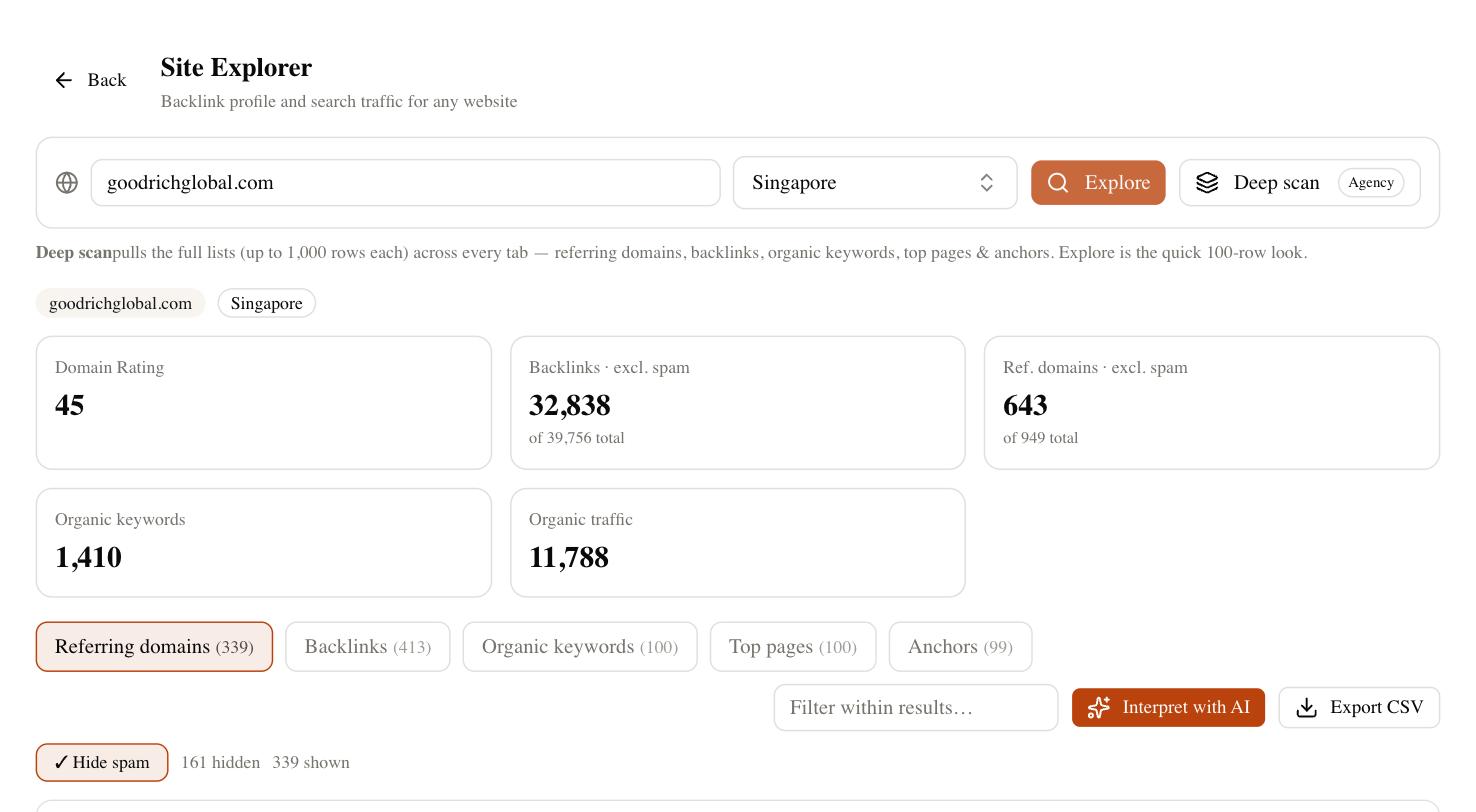
The value is not that it prints a magic number — no honest tool can. It is that the link gap in step three, the piece most people get wrong, is measured against the weakest realistic rival rather than a scary median, and it updates as competitors change. You still apply your own cost bands and timeline judgment, but you start from measured reality instead of a guess. For a batch of keywords, that difference turns a full afternoon of manual counting into a few minutes.
Treat the output as the measurement half of the job, not the whole answer. The tool tells you how far apart you and your target sit today; you supply what a referring domain costs in your niche, how fast your team can ship content, and how much a visitor is worth to your business. Those inputs are yours because they depend on your resources, and no data provider can know them. Paired that way, the measured gap and your own numbers produce an estimate you can actually stand behind.
A worked example
Say you want to rank for a commercial keyword with 1,200 monthly searches. The weakest page-one result has a Domain Rating in the low 30s and 20 referring domains to its ranking page. Your site sits at a similar authority but your page has only 5 referring domains. Your gap is about 15 referring domains. At a blended $300 each, that is roughly $4,500 in link effort. Add $600 for a stronger 2,000-word page, and you are near $5,100 all in.
Now weigh it. If a page-one position drives 150 visits a month at $20 of value each, that is $3,000 monthly, and the campaign pays back in under two months of ranking — clearly worth it. Change the value per visit to $2 and the same $5,100 takes far longer to recover, which might push you toward an easier keyword. The estimate did not make the decision for you; it made the decision honest.
Notice how much the answer swings on inputs you controlled rather than on Google. The link gap set the floor on cost, but the value per visit and the timeline decided whether the keyword was worth chasing at all. That is why the measurement and the judgment have to travel together — a precise gap attached to a lazy value estimate still produces a bad decision. Keep both halves honest and the worked number will steer you toward the keywords that actually pay.
Common mistakes that blow up your estimate
Most bad estimates fail for the same handful of reasons, and every one of them is avoidable once you know to watch for it. Read this list before you present a number to anyone who is going to spend money based on it.
- Benchmarking against the leader. The top result often has hundreds of links and years of trust. You are not racing it — you are displacing whoever sits at position eight or nine.
- Counting all links equally. Ten spammy directory links do not equal one editorial link from a trusted site. Estimate referring domains, and quality ones.
- Pricing links but not content. A page that cannot hold intent will slide back down. Budget the content or the links are wasted.
- Selling a single number. Ranking is probabilistic and positions jitter a few spots day to day. Give a range and a confidence level, never a promise.
Turning the estimate into a decision
Once you know how to estimate cost to rank, the estimate becomes a filter rather than a forecast. Run the seven steps across your keyword shortlist, then sort by payback period. The keywords with the smallest link gap and the clearest buying intent rise to the top, and the ones that would cost more than they return quietly drop off. That ranking of opportunities is worth more than any individual price tag.
Be disciplined about revisiting it. Competitors earn links, you ship content, and the gap you measured in January is not the gap in June — so re-run the comparison before you commit the next quarter’s budget. Treat every estimate as a range with an expiry date, benchmark against the weakest realistic rival, and give any campaign a full ranking cycle before you judge whether the number held. Do that, and your cost-to-rank estimates will steadily get sharper with each keyword you ship.