
Figuring out how to do SEO for a new website is mostly about doing a short list of unglamorous things in the right order, then being patient. A brand-new domain has no history, no backlinks, and no track record with Google, so the work in the first few months is about laying foundations rather than chasing quick wins. This guide walks you through how to do SEO for a new website as a concrete sequence of steps you can start today, with honest timelines so you know what “working” actually looks like.
None of this requires an agency or a five-figure budget. It requires that you set the site up correctly, publish content people actually search for, and give it time. Let’s go in order.
Set your expectations before you start
Here is the part most guides skip. A new site typically sees little to no organic traffic for the first three to six months, and competitive terms can take a year or longer. Google is slow to trust a domain with no history, and no amount of on-page tweaking shortcuts that trust-building period. If someone promises page-one rankings in 30 days for a new domain, they are either targeting keywords nobody searches or they are lying.
What you can realistically expect: within a month or two, Google indexes your pages and you start ranking for very long, very specific phrases with almost no competition. Those early wins are small but real, and they are the signal that your foundation is sound. A single sale or lead from one of those long-tail pages is worth more as proof than a vanity ranking on a term that never converts. Treat the first quarter as planting, not harvesting, and judge yourself on whether the fundamentals are in place rather than on the traffic graph, which will stay flat before it turns.
The step-by-step plan
Work through these in order. Each step assumes the one before it is done, because SEO breaks when you build content on top of a broken foundation.
- Confirm the site is crawlable and indexable. Set up Google Search Console, submit an XML sitemap, and check that no stray “noindex” tag or a blocking robots.txt is hiding your pages. This is the single most common reason a new site gets zero traffic — the pages were never eligible to rank in the first place.
- Nail the technical basics. Make sure the site loads fast on mobile, uses HTTPS, has clean URLs, and does not throw errors. You do not need a perfect score; you need no serious blockers.
- Do keyword research grounded in real search demand. List the topics your buyers actually type, then check which ones have searches you can realistically win. Prioritize low-competition, specific phrases over broad head terms.
- Map one keyword to one page. Give every target its own page so you are not competing against yourself, and structure the site so related pages cluster around a main topic.
- Write genuinely useful content. Answer the search intent fully and better than the weakest result currently ranking. Thin, generic pages do not rank on a new domain, no matter how many you publish.
- Optimize each page’s on-page elements. Write a clear title tag with the keyword near the front, a compelling meta description, one H1, and descriptive headings. Add internal links between related pages.
- Earn a few quality links and citations. Get listed in relevant directories, reach out to sites in your niche, and build the kind of mentions that signal you are a real business.
- Track, wait, and iterate. Watch which pages gain impressions, improve the near-misses, and keep publishing. Momentum compounds.
Get the technical foundation right
Technical SEO sounds intimidating, but for a new site it comes down to a handful of checks. Can Google find your pages, load them quickly, and read them cleanly? If yes, you have cleared the bar. The problems that actually sink new sites are boring ones: a sitemap that was never submitted, a staging-site “noindex” tag that shipped to production, duplicate pages competing for the same term, or a mobile layout that takes eight seconds to load.
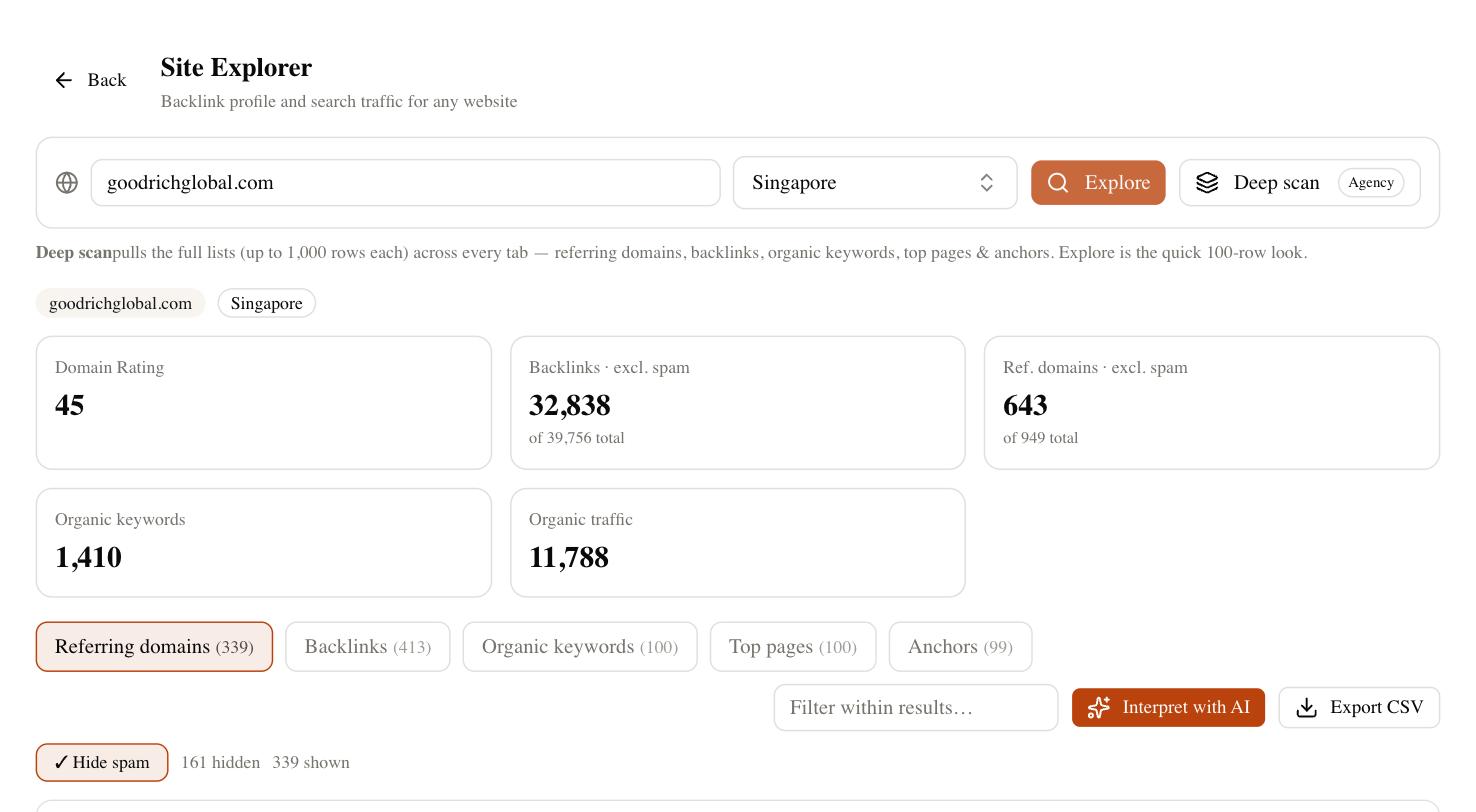
Running a full audit by hand is tedious, and it is easy to miss the one broken thing that matters. This is where SEO Rocket’s Site Audit earns its keep — you point it at your domain and it crawls the whole site, scores overall health, and lists the specific on-page and technical issues along with the exact pages affected, so you fix the blockers instead of guessing at them.
Re-run the audit after each round of fixes. A clean crawl early on means every page you publish later starts from a healthy base, which matters far more on a young domain than any single ranking factor.
Choose keywords you can actually win
The biggest mistake new sites make is targeting keywords far above their weight. You are not going to outrank established brands for a broad, high-volume term in year one, so do not try. Instead, go after long-tail phrases — longer, more specific searches with clear intent and weaker competition. “Best waterproof hiking boots for wide feet” is winnable; “hiking boots” is not.
Judge difficulty against the weakest page-one result, not the strongest. If a couple of thin, outdated pages are ranking on page one for a phrase, that is your opening — you only have to be better than the worst result, not the best. Look at who currently ranks, be honest about whether your new page can beat the worst of them, and build a list of thirty to fifty realistic targets. Group those targets by theme so a cluster of related pages reinforces each other rather than sitting in isolation. That list becomes your content roadmap for the next several months, and revisiting it as you learn what ranks keeps you from wasting effort on terms that were never within reach.
Publish content that deserves to rank
Once you know your targets, create one strong page per keyword rather than a pile of thin ones. Match the search intent exactly: a “how to” query wants a guide, a “best” query wants a comparison, a product query wants a product page. Cover the topic thoroughly, answer the follow-up questions a reader would have, and make it genuinely more useful than what is ranking now.
On each page, put the keyword near the front of the title tag, write one clear H1, use descriptive subheadings, and link to your other relevant pages. Internal links help Google understand how your content fits together and pass authority to your most important pages. Publish consistently — a steady cadence signals an active, maintained site — but never trade quality for volume. Five excellent pages beat fifty forgettable ones on a domain with no authority yet.
Build authority the slow, honest way
Content gets you eligible to rank; links and trust signals help you actually climb. For a new site, start with the achievable: relevant business directories, your social profiles, and industry listings that establish you as a real entity. From there, earn editorial links by creating something worth citing — original data, a genuinely useful tool, or a resource other people in your niche want to reference.
Avoid the shortcuts. Buying cheap bulk links or spamming forums does more harm than good on a new domain and can get you filtered out entirely. A handful of relevant, quality links beats hundreds of junk ones. Link building is slow, and that is fine — it is slow for everyone, which is exactly why doing it properly is a durable advantage.
Track progress without fooling yourself
Measure the right things. In the early months, watch impressions and indexed pages in Search Console rather than obsessing over rankings, because positions on a new site jitter by several spots day to day and mean little until they settle. When a page starts collecting impressions but not clicks, it is close — improve the title, deepen the content, and it often moves onto page one.
Give any change a full ranking cycle before you judge it, and give the site itself a solid six months before you decide whether the strategy is working. Learning how to do SEO for a new website is less about clever tricks and more about doing the fundamentals steadily while everyone else quits at month two. Set the foundation, publish useful pages, earn a few real links, and let time do the compounding.