
Figuring out how to do keyword research with ai is less about handing the whole job to a chatbot and more about letting the machine do the tedious parts while you keep the judgment. AI is genuinely good at the grunt work here — expanding one seed idea into hundreds of variations, clustering them by intent, and spotting patterns you would miss by eye. What it is not good at, yet, is knowing your margins or which of those phrases a real buyer would actually type. This guide gives you a workflow that uses AI for speed and you for the calls that matter.
You can run every step below today, most of it in an afternoon. Where a specific tool makes a step faster, I will name it, but the process works with whatever stack you already pay for.
What AI actually changes about keyword research
The old way was slow in one particular place: generating and sorting ideas. You would type a seed into a keyword tool, export a spreadsheet of a few thousand rows, then spend an hour manually deciding which ones shared the same search intent and which were worth writing for. That sorting step is exactly what large language models do well, because grouping phrases by meaning is a language problem, not a data problem.
What AI does not change is where the numbers come from. Search volume, keyword difficulty, and clicks still have to be measured against a real index of search data — a language model on its own will happily invent a “1,900 searches a month” figure that is pure guesswork. So the reliable pattern is a split: use real SEO data for the metrics, and use AI for the expansion, clustering, and intent-reading on top of that data. Keep those two jobs separate in your head and you will avoid the single biggest mistake beginners make with AI research.
The second thing worth understanding is that AI is at its best when your seed is specific. Feed it a vague, one-word topic and it returns generic filler anyone could have listed. Feed it a tight seed rooted in a real customer problem and it returns the odd, specific long-tail phrasing that is often the easiest to rank for and the closest to a sale. Your input quality sets the ceiling on the output, so the effort you put into the first step below pays off through every step after it.
The step-by-step workflow
Here is the sequence I use. Do them in order — each step narrows the list the previous one produced.
- Start from the customer, not the keyword. Write down the three or four problems your product solves in the words a customer would use, not your internal jargon. These become your seed terms. A plumber’s seed is “burst pipe,” not “emergency plumbing solutions.”
- Expand each seed with AI. Ask an AI tool to generate 50–100 related searches for each seed, explicitly including questions, comparisons, and “near me” or buying-intent variants. This is where AI earns its place — it surfaces long-tail phrasing you would never brainstorm alone.
- Pull real metrics for the expanded list. Drop that list into a keyword tool that reads a live search index and attach volume, difficulty, and — if available — an estimate of clicks. Ignore any metric that came from the AI itself.
- Cluster by intent. Group the survivors into topics where one page could satisfy every phrase in the group. Ten keywords that all mean “how do I fix a leak” are one article, not ten.
- Score each cluster. For every group, weigh volume against difficulty against how close the searcher is to buying. A low-volume, low-competition, high-intent cluster usually beats a fat head term you cannot rank for this year.
- Map clusters to pages and pick your first five. Assign each cluster a target page — new or existing — and choose the five you will actually produce first. Everything else goes in a backlog.
The whole point of the ordering is that you never let AI make the final selection. It expands and it sorts; you decide what is worth your time based on the business reality only you can see.
Where SEO Rocket’s Keywords Explorer fits in
Steps two and three are the ones that usually mean bouncing between a chatbot and a separate data tool, copying lists back and forth. SEO Rocket’s Keywords Explorer collapses that into one move: you give it a seed topic in plain language, and it expands the idea into keyword suggestions while pulling real volume and keyword difficulty from an Ahrefs-grade index against the same list. Because the expansion and the metrics arrive together, there is no gap where an AI-guessed number sneaks in.
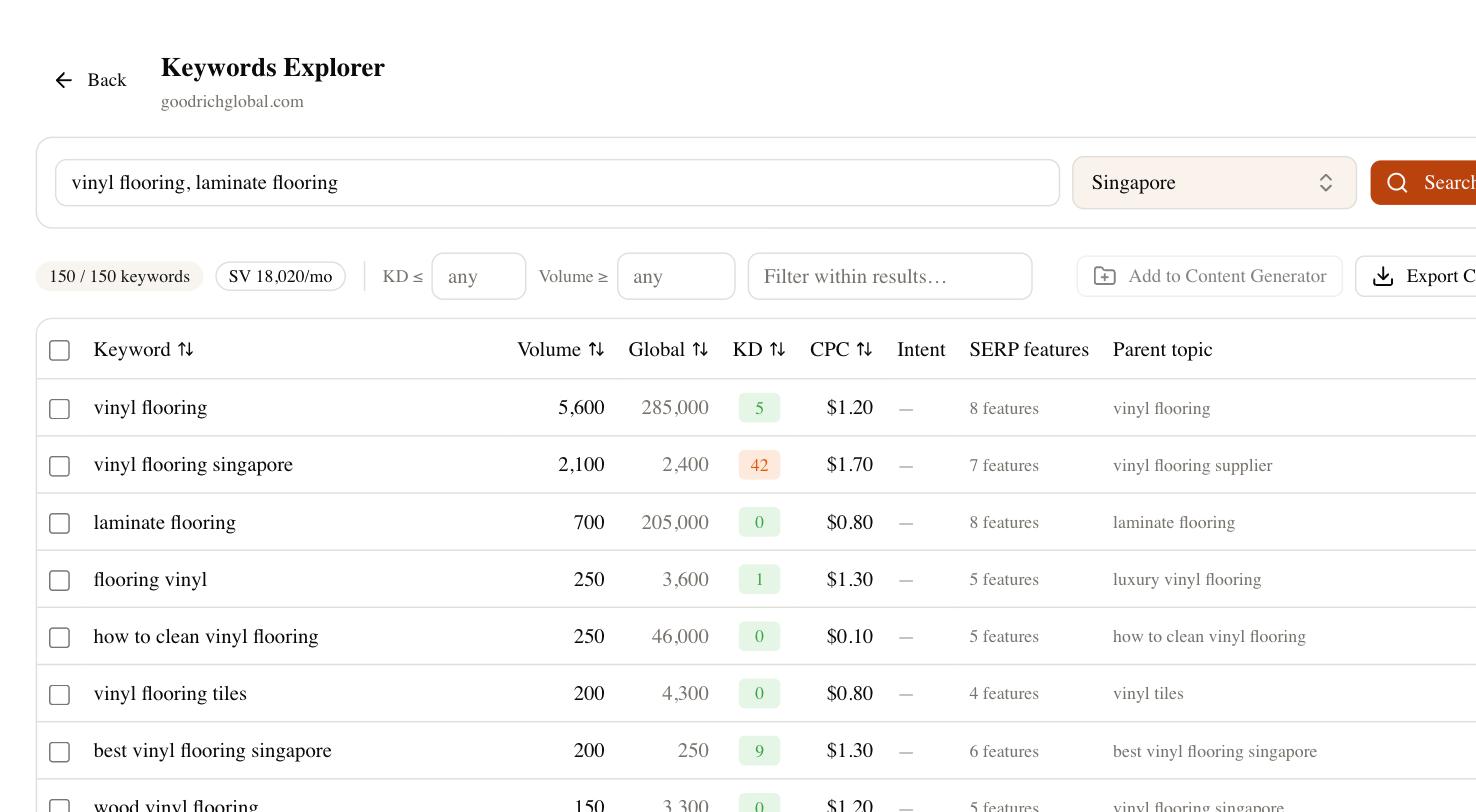
What makes it useful for the workflow above is that the intent clustering happens in the same place. You are not exporting a CSV and prompting a separate model to group it — you can ask for the ideas grouped by intent and get topics you can hand straight to a writer. It is one feature inside a broader tool, not a magic button, and it will not tell you which cluster fits your margins. That call is still yours. But it removes the two most tedious steps, which is exactly the part of keyword research worth automating.
A quick sanity check before you commit
Before you write a word against a cluster, run it through a short checklist. This catches the keywords that look attractive in a spreadsheet but waste a month of effort.
- Can you actually rank? Look at who holds the current page one. If the weakest result there is a thin, dated page from a site no bigger than yours, you have a shot. If every result is a major brand, park it.
- Does the intent match your page? Search the term yourself and read the top results. If they are all buying guides and you planned a product page, the intent is informational — respect it or you will not rank.
- Is there any commercial value? A keyword with 8,000 searches and zero buying intent can be worth less than one with 90 searches from someone ready to hire you.
- Is it one topic or several? If your cluster secretly contains two different questions, split it into two pages before you start.
Benchmark against that weakest page-one result, never the strongest. Ranking is a relative game, and the honest question is whether you can beat the softest competitor already there — not whether you can outrank the category leader on day one.
How long this actually takes
Be realistic about timelines, because AI speeds up the research but not the ranking. The research itself — seeds, expansion, metrics, clustering, and a prioritized shortlist — is a half-day of work for a single site once you know the steps, and AI genuinely shaves hours off the sorting. Publishing and ranking is the slow part that no tool changes: a new page on a young site typically takes two to four months to settle into a stable position, and even then it will jitter a few spots up and down week to week. Anyone selling you instant rankings from AI keyword research is selling the wrong story.
Treat the output as a living backlog, not a one-time list. Rerun the expansion every quarter, because the questions people ask shift as your market and the search results around it change. A cluster that had no ranking chance six months ago can open up when a competitor lets their page go stale, and AI makes re-running the whole sweep cheap enough that there is no excuse to leave the list to rot.
Common mistakes to avoid
The failures are predictable. The first is trusting AI-generated metrics — a model will confidently produce volumes and difficulty scores that were never measured against a real index, and building a content plan on invented numbers wastes months. Always attach metrics from live search data, not from the chatbot that wrote the list.
The second is chasing volume. Big head terms feel like progress, but they are usually the hardest to rank for and the least likely to convert. A pile of specific, lower-volume, high-intent phrases will almost always outperform one glamorous keyword you cannot reach. The third mistake is skipping the human read of the search results — AI can guess intent, but it cannot see the page-one reality that tells you whether your planned page even belongs there. Do the manual check on your finalists. It takes ten minutes and saves you from writing the wrong page well.
Putting it into practice
You now know how to do keyword research with ai without handing over the judgment that makes it work: seed from the customer, expand and cluster with AI, ground every metric in real search data, sanity-check your finalists by hand, and pick a short list you can actually produce. The AI removes the tedium; you supply the business sense. Start with one seed topic this afternoon, take it all the way to five mapped clusters, and you will have a content plan built on evidence rather than guesswork — and a repeatable process you can run again next quarter.