Most guides on how to do competitor analysis stop at “check what keywords your competitors rank for” and leave you staring at a spreadsheet with no idea what to do next. The useful version is narrower and more honest: figure out who actually competes with you for the searches that matter, find the specific pages and topics where they beat you, and turn that into a short list of things you can ship this quarter. That’s the whole job, and you can start it today.
This is a hands-on walkthrough of how to do competitor analysis for search, step by step, with realistic timelines and a clear note on where a tool saves you hours and where it can mislead you. No theory you can’t act on.
Start with your real competitors, not the obvious ones
Your business rivals and your search rivals are rarely the same list. The company you lose deals to might barely publish content, while a niche blog or a marketplace page you’ve never heard of owns the top of the results you want. If you analyze the wrong set, every conclusion after that is wrong too.
So define competitors by the searches, not the boardroom. Pick eight to ten commercial keywords you genuinely want to win — the ones a ready-to-buy customer would type — and look at who ranks on page one for each. The domains that show up again and again across those searches are your true SEO competitors. Keep the list to three or four. Any more and the analysis turns into busywork you’ll never finish.
One caution: don’t automatically add a huge, general authority site to the list just because it ranks. A national publisher or a giant marketplace may sit above you on a query without being a competitor you can, or should, try to displace. Focus on rivals close to your own size and shape — sites where beating them is realistic and where their wins translate cleanly to your situation.
The seven steps, start to finish
Work through these in order. The first pass takes a focused afternoon; after that, a quarterly refresh takes an hour or two.
- List your target searches. Write down the 8–10 keywords that map to real revenue, not vanity volume. These anchor everything else.
- Identify who ranks. Run each search and note the repeat domains on page one. That recurring set is your competitor shortlist.
- Pull each rival’s organic profile. For every competitor, capture the keywords they rank for, their estimated traffic, their strongest pages, and roughly how many sites link to them. This is the raw material for the gap.
- Find the keyword gaps. Compare their ranking keywords against yours. The terms several competitors rank for and you don’t are your clearest, best-evidenced opportunities.
- Study the pages that win. Open the top-ranking page for each gap keyword. Note the format, depth, structure, and what question it actually answers. You’re reverse-engineering intent, not word count.
- Check the backlink picture. Look at who links to their best pages. It tells you whether a keyword is winnable with better content alone or whether it needs links you don’t yet have.
- Turn it into a plan. Sort the gaps by winnability — high commercial value, reachable difficulty, thin competing content — and pick the three to five you’ll tackle first.
Notice that six of the seven steps are just structured looking. The value isn’t in exotic metrics; it’s in doing this deliberately instead of guessing, and in writing the output down so it becomes a plan rather than an impression.
How to read a gap without fooling yourself
A keyword gap is a hypothesis, not a guarantee. A competitor ranking for a term you don’t is a strong signal that the term is reachable in your niche — but only if three things line up. The keyword has to carry real intent, the top pages have to be beatable with the content and links you can realistically produce, and the search has to actually convert once you’re there.
Two traps catch people here. The first is chasing volume: a 10,000-search term you’ll never rank for is worth less than a 200-search term that closes deals. Benchmark against the weakest page-one result, not the strongest — if the thinnest page ranking is a short, dated post, you have a real opening; if even the weakest result is a deep, well-linked guide, be honest that it’s a long fight. The second trap is trusting difficulty scores as gospel. Third-party metrics like domain rating and traffic estimates are directional, not exact, and they disagree between tools. Use them to sort and prioritize, never as the final word.
There’s a third check worth adding before anything reaches your plan: intent match. A competitor might rank for a term with a page that answers a different question than the one your buyer is asking. Read the actual page and the search result around it. If the top results are all how-to guides and you were planning a product page, the search wants information, not a pitch — and forcing the wrong format is a slow way to lose. Getting intent right is often the single biggest difference between a page that climbs and one that stalls at the bottom of page two.
Where SEO Rocket fits
Steps three and four — pulling every rival’s full profile and diffing it against yours — are the slow, tab-heavy part if you do it by hand. SEO Rocket’s Competitor Gap feature does exactly that lookup on real, Ahrefs-grade data: you name a competitor (or let it find them from your target keywords), and it returns the keywords they rank for that you don’t, with volume, difficulty, and the ranking URL beside each one. Because it’s chat-first, you ask for the comparison in plain language instead of clicking through report screens.
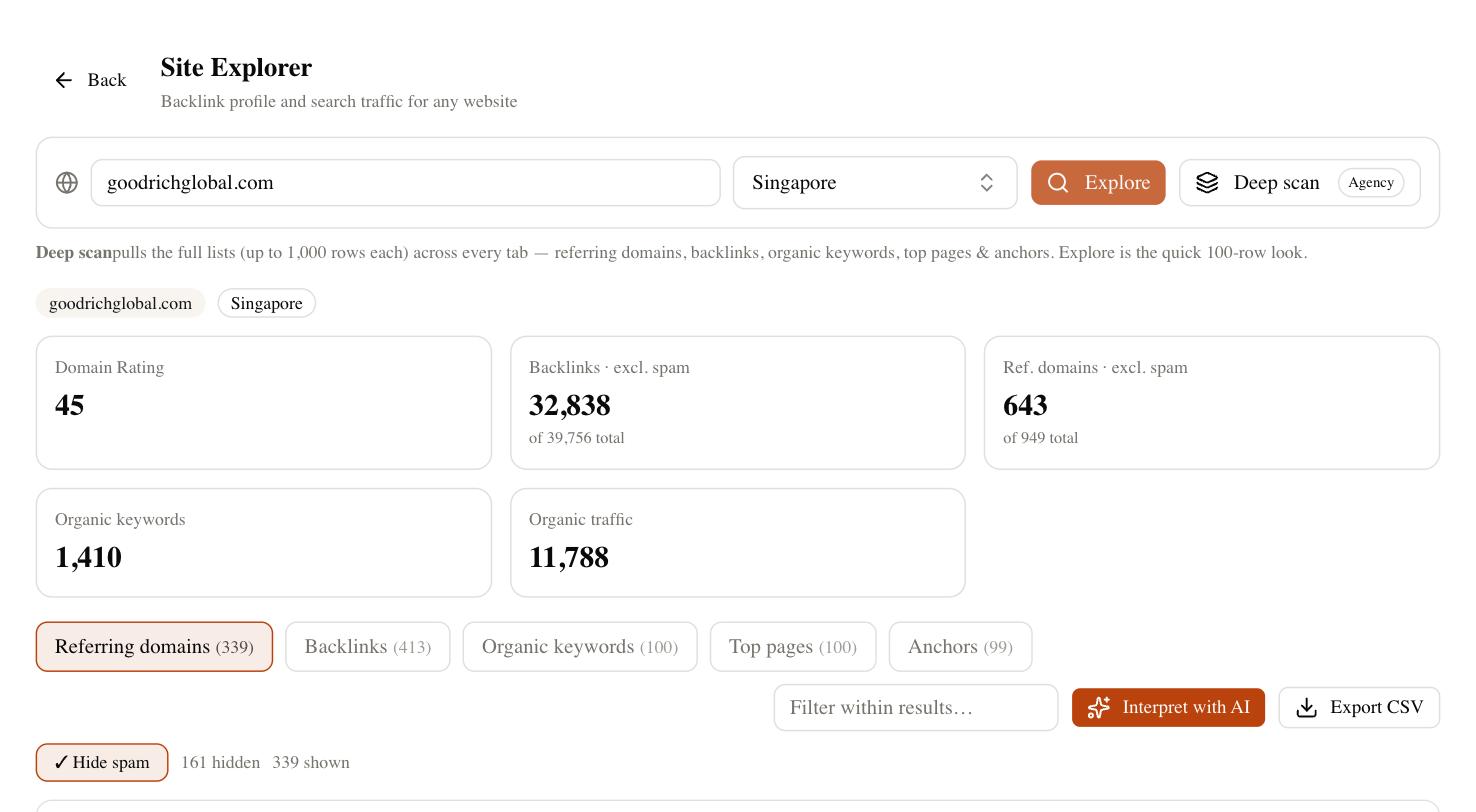
The Site Explorer view covers step three the same way: one domain profile with Domain Rating, organic traffic, top pages, and referring domains — the core numbers you’d otherwise assemble from several exports. What it won’t do is make the judgment calls for you. The tool surfaces the gaps fast and accurately; deciding which three are worth your quarter, and whether a page needs better content or more links, is still your call. That’s the honest division of labor — it removes the grunt work, not the thinking.
Be honest about timelines
Competitor analysis is fast; acting on it is not. Expect the research itself to take an afternoon for the first full pass. Producing a genuinely better page than the one you’re targeting takes days, not minutes, if you do it properly. And ranking that page is measured in months — a new piece of content in a competitive niche typically needs three to six months to settle into its true position, longer if the winning pages have link profiles you have to catch up to.
Rankings also jitter day to day. A page that sits at position seven will bounce a few spots either way for reasons no tool can fully explain, so don’t judge a new page in its first fortnight. Track the trend over a ranking cycle, not the daily noise. Anyone promising you page one in weeks from a competitor analysis is selling something.
A checklist to run each quarter
Once you’ve done the first pass, competitor analysis becomes maintenance. Search results shift, rivals publish, and gaps you closed reopen elsewhere. Run this short loop every quarter to keep the plan current:
- Re-pull the shortlist. Confirm your three or four competitors are still the ones ranking for your target searches — the list changes more than you’d expect.
- Diff the gaps again. Note new keywords rivals gained and any you’ve since won, so you’re always working the freshest opportunities.
- Review your live pages. Check where your published content actually landed against the target, and refresh the ones that stalled just outside page one.
- Reprioritize. Pick the next three gaps by value and winnability, and drop anything that turned out to be a dead end.
Done consistently, that loop is worth more than any one-off audit. Competitor analysis isn’t a report you file — it’s a habit that keeps your content pointed at searches you can actually win, and keeps you honest about the ones you can’t.