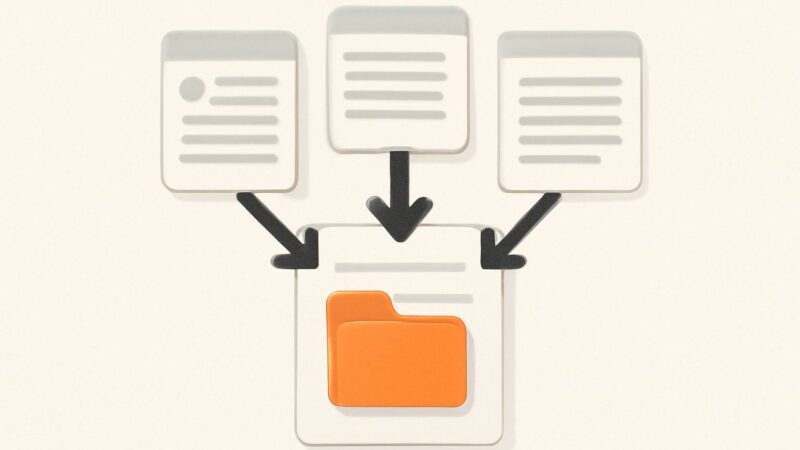
Most writers treat an article outline as a formality — a list of headings scribbled before the “real” work of writing begins. That’s exactly why so many drafts wander, repeat themselves, and lose to a thinner competitor. A good outline isn’t a table of contents. It’s a bet: a structured hypothesis about what a searcher needs, in what order, and what your page can say that the current page one can’t. Get the outline right and the draft almost writes itself. Get it wrong and no amount of polish saves it.
An Outline Is a Bet on Intent, Not a Table of Contents
The lazy way to outline is to brainstorm every subtopic you can think of and stack them into headings. The problem is that a searcher didn’t type your keyword to read everything you know — they typed it to resolve one specific need. Your outline’s job is to decode that need and sequence your page to satisfy it faster than the alternatives. Every section either moves the reader toward that resolution or it’s dead weight Google’s helpful-content systems will notice.
So before you write a single heading, answer one question in a sentence: what does this reader want to be true by the time they leave the page? “They want to know how to structure their own article and feel confident starting one.” That sentence is your north star. Every section in the outline gets tested against it, and anything that doesn’t serve it gets cut — even if it’s interesting.
Start With the SERP, Not a Blank Page
You cannot outline in a vacuum. Open the search results for your target keyword and read the top five to ten ranking pages the way an editor reads a competitor’s issue. You’re not looking to copy their headings — you’re reverse-engineering the consensus of what Google currently considers a complete answer, and then finding where that consensus is weak.
Note three things for each ranking page: the sections it covers, the sections it skips, and the moment it gets vague or dated. The goal isn’t to out-write the number-one result — it’s to beat the weakest page still ranking on page one, because that’s the realistic bar for a new or mid-authority site. If position eight is a shallow listicle with no worked example and stale advice, a genuinely thorough article outline that fills those exact gaps will overtake it. This is where SEO Rocket’s competitor gap analysis earns its keep: it surfaces the topics and subtopics your rivals rank for that your draft doesn’t yet cover, so the outline targets real gaps instead of guessed ones.
Map the Sub-Questions Before You Map the Sections
A ranking page answers the headline query and the cluster of follow-up questions the searcher will have next. Pull those from the “People Also Ask” box, the “related searches” strip, and the autocomplete suggestions. Each one is a sub-question your page can absorb — often as its own H2 or FAQ entry — that signals topical completeness to both Google and a reader deciding whether to bounce.
List every sub-question raw, then group them. You’ll usually see three or four natural clusters emerge: definition and framing, process and how-to, decision rules and trade-offs, and edge cases or examples. Those clusters become the spine of your outline. This is also the stage to note the entities a genuine expert would reference — named methods, adjacent concepts, tools — so the finished piece reads as authored by someone who actually does the work, not someone paraphrasing three blog posts.
Order Sections by Intent, Not Chronology
The most common outlining mistake is chronological ordering: telling the story in the sequence you’d perform the task. Readers don’t arrive at the start of a process — they arrive at their point of confusion. Order your sections by what resolves the query fastest, front-loading the answer, then going deep. Put the payoff or the core definition high, the detailed process in the middle, and the caveats and examples toward the end where a committed reader wants them.
A useful rule: if a reader could stop reading after your third H2 and still have gotten what they came for, your ordering is probably right. The deep sections reward the people who keep going; they shouldn’t gate the basic answer. This intent-first sequencing is also what wins featured snippets, because Google extracts concise answers from pages that lead with them rather than burying them under 600 words of preamble.
Decide How Many H2s the Query Actually Needs
There’s no universal section count, but there is a decision rule. Size the outline to the query’s complexity, measured by two signals: how many distinct sub-questions surfaced in your SERP and PAA research, and how deep the ranking pages go. A “what is X” definitional query might need five or six H2s. A comprehensive how-to guide in a competitive niche usually needs eight to twelve, plus a short FAQ.
- One H2 per genuine sub-question — if two headings would answer the same reader need, merge them; splitting padding into two thin sections fools no one.
- Add an FAQ block when your PAA research surfaced two to four questions that don’t fit the main flow but a searcher clearly asks. These win snippets and get cited by AI answer engines.
- Cap it at completeness, not length. Stop adding sections when the last one you’d add doesn’t serve the north-star sentence. More headings past that point dilute the page.
Build Information Gain Into the Outline
Here’s the part generic outlining advice skips entirely, and it’s the part that gets you indexed. Google’s helpful-content system rewards pages that add something the existing results don’t — a concept called information gain. If your outline only recombines the same sections everyone else has, you’ve built a page that’s redundant by design, and redundant pages struggle to earn a ranking no matter how clean the writing is.
So dedicate at least one or two sections of every article outline to something the page-one results lack: a sharper framework, a concrete mechanism, a decision rule with real thresholds, a worked example, or an honest caveat competitors won’t admit. Mark these sections in your outline as your “gain” — the reason the page deserves to exist. If you can’t name a single section that adds gain, you don’t have an outline worth drafting yet; you have a summary of what already ranks.
Draft the Angle and the H1 Before the Body
Write your working title and opening angle while outlining, not after. The angle is the point of view that unifies the sections — the thing you believe that the competing pages are too timid or too generic to say. In this article, the angle is “an outline is a bet on intent, not a table of contents.” That single claim dictated which sections belonged and which didn’t. A body drafted without an angle reads like a Wikipedia stub; a body drafted around one reads like an expert talking.
Your H1 should carry the focus keyword and hint at the angle or the payoff. Then draft a one-line promise for the introduction: what the reader will be able to do by the end. Lock these before the body, because they’re the constraints that keep a long draft from sprawling.
A Worked Example: From Keyword to Skeleton
Say you’re targeting the keyword “content brief.” You open the SERP and find the top results all define what a brief is and list its components, but none show a worked example or explain how a brief differs from an outline — a distinction searchers clearly care about, because it shows up in related searches. That’s your gain, spotted before you write a word.
Your skeleton falls out of that research: an intro that punctures the “a brief is just a checklist” framing; an H2 defining what a brief actually locks down; an H2 on each core component; an H2 with a filled-in example brief; an H2 clarifying brief versus outline; a short FAQ pulled from PAA; and a close on how the brief speeds up drafting. Notice that the example section and the “brief versus outline” section are the two that competitors skipped — they carry the information gain, and they’re the reason this hypothetical page could overtake a shallow incumbent. Every other section is table stakes you include because leaving them out would read as incomplete.
Outline vs Content Brief: Don’t Confuse Them
An outline and a content brief overlap but aren’t the same document, and treating them as interchangeable causes half the confusion writers feel. An outline is the structural skeleton — the H1, the ordered H2s and H3s, and a note on what each section must accomplish. A brief wraps the outline in strategic context: the target keyword and its intent, the audience, the angle, the internal links to include, the word-count range, and the sources to cite. The outline is what you build first; the brief is what you hand a writer so they can execute without guessing. For solo work, a strong outline plus an angle often suffices. For a team, the brief is what keeps quality consistent across writers.
From Outline to Draft — and Where AI Fits
A disciplined outline is also what makes AI-assisted drafting actually work instead of producing generic mush. Hand a language model a bare keyword and you get a bland page that recombines the average of the web. Hand it a structured outline with your angle, your ordered sections, and your named information-gain points, and it drafts something with a spine. That’s the model behind SEO Rocket’s validation-gated AI writer: it works from real keyword and competitor data rather than a blank prompt, and it enforces gates — a minimum section count, title and meta limits, and a repair loop for thin drafts — so the output respects the structure the outline set. The tool doesn’t replace the editorial layer; a human still supplies the angle and fact-checks the claims. But a good outline is the difference between AI that helps and AI that generates the exact redundant content Google is built to demote.
Frequently Asked Questions
How long should an article outline be?
Long enough to remove all ambiguity about structure, no longer. For a standard blog post, an article outline is the H1, six to twelve H2s with a one-line purpose each, any critical H3s, and a note on which sections carry your information gain. If your outline is so detailed it’s basically the draft, you’ve stopped outlining and started writing — which is fine, but it’s a different task.
Should I outline before or after keyword research?
After. Keyword research and SERP analysis tell you the intent, the sub-questions, and where competitors are weak — all the inputs the outline depends on. Outlining first means guessing at structure and then retrofitting it to what searchers actually want, which usually means rewriting the whole thing.
Does the outline affect SEO or just readability?
Both, and they’re linked. A logical heading structure helps Google parse and index your sections, makes you eligible for featured snippets when you lead with concise answers, and signals topical completeness. It also keeps human readers from bouncing. The outline is where on-page SEO and reader experience are decided simultaneously, before a single sentence is polished.