
Every ranking page starts with one decision: which search to target. Get that wrong and even brilliant content goes nowhere. Get it right and you’re halfway to page one before you’ve written a word. That decision is what keyword research is for — finding the exact terms your audience types into Google, and picking the ones you can realistically win.
This guide takes you through the whole process, beginner to confident, with a tool that does the heavy lifting at each step.
Key takeaways
- Good keyword research balances three things: search volume, difficulty, and intent.
- As a beginner, chase low-difficulty keywords with real volume — your quick wins.
- Search intent decides whether a keyword is even worth targeting.
- Your competitors’ keywords are a free, proven list of what to write next.
- Group keywords into topic clusters, not a random pile.
What keyword research actually is
Keyword research is the practice of finding and prioritizing the search terms worth creating content for. It answers three questions for every idea: How many people search it? How hard is it to rank for? And what does the searcher actually want? Nail those three and you have a content plan built on demand instead of guesswork.
Step 1: Start with seed topics
Before any tool, list the broad topics your business is about. A flooring site might jot down “vinyl flooring,” “carpet,” “floor installation,” “floor repair.” These seeds are the launchpad — you’ll expand each into dozens of specific keywords next. Aim for five to ten seeds that map to what you actually sell or write about.
Step 2: Expand seeds into keyword ideas
Now turn each seed into a list of real searches, each with its numbers. Two metrics matter most:
- Search volume — roughly how many monthly searches the term gets.
- Keyword difficulty (KD) — an estimate (0–100) of how hard page one is.
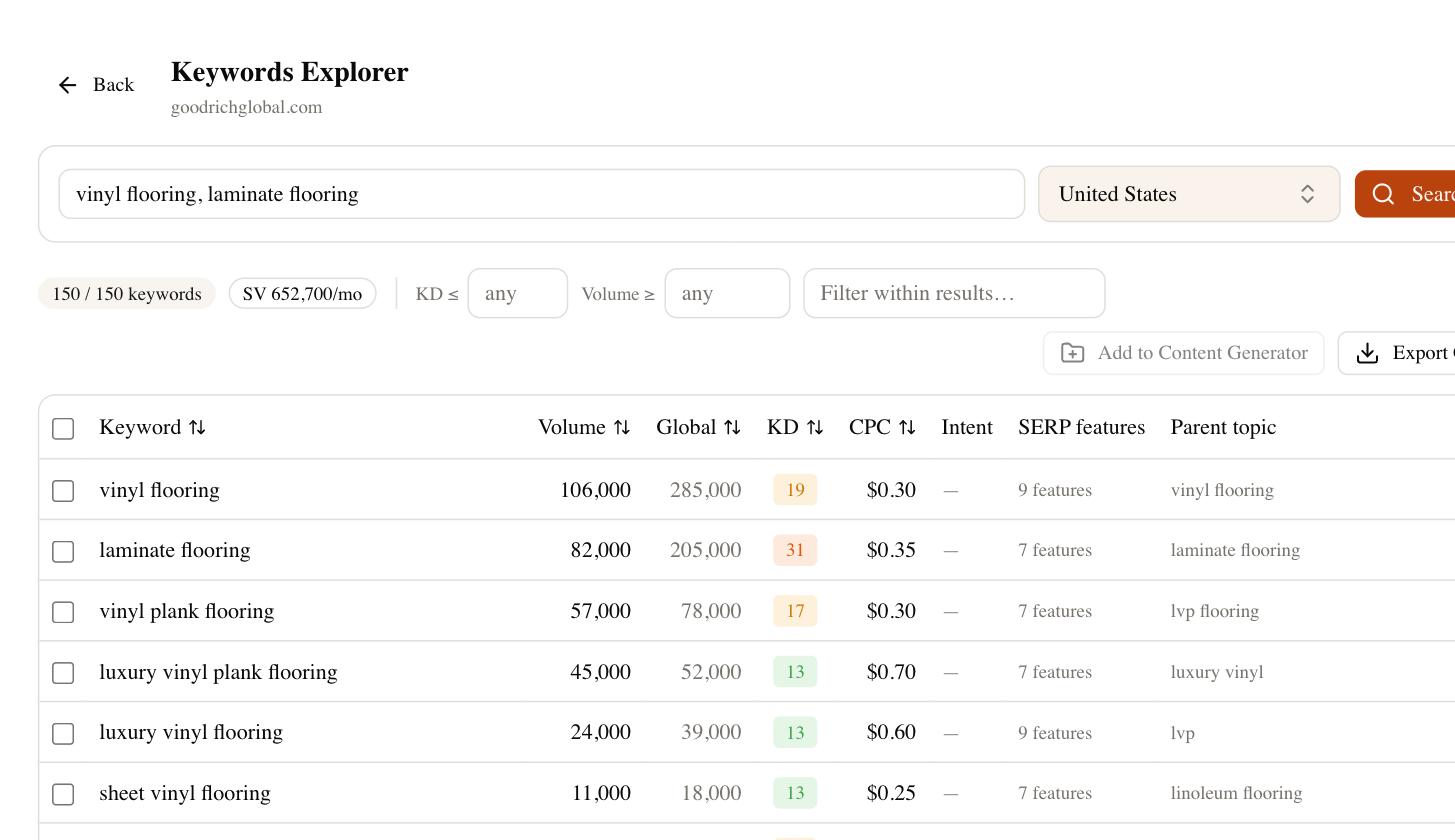
In SEO Rocket, open Keywords Explorer, enter a seed, and you get a full list of related keywords with volume and difficulty — no spreadsheets, and it saves the good ones straight to your project.
Step 3: Read the search intent
Search intent is what the person really wants. Miss it and you won’t rank, however thorough your page. There are four common types:
| Intent | Example keyword | What to create |
|---|---|---|
| Informational | what is vinyl flooring | A clear explainer / guide |
| Commercial | best vinyl flooring | A comparison or roundup |
| Transactional | buy vinyl flooring | A product / category page |
| Navigational | [brand] vinyl flooring | The relevant brand page |
Pro tip: To check intent fast, search the keyword yourself and look at what’s ranking. If page one is all how-to guides, Google has decided the intent is informational — match it or don’t bother.
Step 4: Prioritize your quick wins
Now filter for opportunity. As a newer site, sort your list by difficulty and focus on low-KD keywords that still have meaningful volume. A term with KD 8 and 300 searches a month is a far better first target than KD 65 and 10,000 searches you can’t touch for a year.
SEO Rocket’s Keywords Explorer lets you filter by max KD and min volume in one click, so your easy wins float to the top. Ask it to “find easy keywords for my site” and it does exactly this.
Step 5: Steal your competitors’ keywords
The fastest shortcut to a great keyword list is looking at what already works for your competitors. A content gap analysis shows the keywords your rivals rank for that you don’t — proven, on-topic, and waiting to be claimed.
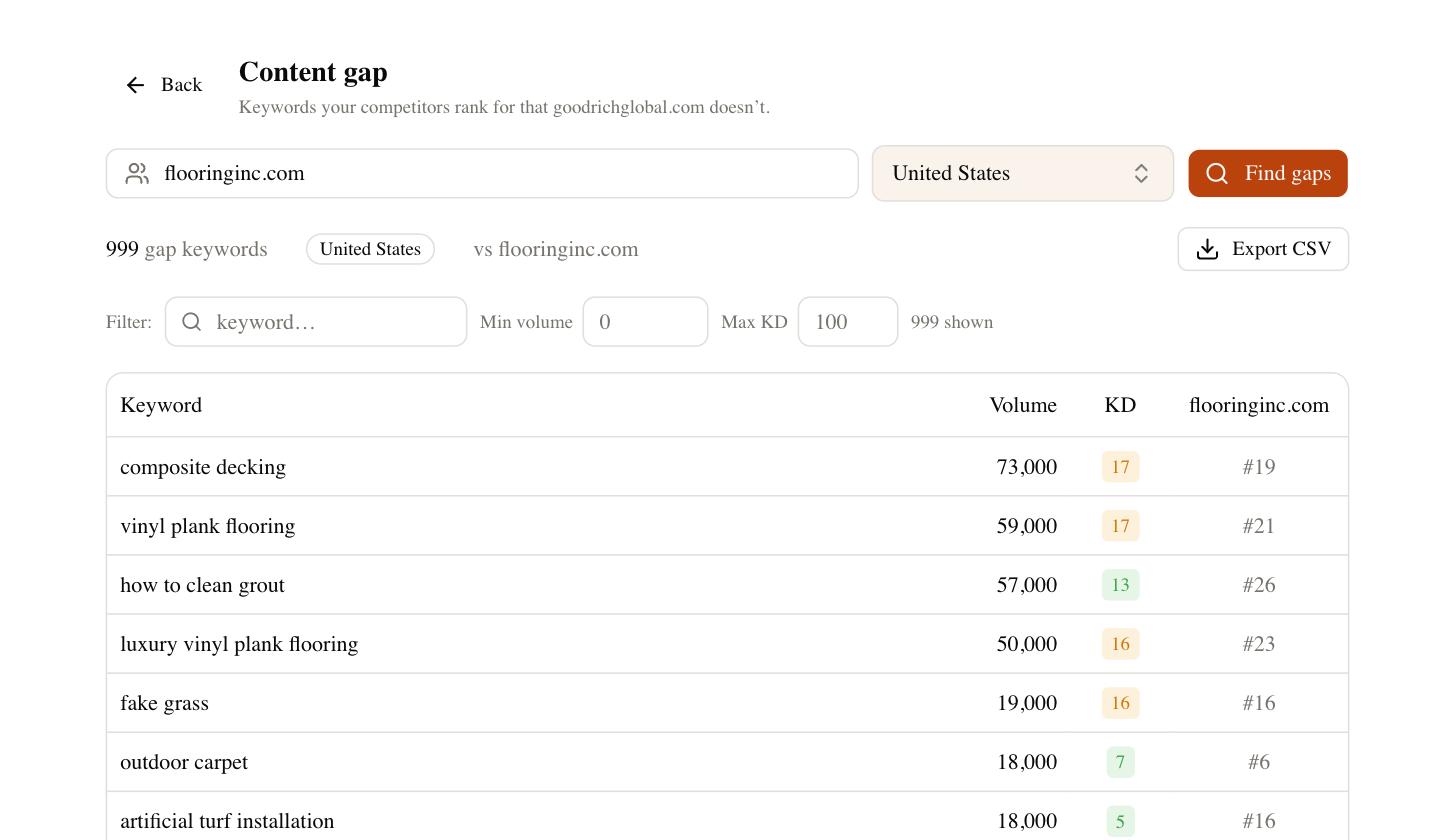
In SEO Rocket, Content Gap does this in seconds: enter a competitor or two and it returns every keyword they own and you don’t, ranked by opportunity.
Step 6: Group keywords into topic clusters
Don’t leave your keywords as a flat list. Group them into clusters: a broad pillar topic plus the specific subtopics (spokes) around it. For example, a “vinyl flooring” pillar with spokes on “how to install vinyl flooring,” “vinyl vs laminate,” and “best vinyl flooring brands.” Interlinking a cluster is what signals topical authority to Google — and it tells you exactly what to write, and in what order.
Ask SEO Rocket to “build my content plan” and it clusters your saved keywords into pillars and spokes automatically.
How many keywords should one page target?
One primary keyword per page — but that page will naturally rank for dozens of closely related variations if you cover the topic well. Don’t create separate pages for “cheap vinyl flooring” and “affordable vinyl flooring”; they’re the same intent, so one great page wins both. Reserve new pages for genuinely different searches.
Frequently asked questions
What is a good search volume for a keyword?
It depends on your niche. In a broad market, 500+ monthly searches is meaningful; in a narrow B2B niche, 50 highly-relevant searches can be gold. Relevance and intent matter more than raw volume.
How do I find low-competition keywords?
Look for low keyword difficulty (KD) paired with real search volume and clear intent. Long-tail keywords — longer, more specific phrases — are usually easier and convert better because the searcher knows exactly what they want.
Is keyword difficulty accurate?
It’s a directional estimate, not a promise. Two keywords with the same KD can differ in practice based on the specific pages ranking. Use it to shortlist, then sanity-check by looking at who actually ranks.
How often should I do keyword research?
Do a thorough pass when planning content, then revisit quarterly. Search behavior shifts, new terms emerge, and your growing authority unlocks keywords that were once too hard.
Putting it all together
That’s keyword research end to end: start with seed topics, expand them into ideas with volume and difficulty, read the intent, prioritize your quick wins, mine your competitors’ gaps, and group everything into clusters. You now have a content plan built on real demand.
Running all of that by hand across dozens of keywords is slow. SEO Rocket handles the expansion, filtering, competitor gaps and clustering from one chat — so you spend your time creating, not collating. Find your easy-win keywords free and see your opportunities in about a minute.