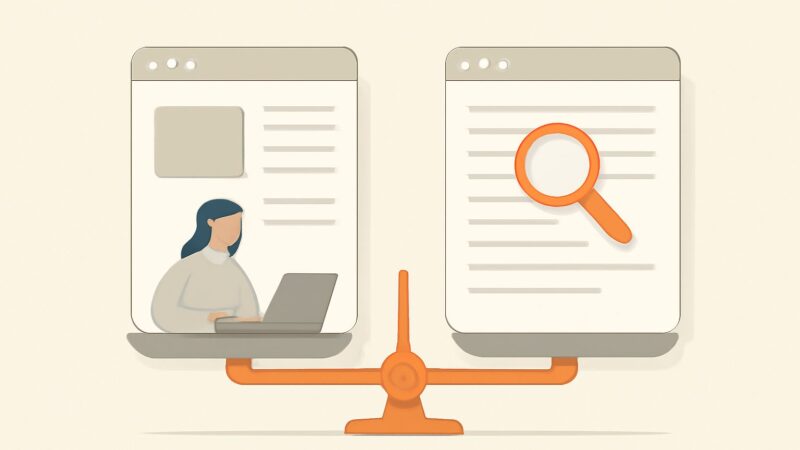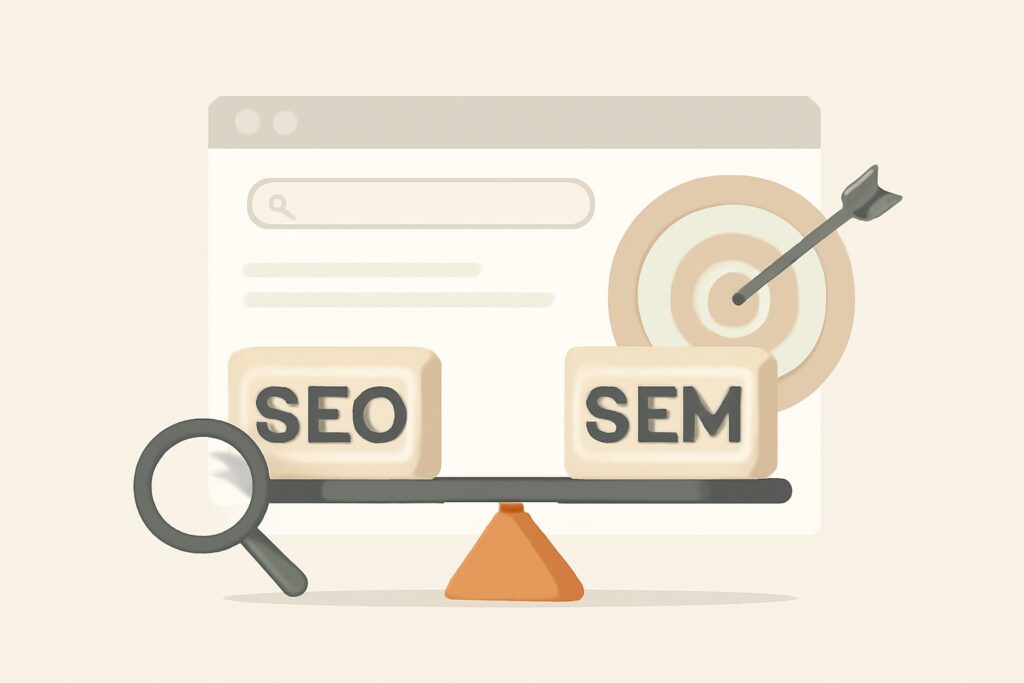
The SEO vs SEM comparison trips people up before it even starts, because the two terms don’t sit on the same level. Most articles line them up as rival channels — organic on the left, paid on the right, pick one. That framing is wrong, and it leads to bad budget decisions. SEM, read strictly, is the umbrella; SEO is one of the things under it. But everyday usage has collapsed “SEM” to mean paid search alone, so the real question buried inside SEO vs SEM is almost always: should I earn rankings or buy them? This guide answers that, and untangles the terminology so you know which fight you’re actually in.
What SEM Originally Meant vs How People Use It Now
Coined in the early 2000s, search engine marketing (SEM) covered everything you do to get visibility on a search engine results page — organic optimization and paid ads together. Under that original definition, SEO is a subset of SEM, and the phrase “SEO vs SEM” is almost a category error, like “apples vs fruit.”
Over the years, though, the industry quietly redefined the word. Today, when a marketer says SEM, they nearly always mean the paid side — Google Ads, Microsoft Advertising, pay-per-click. So the practical meaning of SEO vs SEM has become “organic search vs paid search.” That’s the version this guide uses, because it’s the decision that actually has money riding on it. Just know that if a client or a textbook uses the older, broader sense, you’re both technically right — you’re using different maps.
The Core Difference: Earned vs Bought Placement
Strip away the jargon and the distinction is simple. SEO earns a position by convincing Google’s ranking systems that your page is the best answer to a query. SEM (paid) buys a position by outbidding competitors in an auction. One is a reputation you build; the other is space you rent. The moment you stop paying for SEM, your ads vanish; the rankings you earned through SEO keep working — decaying slowly, not instantly.
That single mechanical difference — earned versus bought — drives every other contrast in cost, speed, durability, and risk. Hold onto it, because the rest of this comparison is really just that one fact playing out across different dimensions.
Speed: SEM Is Instant, SEO Is a Slow Compound
This is where the two channels diverge most sharply, and where impatient teams make their worst call. Paid search is close to instant — you can launch a campaign this morning and be showing at the top of a commercial query by lunch. If you need traffic for a product launch, a seasonal push, or a validation test next week, SEM is the only channel that delivers on that timeline.
SEO does not work that way. For a new or mid-authority domain, a competitive keyword typically takes three to six months to reach page one, sometimes longer in the hardest niches. Google has to crawl the page, weigh it against everything already ranking, and watch how users respond before it trusts you with a top slot. The upside is that once you’re there, you’re not paying per click to stay — which is exactly the trade the impatient team throws away.
Cost Structure: Rented Traffic vs an Owned Asset
The cost curves run in opposite directions, and this is the part budget spreadsheets usually get backwards. SEM has low upfront cost and high marginal cost: every click is billed, and the moment your budget runs dry, the traffic stops. Costs also climb over time as competitors bid up the auction — in saturated verticals like insurance or legal, a single click can run into the tens of dollars.
SEO inverts that. It has high upfront cost — content, technical work, links, and months of patience — but near-zero marginal cost once a page ranks. The tenth visitor costs the same as the ten-thousandth: nothing. Over a long enough horizon, an SEO page becomes an owned asset that keeps returning traffic, while SEM stays a metered utility you rent by the click. Neither is “cheaper” in the abstract; SEM is cheaper to start, SEO is cheaper to sustain.
Control and Precision: Where Paid Search Wins
SEM gives you levers SEO simply can’t. You choose the exact keywords, the geography down to a postcode, the time of day, the device, and often the demographic. You control the headline, the description, the sitelinks, and the landing page, and you can A/B test them in real time. When a campaign underperforms, you see it in the dashboard within hours and adjust the same afternoon.
SEO offers far less direct control. You can influence your title and meta description, but Google may rewrite them. You can target a query, but the algorithm decides your position, and it can move overnight after a core update. This precision gap is the honest reason SEM remains indispensable for anything time-sensitive or margin-sensitive: when you need to guarantee a message reaches a specific audience at a specific moment, only paid search delivers that certainty.
Trust and Click Behaviour: Where Organic Wins
Here’s the counterweight. A large share of searchers skip ads entirely and click the organic results, trusting them as the “real” answers rather than paid placements. Ads carry a “Sponsored” label, and a segment of users treats that label as a reason to scroll past. Organic listings, especially for informational and research queries, capture attention that no ad slot reliably buys.
This is why the organic vs paid search split isn’t just about cost — it’s about intent stage. People early in their research, comparing options and reading guides, gravitate to organic content. People ready to buy, typing a high-commercial query, are more receptive to a well-targeted ad. The channels don’t just cost differently; they meet the searcher at different moments in the decision.
Which Wins on Which Query Type
The smartest way to split budget isn’t a blanket ratio — it’s by query intent. A rough decision rule:
- High commercial intent, immediate need (“emergency plumber near me,” “buy running shoes”): lean SEM. The click is worth a lot right now, and paid guarantees the placement.
- Informational and research queries (“how to choose running shoes,” “what is technical SEO“): lean SEO. Ads convert poorly here, and organic content builds the trust that pays off later in the funnel.
- Expensive, competitive commercial terms where CPC is brutal: earn the organic ranking so you’re not renting every click forever — but run paid in parallel until the organic position matures.
- Brand terms: rank organically for free, and consider a cheap defensive ad only if competitors are bidding on your name.
Map your keyword list against this grid before you spend a dollar, and the SEO-vs-SEM question mostly answers itself, query by query.
Why the Best Answer Is Usually “Both”
Framing this as an either/or is the amateur move. The two channels feed each other. Run SEM first to discover which keywords actually convert — paid gives you conversion data in days that SEO would take months to reveal — then pour your SEO effort into the terms you’ve proven pay off. Meanwhile, ranking organically for a term you also advertise on lets you occupy two slots on the same results page, and often lets you trim paid spend on queries where your organic listing already earns the click.
SEM is your short-term revenue engine and your research lab; SEO is your long-term margin compounding in the background. The right question is rarely “which one” — it’s “how much of each, and in what sequence.” For most businesses that means paid carrying the load in months one through six while the organic asset is still being built, then paid dialing back on the terms where organic has taken over.
How SEO Rocket Fits the Organic Side
Whichever mix you land on, the SEO half needs the same disciplined process to be worth funding. SEO Rocket runs that half as one chat-first workflow: AI keyword research on real Ahrefs data — with search volume and keyword difficulty shown honestly as third-party estimates, not ground truth — plus competitor and keyword-gap analysis to find the terms rivals rank for that you don’t. Its validation-gated AI writer drafts content against enforced standards (length floor, title and meta limits, section count, a repair loop), and a real-crawler site audit surfaces the on-page issues that quietly cap organic performance.
Rank tracking and AI-visibility tracking then show whether the organic asset is actually maturing — the signal that tells you when it’s safe to pull paid spend off a query. It’s the playbook proven across 1,000,000+ ranking pages, packaged at roughly $50/month with a free tier. It won’t run your Google Ads, but it makes the organic side of the SEO-vs-SEM equation something you can execute consistently rather than sporadically.
The Honest Caveats on Both Sides
Neither channel is a free lunch, and pretending otherwise is how budgets get wasted. SEO’s downside: no guaranteed rankings, no fixed timeline, and real exposure to algorithm updates that can move you without warning. Anyone promising a specific position by a specific date is selling something. SEM’s downside: the traffic evaporates the instant you stop paying, click costs only rise as auctions heat up, and a poorly structured campaign can burn budget on irrelevant clicks fast. The channels fail in different ways, and a real strategy accounts for both failure modes rather than assuming one is safe.
Frequently Asked Questions
Is SEM the same as PPC?
Not exactly, though they’re used interchangeably in casual conversation. PPC (pay-per-click) is a billing model — you pay each time someone clicks. SEM, in its modern narrow sense, refers to the whole practice of paid search marketing, which is almost always run on a PPC basis. So most SEM is PPC, but SEM also covers campaign strategy, keyword bidding, and ad copy, not just the payment mechanism.
Should a small business start with SEO or SEM?
If you need customers this month and have some budget, start with SEM — it delivers immediately and reveals which keywords convert. Run it while you build SEO in the background, since SEO takes months to pay off but then costs almost nothing per visit. Once your organic rankings mature on your best terms, you can dial paid spend back. Starting with paid also gives you real conversion data to point your SEO effort at the right keywords.
Does running Google Ads improve your organic rankings?
No. Google has stated repeatedly that paid campaigns give no direct organic ranking boost — the two systems are separate. What paid search can do indirectly is build brand awareness and generate the branded searches and engagement signals that correlate with a healthier site, plus hand you conversion data that sharpens your SEO targeting. The lift is strategic, not algorithmic.
Which is cheaper over the long run, SEO or SEM?
SEO is usually cheaper to sustain because a ranking page keeps returning traffic at near-zero marginal cost, while SEM bills every click forever and gets pricier as auctions heat up. But SEO carries high upfront cost and no guarantee, and it takes months to break even. SEM is cheaper to start and more predictable. The honest answer: SEM is cheaper short-term, SEO is cheaper long-term, and most businesses need both.