
SEO for Etsy is not the same job as SEO for a website you own. On your own site you control the URL, the meta tags, the page speed, the schema, and the redirects. On Etsy you control almost none of that — you’re renting space inside someone else’s search engine, and the rules are theirs.
That’s the honest starting point for SEO for Etsy: figure out which knobs Etsy actually hands you, turn those hard, and stop wasting energy on the ones it welded shut. This guide walks through both, plus the moves that genuinely move a listing and where a tool like SEO Rocket fits (and where it honestly doesn’t).
Etsy search and Google search are two different games
Your listing has to win in two separate places, and they don’t rank the same way. Etsy’s internal search decides what a shopper sees when they type “linen apron” into the Etsy bar. Google decides whether that same listing shows up on the open web. They share your title and tags, but the ranking logic is completely different.
Etsy’s algorithm weighs query match against your title, tags, categories, and attributes — then layers on a listing quality score built from click-through rate, favorites, and conversions. A listing that gets clicked and bought climbs; one that gets impressions and no sales sinks. Recency gives new listings a short visibility bump, shipping price and your shop’s “customer and market experience” score feed in too. Google, meanwhile, mostly cares about your title, your description’s opening lines, and whether the page earns links and traffic. You optimize for both, but you can’t treat them as one.
The practical upshot is that one listing serves two masters, and you write it once to satisfy both. Nail the query-match basics — a keyword-front title and thirteen sharp tags — and you’ve covered most of the Etsy side. Then treat the description and any off-Etsy pages as your Google play, because that’s the only half where classic web SEO tactics still bite. Confuse the two and you’ll burn hours polishing signals the platform ignores.
What you control, and what you don’t
Before you spend an hour on anything, know whether Etsy even lets you touch it. Here’s the real breakdown.
| SEO element | On Etsy you can… |
|---|---|
| Listing title | Full control — up to 140 characters; the front matters most |
| Tags | Full control — 13 tags, 20 characters each |
| Categories & attributes | Full control — they act like extra tags |
| Description | Full control — weak signal for Etsy, real signal for Google |
| URL slug | None — auto-generated from your title |
| Meta title / description | None — Etsy builds them from your listing |
| Page speed & rendering | None — Etsy’s platform |
| Structured data / schema | None — Etsy injects its own product markup |
| Redirects & canonicals | None — a sold-out or deleted listing is gone |
| Backlinks to the listing | Indirect — you can earn them, but they point to etsy.com |
Read that top to bottom and the strategy writes itself. Titles, tags, categories, attributes, and the description are where your effort pays. Everything below the line is Etsy’s problem, and worrying about it is wasted motion.
The moves that actually move a listing
Start with the title, because it does double duty for Etsy and Google. Lead with the exact phrase a buyer types — “personalized dog bandana,” not “the perfect gift for your furry friend.” Etsy reads the front of the title with the most weight, so the first 40 or so characters should carry your primary keyword, then variations after.
Tags are your biggest lever and the most under-used. You get 13, so use all 13, and make each one a multi-word phrase rather than a single word — “sterling silver ring” beats “silver,” which you’d never win. Don’t repeat words already carrying weight in your title; spread coverage across long-tail phrases instead. Fill every category level and every attribute Etsy offers, because those quietly function as extra tags you don’t spend a slot on.
Then optimize for conversion, because Etsy’s quality score punishes listings that get seen and skipped. Clean photos, a competitive price, and free-shipping-eligible pricing all raise the click and buy rate that feeds ranking. On Etsy, a listing that sells ranks better — SEO and merchandising are the same job.
The mistakes that quietly cost you
The most common one is stuffing single-word tags and repeating your title words across all 13 — that wastes slots on phrases you can’t win and covers no new ground. Another is writing a poetic, keyword-free title that reads nicely and matches nothing a shopper types.
The renewal myth is worth killing. Paying to renew a listing gives a brief recency flicker, not a durable ranking boost; it’s not a strategy, it’s a fee. And don’t ignore the description just because Etsy underweights it — Google reads the first line or two as your snippet, so a description that opens with fluff hands your Google traffic to a competitor whose first sentence names the product.
Weak photos are the mistake nobody files under SEO, but they are. Your lead image drives whether a shopper clicks, and click-through feeds straight into the quality score that decides your Etsy rank. A listing can have a flawless title and thirteen perfect tags and still slide because the first photo doesn’t earn the click. Fix the image before you touch the keywords again.
The Google side is where a real SEO tool earns its keep
Here’s the part most Etsy sellers miss: your listings can rank in Google, and that traffic is free, compounding, and outside Etsy’s crowded internal search. This is exactly where SEO Rocket’s data helps — not with Etsy’s black-box algorithm, but with the open-web half of the equation. You can research what people actually search on Google, check the difficulty, and see which phrases your competitors’ listings already rank for that yours don’t.
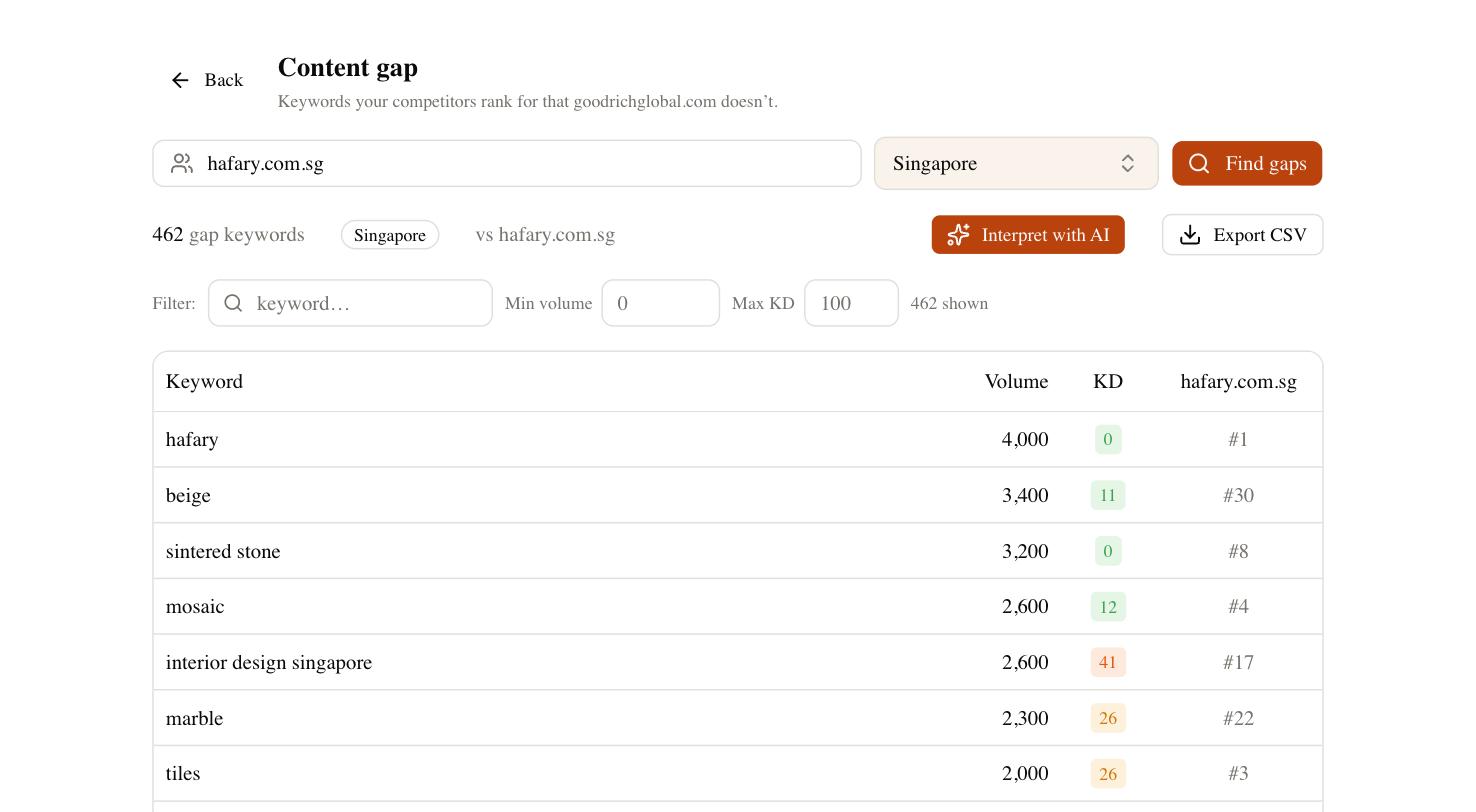
That content-gap view turns guesswork into a title-and-tag plan grounded in real search volume. Pair it with rank tracking for the Google terms that matter, and use the AI content writer to draft descriptions and a supporting off-Etsy blog or shop-about page that links back. Brand Radar tells you whether AI search — ChatGPT, Perplexity, Google’s AI Overviews — ever surfaces your products, a channel no Etsy tool touches.
External traffic is the rare move that pays on both fronts at once. Every share, pin, or backlink pointing at your listing tells Google the page matters, and Etsy sees the same visit-and-buy behavior that lifts your internal quality score. So it’s worth building a small footprint around the keywords SEO Rocket surfaces — a blog post, a shop story, a handful of social posts — and sending that traffic straight to the listings you most want to rank.
Where SEO Rocket stops, honestly
Be clear-eyed about the split. SEO Rocket is built on Ahrefs-grade Google data, so it’s powerful for the open-web side of your Etsy presence and useless for reverse-engineering Etsy’s internal ranking, which no external tool can see. For the on-Etsy game, your best data lives in Etsy’s own Search Analytics and Stats.
So run two loops. Use Etsy’s dashboards to tune titles, tags, and conversion inside the marketplace, and use SEO Rocket to win the Google and AI-search traffic that flows to your listings from outside it. Do both and you’re covered on every surface your buyers actually use — which is the whole point of doing SEO for Etsy properly rather than optimizing half the picture.