
SEO for images is where a lot of otherwise-clean sites quietly leak performance. The files are heavy, the alt text is missing or stuffed, and the whole thing gets treated as an afterthought once the copy is written. Done well, SEO for images does two jobs at once: it earns visibility in Google Images and it protects the page-speed and Core Web Vitals scores that decide how your normal blue-link rankings perform.
What makes images different from the rest of on-page SEO is how little of the outcome you control directly, and how much of it is decided by file-level decisions most people never revisit. This guide sticks to the parts that actually matter — the settings, the constraints, and the honest limits.
What image SEO actually controls — and what it doesn’t
You control the inputs: the file format, the compression, the dimensions, the file name, the alt text, the surrounding page context, and whether the image is even discoverable by a crawler. Those are real levers and they cover most of the wins.
You do not control the output. Google decides whether to index an image at all, how to crop or scale its thumbnail, which query it surfaces for, and whether it serves its own re-compressed copy instead of yours. You also can’t force an image to rank just because the page around it ranks — image and web results are separate systems. Accept that split early and you’ll stop wasting time on things you can’t influence.
File names and alt text — the highest-leverage moves
These are the two cheapest wins in image SEO and the two most commonly skipped. A file called IMG_4021.jpg tells a crawler nothing; blue-suede-loafers-mens.jpg tells it exactly what the picture is. Rename files before upload, use hyphens between words, and keep them short and literal — no keyword stuffing, no dates, no camera junk.
Alt text is the other half. Write it for a person who can’t see the image: describe what’s in the frame, plainly. “Blue suede men’s loafers on a wooden floor” beats “shoes loafers footwear buy shoes cheap.” Decorative images — spacers, background flourishes — should get empty alt attributes (alt="") so screen readers skip them. Getting alt text right serves accessibility and search at the same time, which is rare enough to be worth doing properly.
Page speed is where image SEO is won or lost
Images are almost always the heaviest thing on a page, so they’re the single biggest lever on load time and on Largest Contentful Paint. This is the part of image SEO that quietly moves your regular rankings, not just your image rankings.
Three fixes cover most of it. First, serve modern formats — WebP or AVIF instead of JPEG or PNG — which cut file size substantially at the same visual quality. Second, size images to the space they occupy; shipping a 3000px photo into a 600px slot wastes bandwidth on every visit, so use srcset to hand each device the right resolution. Third, always set explicit width and height attributes so the browser reserves space and the layout doesn’t jump — that jump is Cumulative Layout Shift, and it’s a ranking signal.
Lazy loading helps too, but apply it with care. Add loading="lazy" to images below the fold so they load only when needed, and never lazy-load your hero image — deferring the largest visible element is a common own-goal that tanks LCP.
Discovery: sitemaps, structured data, and rendering
An image that a crawler can’t find won’t rank, no matter how good it is. The most common failure here is JavaScript. If your images are injected client-side, loaded from a data attribute, or hidden behind a script that never fires for the crawler, they may never get indexed. Keep the real image URL in a standard <img src> or in a <noscript> fallback so it’s visible in the raw HTML.
Beyond that, two additions help. List important images in an image sitemap (or the image extension of your XML sitemap) so Google has a direct manifest. And where it fits — products, recipes, articles — add structured data so images become eligible for rich results and the licensable-image badge. Structured data doesn’t guarantee anything, but it’s a low-cost eligibility ticket.
The platform-specific mistakes people make
A handful of errors show up on almost every audit. Watch for these:
- Uploading straight from the camera. Multi-megabyte originals with generic file names, no compression, no resizing — the default path on most CMSs, and the worst one.
- Blocking the image folder in robots.txt. A single disallow line on
/wp-content/uploads/or a CDN path can wipe out image indexing entirely. - Hotlinking or moving files without redirects. When image URLs change during a redesign and old paths 404, you lose whatever image rankings you’d built.
- Text baked into images. Google can’t reliably read words rendered inside a JPEG, so headlines and key copy inside graphics are invisible to search and to screen readers.
- Alt-text keyword stuffing. Cramming target phrases into every alt attribute reads as spam and helps no one.
The honest limits of image search traffic
Here’s the part most guides skip: for many sites, Google Images is a modest traffic source, not a transformative one. Searchers on the image tab are often browsing rather than buying, they frequently view the picture without ever clicking through, and Google increasingly serves a scaled copy it hosts itself. If you sell physical, visual products — furniture, fashion, food, real estate, crafts — image search can be a genuine channel worth real effort. If you run a B2B SaaS blog, it usually isn’t, and your image work should be aimed almost entirely at page speed and accessibility instead.
Be clear-eyed about which camp you’re in before you invest. The page-speed benefits of good image handling are universal and always worth it — every visitor to every page feels a faster load, and Google measures it. The image-search referral traffic is real but capped, and pretending otherwise just leads to disappointment. So set your effort to match the payoff: do the technical hygiene everywhere because it lifts your normal rankings, and reserve the deeper work — original photography, licensing schema, careful thumbnail framing — for the pages where visual search genuinely converts.
An image SEO checklist you can run today
Work through this on any page before you call it done. It’s the short version of everything above.
| Check | Target | Why it matters |
|---|---|---|
| File name | Descriptive, hyphenated, lowercase | Tells crawlers what the image is |
| Format | WebP or AVIF where supported | Smaller files, faster LCP |
| Dimensions | Sized to display slot via srcset | No wasted bandwidth on mobile |
| Width/height attributes | Always set | Prevents layout shift (CLS) |
| Alt text | Plain description, no stuffing | Search + accessibility |
| Lazy loading | Below-fold only | Faster initial paint |
| Crawlability | Real src in HTML, not blocked | No indexing, no ranking |
| Sitemap + schema | Listed where valuable | Discovery and rich-result eligibility |
Where SEO Rocket fits
Most of the work in SEO for images is manual and file-level, and no tool does the compressing for you. Where SEO Rocket helps is the two ends of the job: finding the visual queries worth targeting, and catching the technical problems that break image indexing at scale. Neither is the kind of thing you want to check by hand across a few hundred URLs.
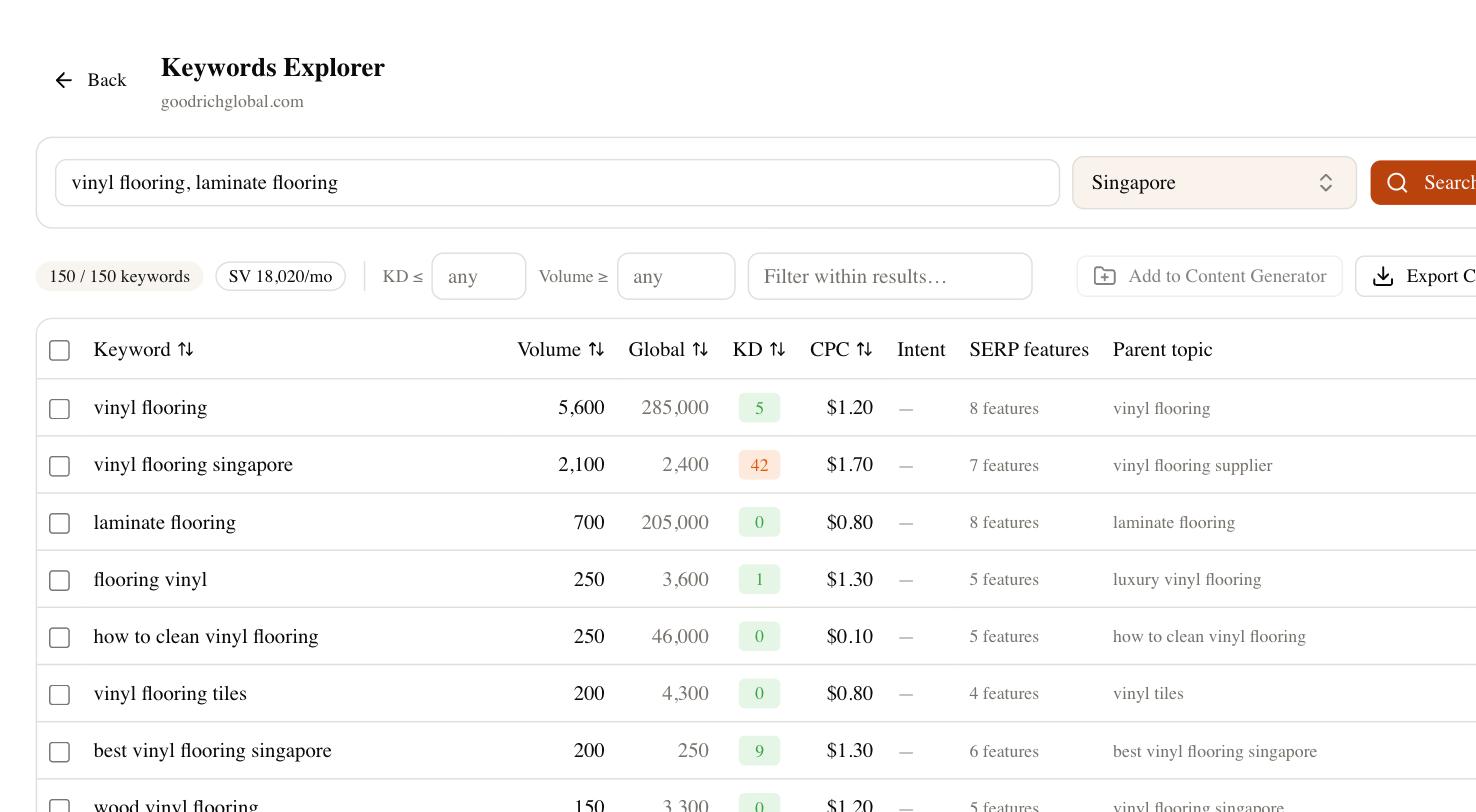
On the research side, you can ask in plain language for the image-friendly terms in your niche and see the demand behind them before you shoot or source anything.
On the technical side, the site audit flags the failures that silently kill image performance — missing alt attributes, oversized files dragging down Core Web Vitals, blocked image directories, and broken image URLs after a migration. That turns image SEO from a vague “we should optimize the pictures” into a specific, prioritized list you can actually clear. Pair that with disciplined file-level habits on every upload, and images stop being a liability and start pulling their weight.