
SEO for pet businesses looks nothing like SEO for a software company or a national retailer. A dog owner searching “mobile groomer near me” at 8am on a Saturday is ready to book that day, in a five-mile radius, and they will call whoever shows up first and has decent reviews. That urgency and that tiny geographic window change everything about how you should approach search.
Whether you run a grooming salon, a boarding kennel, a veterinary clinic, a training business, or a pet supply store, SEO for pet businesses rewards specificity over volume. You do not need to rank for “dogs.” You need to own a handful of high-intent, local searches that turn into booked appointments. This guide covers how pet owners search, the keywords worth targeting, the moves with the most leverage, and the mistakes that quietly cost you customers.
How pet owners actually search
Pet owners search in two very different modes. The first is urgent and transactional: “emergency vet open now,” “cat boarding this weekend,” “dog groomer near me.” These searchers have a pet in the car or a trip booked, and they convert within hours. The second mode is research-heavy and emotional: “why is my puppy not eating,” “best food for a senior dog with kidney issues,” “how much does dog teeth cleaning cost.” These people are not ready to book, but they are choosing who to trust.
Both matter, and they need different pages. The urgent searches want a fast, local page with your phone number, hours, service area, and reviews above the fold. The research searches want genuinely helpful content that answers the question and gently positions you as the expert. Serve one and ignore the other and you leave money on the table.
The keywords that actually make you money
Head terms like “dog food” or “pet grooming” are a trap for local pet businesses. They are dominated by Chewy, Petco, and national directories, the intent is muddy, and even if you ranked you would attract clicks from people three states away. Your money lives in specific, qualified phrases. Here is how to think about the mix.
| Keyword | Intent | Who should target it |
|---|---|---|
| mobile dog grooming [city] | Ready to book | Groomers with a van |
| dog boarding near me | Ready to book | Kennels, sitters |
| emergency vet [city] | Urgent, high value | Clinics with after-hours |
| puppy training classes [city] | Ready to book | Trainers |
| cat boarding cost [city] | Comparing, near-ready | Boarders |
| how much do dog vaccinations cost | Research, pre-booking | Vets |
| best flea treatment for cats | Research, national | Pet supply stores |
| grain free dog food for allergies | Commercial, national | Ecommerce sellers |
Notice the pattern. Service businesses want city-modified, ready-to-book phrases and cost queries. Product sellers want problem-and-solution phrases that scale nationally. Very few pet businesses should chase the broad head terms at all.
Local versus national intent
Most pet businesses are local, and that is a gift. Ranking in the map pack for “dog groomer [your town]” is far more achievable than ranking nationally for anything, and the traffic converts at a much higher rate. If you offer a physical service — grooming, boarding, vet care, day care, training — your entire strategy should orbit Google Business Profile and location-specific pages.
Pet ecommerce is the exception. If you sell food, supplements, toys, or accessories that ship, you are competing nationally against deep-pocketed retailers, and the game becomes long-tail content and product-page SEO. Know which business you are before you copy a competitor’s playbook, because a boarding kennel and a supplement brand need almost opposite tactics.
The highest-leverage moves
Start with Google Business Profile if you are local. A complete, active profile with real photos, correct hours, service categories, and a steady stream of recent reviews often outperforms your website for “near me” searches. Ask every happy customer for a review, and respond to all of them.
Next, build one dedicated page per service, not a single “Services” page listing everything. A groomer should have separate pages for full grooming, nail trims, and mobile grooming, each targeting its own keyword. If you serve multiple towns, create a page for each real location you cover — but only if you can write something genuinely distinct about serving that area, not a template with the city name swapped in.
Then answer the research questions. A vet who publishes a clear, honest page on “what to expect during a spay” or “signs your dog needs to see a vet” earns trust before the first appointment and captures the research-mode searchers your competitors ignore. This is slow-building, compounding work, and it is where most pet businesses never bother to compete.
Mistakes pet businesses keep making
The most common one is targeting terms that are too broad. Ranking page three for “pet grooming” does nothing; ranking page one for “cat grooming [your suburb]” fills your calendar. Aim narrow and win.
The second is neglecting reviews and the Business Profile while pouring effort into the website. For local pet services, the map pack sits above the regular results, and reviews are a major factor in who appears there. A beautiful site that ranks below three competitors in the map pack loses.
The third is thin, duplicated location pages. Google has gotten good at spotting ten near-identical “Dog Walking in [City]” pages, and it can hurt more than help. If you cannot make a location page genuinely useful, do not publish it. The fourth is ignoring AI search entirely — more owners now ask ChatGPT or Google’s AI Overviews “who’s a good dog trainer in [city],” and if you are invisible there you are missing a growing slice of demand.
Where SEO Rocket fits
SEO Rocket is built for exactly this kind of focused, local work. You can ask it in plain language which keywords your competitors rank for that you do not, and it pulls the volume and difficulty on real, Ahrefs-grade data — so you find the “mobile grooming [city]” gaps worth chasing instead of guessing. Its rank tracker watches your specific local terms so you know whether a new service page is actually moving.
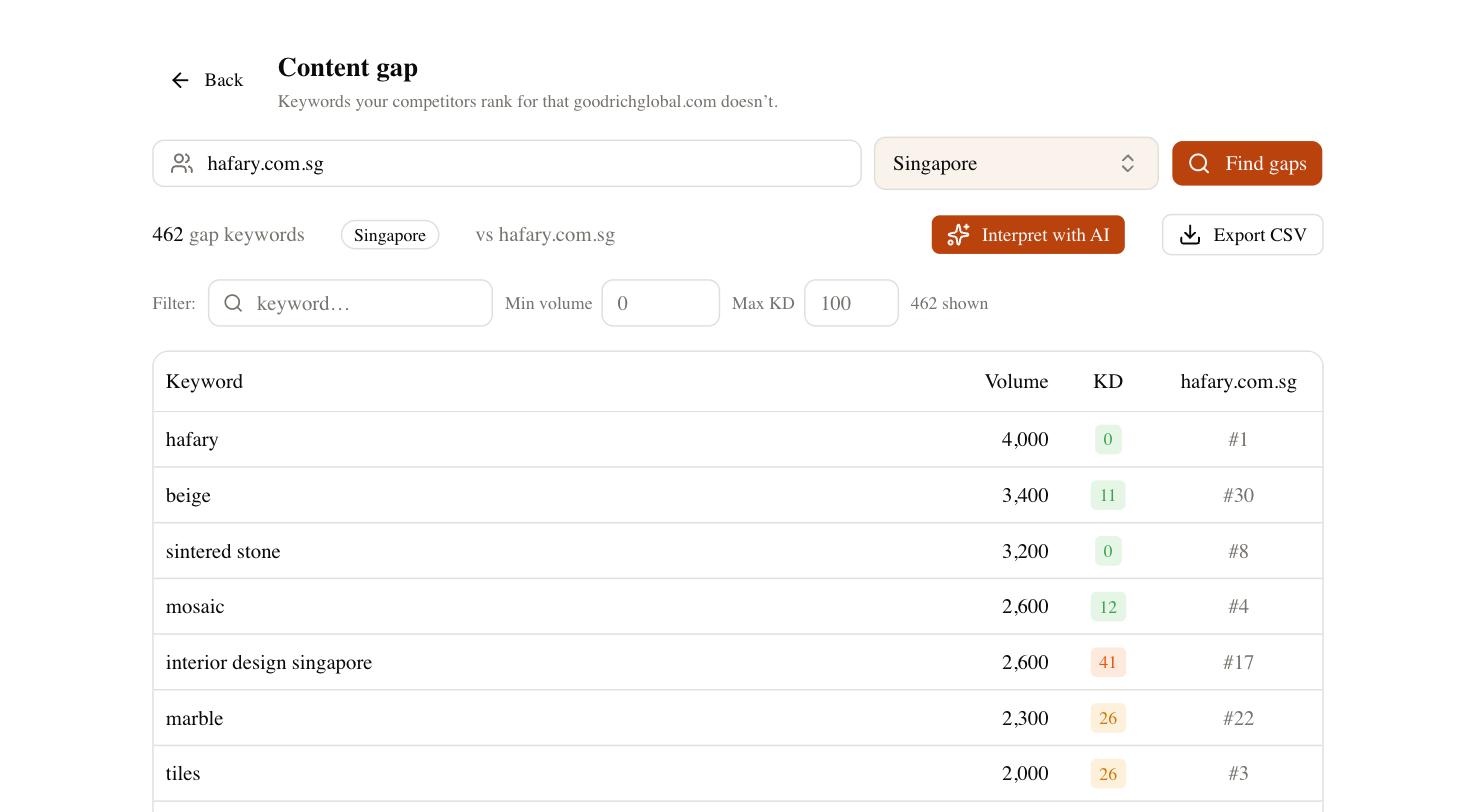
The site audit flags the technical issues that quietly hurt local pages — slow load times, missing schema, broken booking links. Brand Radar tracks whether AI assistants mention your business when someone asks for a recommendation in your area. And if you manage several pet clients or locations, the client dashboards let you hand over a clean, read-only report without exporting a thing. It is one workflow instead of four subscriptions, which for a busy owner or a small agency is the whole point.
A simple order to work in
Do not try to do everything at once. Work down this list, finishing each before the next: claim and fully complete your Google Business Profile; set up a review request into your booking flow; build one strong page per core service; add city pages only where you can write something real; publish two or three honest answer pages for your top research questions; then track your local keywords and adjust. Give it a full quarter before judging results — local rankings move slowly, and reviews compound over months, not days. Done in that order, SEO becomes the most reliable customer channel a pet business can own.