
SEO for recruiters is unusual because you are selling to two completely different audiences at once, and only one of them pays you. Candidates search for jobs; employers search for someone to fill them. Most recruitment sites pour their content into candidate-facing pages and then wonder why the traffic never turns into fees. Effective SEO for recruiters starts by getting that priority right and building around the searches that end in a signed terms-of-business.
The good news is that recruitment is a keyword-rich, high-intent niche. When a hiring manager types “engineering recruitment agency Manchester,” they have a live vacancy and a budget. That is a far warmer search than most industries ever see, and it is winnable if you build the right pages.
Who is actually searching, and what they want
Split your keyword universe into two buckets before you write a single page. Candidates search job titles, salary questions, and “how to” career content — high volume, low commercial value to you. Employers search for agencies, specialisms, and locations — lower volume, but each visit can be worth thousands in placement fees.
You need both, but not equally. Candidate content feeds your database and builds topical authority; employer content pays the bills. If you only have budget or time for one, build for the employer first. A page that ranks for “IT recruitment agency London” is worth more than a hundred candidate blog posts about interview tips.
The money keywords live on the employer side
Employer searches follow predictable patterns: specialism plus “recruitment agency” or “staffing agency,” specialism plus location, and role-specific executive search terms. These are your commercial keywords, and they convert because the searcher is a buyer, not a browser.
There is also a middle layer of investigational searches — “how much do recruitment agencies charge,” “what does an executive search firm do,” “agency vs in-house recruiting.” These pull in employers who are earlier in the decision. Answer them honestly and you catch the client before your competitor does, which matters because hiring managers rarely brief more than two or three agencies.
| Keyword example | Intent | Who’s searching | Priority |
|---|---|---|---|
| it recruitment agency london | Commercial, local | Employer with a live role | High |
| hospitality staffing agency near me | Commercial, local | Employer, often urgent temp need | High |
| executive search firm for cfo | Commercial, national | Board or HR hiring senior leadership | High |
| how much do recruitment agencies charge | Investigational | Employer weighing options | Medium |
| best recruitment agencies for graduates | Comparison | Employer and candidate both | Medium |
| warehouse operative jobs birmingham | Job search | Candidate | Low (feeds database) |
Local versus national intent — and why it changes your structure
The line between local and national SEO in recruitment runs along your desk. Temp, volume, and blue-collar staffing is intensely local: an employer wants warehouse staff in their own town, so “near me” and city-name searches dominate. Permanent placement in a niche specialism is often national or even international, because a company will look anywhere to find a rare skill set.
That distinction dictates your site structure. If you place temp and contract staff, you need genuine location pages — one per city or region you actually service, each with local detail, not a template with the town name swapped in. If you run executive or niche search, you lean into specialism pages and thought-leadership instead, because location barely narrows the search. Get this wrong and you either build thin local pages that never rank or waste effort on geography your buyers do not care about.
The highest-leverage pages to build first
Three page types do most of the heavy lifting. Specialism pages — one for each sector or role type you recruit, written for the employer, explaining how you fill those roles and why your shortlist is better. Location pages — only for areas you truly serve, with real local context. And a small set of honest “how it works” pages covering fees, timelines, and the difference between contingency and retained search.
Notice what is missing: a generic homepage trying to rank for everything, and a blog stuffed with candidate advice. Those have their place, but they are not where the fees come from. Build the commercial pages first, get them ranking, then layer content around them.
Common mistakes recruiters make
The biggest error is building the whole site for candidates because candidate traffic is easier to win. It feels productive — the numbers go up — but the visitors have no money to spend with you. The second mistake is chasing raw job-title keywords like “software developer jobs,” where you are competing head-on with Indeed, LinkedIn, and Reed. You will lose that fight, and even if you win a slot, the click rarely converts to a client.
Other recurring problems: thin location pages that Google treats as doorway spam, no rank tracking so you cannot tell what is working, and ignoring the client testimonials and case studies that build the trust an employer needs before handing over a retained brief. Recruitment is a trust sale, and your pages have to earn it before a hiring manager will pick up the phone.
One more mistake worth naming: publishing a page and never revisiting it. Rankings move, competitors launch new specialism pages, and a page that sat at position four last quarter can quietly slip to page two. Without tracking you find out months later, after the client briefs have already gone elsewhere. Treat your commercial pages as living assets, not a one-time launch.
How SEO Rocket fits a recruitment workflow
SEO Rocket is built around the questions a recruiter actually asks, in plain language rather than a wall of tabs. Ask it for the commercial keywords in your specialism and location and it runs the research on real, Ahrefs-grade data — search volumes, difficulty, and the terms your rivals rank for that you are missing through the competitor gap tool. That gap analysis is often the fastest win: it surfaces the exact employer searches a competing agency owns and you do not.
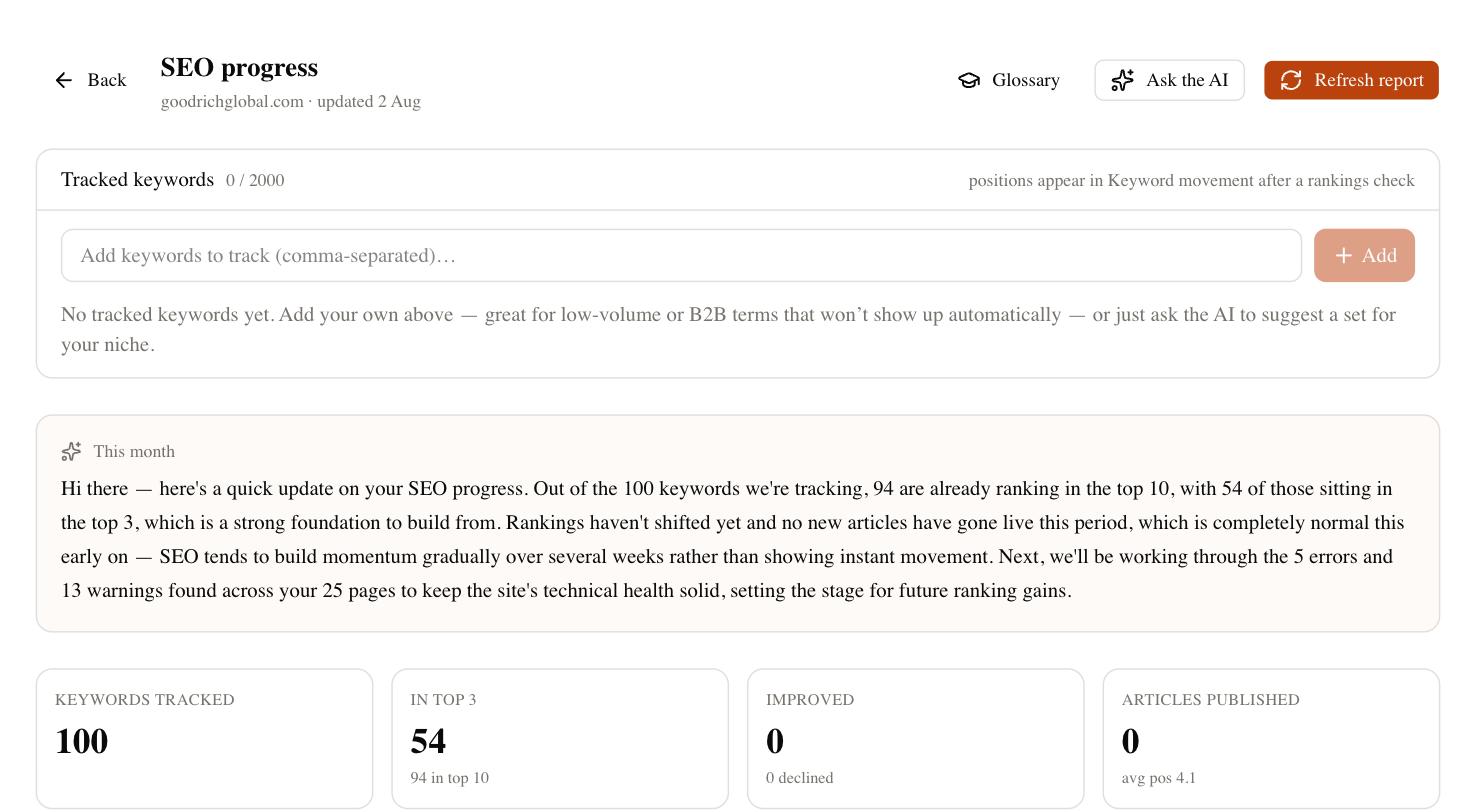
From there the same tool drafts the specialism and location pages, tracks your positions so you can see which pages are climbing, and — through Brand Radar — shows whether ChatGPT and other AI answers mention your agency when someone asks for recruiters in your field. That last part matters more each month, because employers increasingly ask an AI assistant for a shortlist of agencies before they ever open Google. If you run several client sites or want to prove results, the read-only dashboards let you hand an employer a clean report without exporting anything.
A priority checklist to start this week
You do not need a six-month project to make progress. Work through this in order and you will have a commercial foundation quickly.
- List your top three specialisms and top three service locations — these become your first pages.
- Pull the commercial keywords for each (specialism plus “recruitment agency,” specialism plus location) and note real volume and difficulty.
- Build one strong specialism page per desk, written for the employer, not the candidate.
- Add genuine location pages only for areas you truly service — with local detail, not a template.
- Publish an honest fees-and-process page to catch investigational searches early.
- Set up rank tracking so you can see movement within the first few weeks.
- Check whether AI search mentions your agency, and fix the gap if it does not.
Recruitment gives you something most industries envy: buyers who search with a live vacancy and a budget. Aim your pages at those searches instead of the candidate traffic that feels good but never converts, and SEO becomes a steady source of client briefs rather than a cost. Build the employer pages first, track what ranks, and let the candidate content follow.