
SEO for tattoo shops is almost entirely a local game, and that changes everything about how you should approach it. Nobody flies across the country for a walk-in session, so SEO for tattoo shops lives and dies on whether people within driving distance can find you when they finally decide to get inked. Get that right and you fill the calendar. Get it wrong and you lose bookings to the shop three blocks away with a better Google Business Profile.
This guide is specific to how tattoo buyers actually search, the keywords that lead to real appointments, and the handful of moves that move the needle fastest. Skip the generic advice — here is what works for a tattoo studio.
How tattoo buyers actually search
Tattoo clients search in two distinct modes, and you need to win both. The first is discovery: someone knows they want work but hasn’t picked a shop. They type “tattoo shop near me,” “best tattoo artist Denver,” or “walk-in tattoo downtown.” This is the local pack fight — the map results with three listings above the regular links.
The second mode is style-specific and higher intent. These people already know exactly what they want and they’re comparing portfolios. They search “fine line tattoo Austin,” “cover up tattoo specialist,” “black and grey realism artist,” “traditional Japanese tattoo,” or “cosmetic tattoo eyebrows near me.” These searchers convert far better because they’re past the “should I” stage and deep into “who.” A shop that only targets the generic “tattoo shop” terms leaves the highest-intent traffic on the table.
There’s a third, quieter mode worth naming: research searches people run before they commit. “How much does a sleeve tattoo cost,” “tattoo aftercare tips,” and “does a rib tattoo hurt” don’t book an appointment today, but they’re how a nervous first-timer decides which shop feels trustworthy. Answer those questions honestly on your site and you earn the visit later, plus a steady trickle of traffic that competitors ignore.
The money keywords, mapped to intent
Your keyword strategy should mirror those two modes plus a few practical searches people run before they book. Here is a starting map you can adapt to your city and specialties.
| Keyword example | Intent | What page should rank |
|---|---|---|
| tattoo shop near me | Local discovery | Google Business Profile + homepage |
| best tattoo artist [city] | Comparison | Artist bios + reviews page |
| fine line tattoo [city] | Style-specific | Dedicated style/service page |
| cover up tattoo [city] | High-intent style | Cover-up service page with before/after |
| walk-in tattoo [neighborhood] | Same-day intent | Homepage + walk-in policy page |
| how much does a sleeve tattoo cost | Research | Pricing/FAQ blog post |
| cosmetic tattoo / microblading [city] | Service niche | Dedicated service page |
Notice the pattern: almost every valuable term carries a city, neighborhood, or style modifier. Pure head terms like “tattoo” are useless to a single studio — too broad, too national, and dominated by directories. Your wins are the specific combinations.
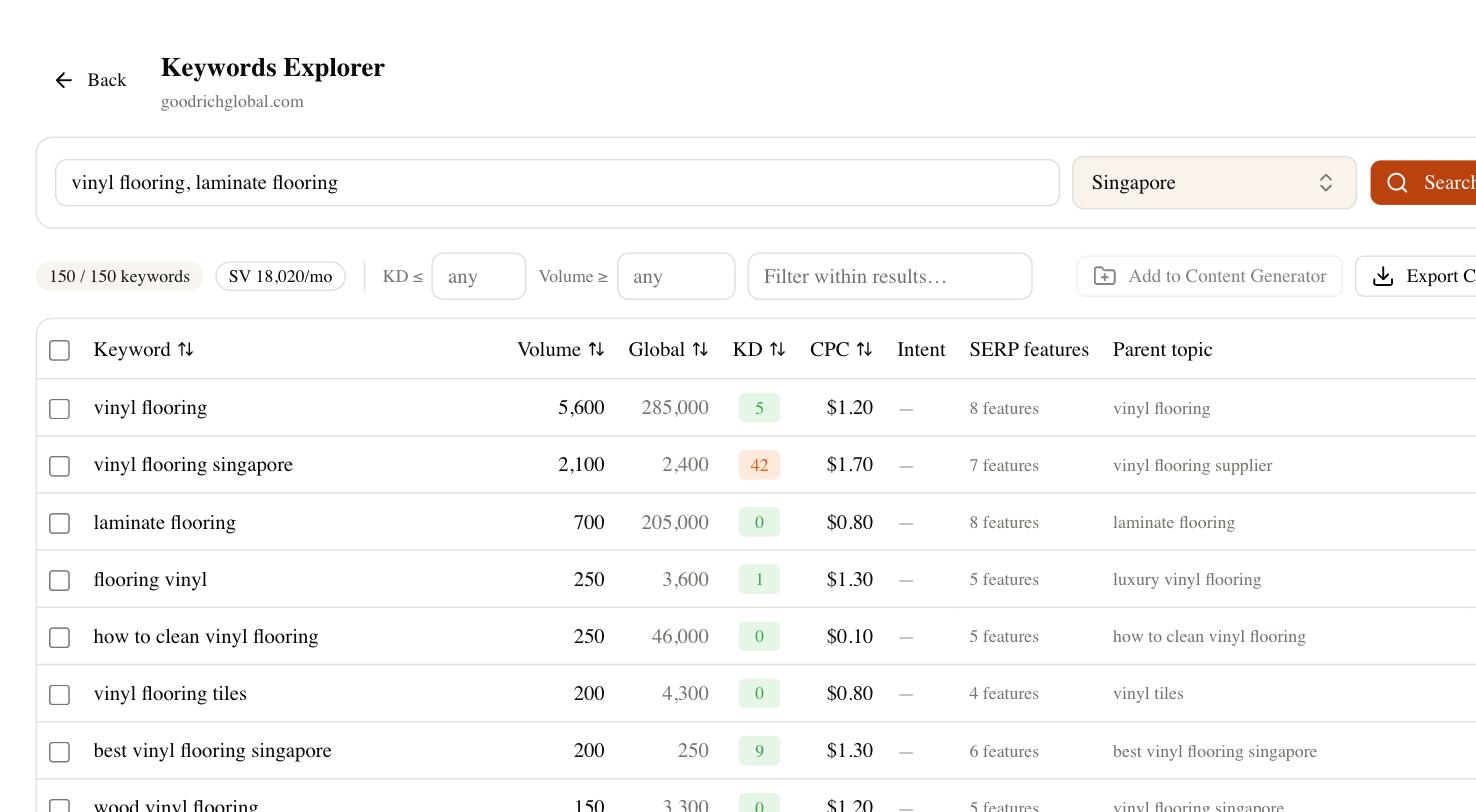
To build this list properly, start with a seed like “tattoo [your city]” and pull the related terms with their search volume and difficulty. You’re hunting for the style-plus-city combinations that have real volume but low competition — those are the pages worth building first. SEO Rocket’s Keywords Explorer surfaces those ideas on Ahrefs-grade data, so you can sort by volume and difficulty instead of guessing.
Google Business Profile is your homepage
For a tattoo shop, your Google Business Profile does more heavy lifting than your website. It’s what shows in the map pack, it’s where reviews live, and it’s the first thing a discovery searcher sees. Treat it like a primary channel, not an afterthought.
The high-leverage moves are unglamorous but they compound. Pick the right primary category (“Tattoo shop”), add every service you offer, and keep hours accurate — especially around holidays when walk-in traffic spikes. Post fresh portfolio photos regularly; Google favors active profiles and clients judge you on the work. Most importantly, ask every happy client for a review by name, because review volume and recency are among the strongest local ranking signals you can influence directly.
Reviews do double duty. They lift your local ranking, and they’re the deciding factor for a searcher choosing between three studios in the map pack. A shop with dozens of recent, detailed reviews mentioning specific artists and styles reads as busy and trusted. Respond to them too — a short, genuine reply to every review, good or bad, signals an active owner and gives you natural chances to mention the style keywords clients used. This is free, and most of your competitors won’t bother.
Build style and artist pages, not one thin site
The biggest structural mistake tattoo shops make is running a beautiful three-page website — home, gallery, contact — and expecting it to rank for everything. It won’t. Search engines rank pages, not vibes, and a single gallery page can’t compete for “cover up tattoo,” “fine line,” and “Japanese irezumi” all at once.
The fix is a page per style you specialize in and a page per artist. A dedicated “Cover-Up Tattoos” page with before-and-after photos, a description of your process, and honest talk about what’s possible will outrank a generic gallery every time someone searches that term. Artist pages matter too — regulars and referrals often search an artist by name, and a strong bio page captures that traffic while showcasing a specialty. This is also how you turn a portfolio into content that actually ranks.
Don’t build fifty pages for styles you rarely do. Pick the three or four you genuinely want more of — the work that pays best and that your artists love — and make those pages excellent. Each one should name the style in the heading, describe your approach in plain language, show your own work rather than stock images, and answer the obvious questions a client has before booking. A handful of focused, honest pages beats a sprawl of thin ones every time.
Common mistakes that cost tattoo shops bookings
A few errors show up again and again when studios audit their search presence. Fix these before you spend a dollar on anything fancier.
- Living entirely on Instagram. Social is great for portfolio proof, but you don’t own it and it barely ranks in Google. A studio with no crawlable website is invisible to discovery searchers.
- Inconsistent name, address, and phone. If your details differ across your site, Google, Yelp, and directories, local rankings suffer. Pick one exact format and use it everywhere.
- No service pages. One gallery can’t target every style. Missing style pages means missing the highest-intent searches.
- Ignoring reviews. Few reviews, or no responses to them, reads as inactive to both clients and Google.
- No mobile optimization. Nearly all “tattoo near me” searches happen on a phone. A slow or clunky mobile site loses the booking before the client sees your work.
Your first-90-days priority checklist
Order matters more than effort here. Work top to bottom and you’ll see movement before you finish the list.
- Claim and fully optimize your Google Business Profile — category, services, hours, photos.
- Fix name, address, and phone consistency across every listing you can find.
- Build one service page for each style you actually specialize in.
- Add an artist page per resident, with a bio and their best work.
- Set up a simple, repeatable system to request reviews after every session.
- Research your city-plus-style keywords and write two or three helpful posts (pricing, aftercare, choosing a design).
- Track your rankings for the local terms so you know what’s working.
None of this is quick-fix magic. Local rankings take a few weeks to respond and they jitter a little day to day, so judge progress over a full month, not a Monday. But the shops that put the boring fundamentals in place — a real website with style pages, a maintained profile, and a steady flow of reviews — consistently pull ahead of flashier studios that never got past a link-in-bio. Do the fundamentals, track what moves, and let the work speak.