SEO for web designers is a strange discipline, because you are selling the exact thing you need to do well. A prospect who finds you through search has already watched your site load, judged your typography, and formed an opinion about whether you can be trusted with their money — all before you say a word. That is why SEO for web designers is less about chasing traffic and more about ranking, in the right town, for the handful of searches a buyer types when they are ready to hire.
Most of that intent is local and commercial. Almost nobody who searches “web designer” is browsing for fun — they own a business, their current site embarrasses them, and they want someone nearby who can fix it. Get in front of those searches and you win projects. Chase vanity volume instead, and you rank for terms that never convert.
Why this niche plays by different rules
Three things make web design SEO unlike, say, ranking an ecommerce store. First, the money keywords are low-volume but high-intent: a term searched a few dozen times a month can be worth more to you than one searched thousands of times, because the searcher is a buyer with a budget, not a researcher. Second, the market is fiercely local — a business owner in Austin wants an Austin designer they can meet, so national rankings matter far less than showing up for “web designer Austin” and its neighbors. Third, your own site is the proof. A plumber can rank with an ugly site; you cannot. Every technical and design decision doubles as a live audition.
There is also a niche-within-a-niche opportunity most designers ignore. “Web design for dentists,” “Shopify designer for jewelry brands,” “law firm website design” — these vertical terms have almost no competition, and the buyers convert at far higher rates because you look like a specialist, not a generalist who will learn their industry on their dime. A dentist comparing three studios will always pick the one whose homepage speaks to dentists, even if the work is otherwise identical. That preference is worth more than a page-one ranking on a broad term you will never crack.
The keywords your buyers actually type
Before you write a single page, map intent. The table below groups the searches that matter for a designer or small studio, with the mistake to avoid on each. Volume numbers vary by market, so treat these as intent categories, not a ranking of value.
| Keyword pattern | Example | Intent | Priority |
|---|---|---|---|
| Service + city | web designer Portland | Ready to hire, local | Highest — your money page |
| Vertical + design | web design for restaurants | Specialist hire | High — low competition |
| Platform + designer | WordPress designer near me | Qualified, tech-specific | High |
| Outcome-based | website that converts | Problem-aware | Medium — blog + service |
| Cost / comparison | how much does a website cost | Researching, pre-buy | Medium — nurture content |
| Head term | web design | Broad, mixed | Low — rarely worth it |
The pattern is clear: your homepage and a few tight service-plus-location pages carry the commercial weight, while blog content earns the “cost,” “vs,” and “how to choose” searches that feed prospects into your pipeline weeks before they are ready to buy.
The highest-leverage moves
Start with a Google Business Profile if you have any local presence at all — even a home office. It is the fastest route into the local map pack, and for “designer near me” searches it often outranks your website. Fill it out completely, pick the right primary category, and gather a few genuine client reviews.
Next, build a real service page for each area and vertical you serve, not one thin “areas we cover” list stuffed with town names. A page titled “Website Design in Denver for Small Businesses” with actual local context, a relevant case study, and clear pricing signals will beat ten location tags on a single URL. Then turn your portfolio into content: every project write-up that explains the client’s problem, your approach, and the result is a page Google can rank and a buyer can relate to.
The mistakes web designers make
The cruel irony is that designers often build sites Google struggles to read. Heavy image-based hero sections with no real headings, entire pages rendered in JavaScript, text baked into graphics, gorgeous animations that push your largest content paint past the point where visitors and crawlers give up — these are craft choices that quietly kill rankings. Beautiful is not the same as findable.
The other classic error is neglect. You spend your billable hours perfecting client sites and let your own go stale for two years, with no new content, no fresh case studies, and a homepage that still says “2023.” You would never let a client ship that. Treat your own site as your most important project, because for search it is the only one that markets you. A third common error is aiming too high too soon — pouring months into ranking for a single-word head term while ignoring the low-competition local and vertical pages that would win real projects in a fraction of the time. Ambition is fine, but pay the rent first.
How SEO Rocket fits into the work
You did not become a designer to babysit twelve SEO tabs, which is where a chat-first tool earns its place. In SEO Rocket you ask for what you need in plain language — “show me the keywords a competing studio in my city ranks for that I don’t” — and it runs the lookup on real, Ahrefs-grade data underneath. The competitor gap feature is especially useful here: point it at two rival designers and it hands you the exact local and vertical terms you are missing.
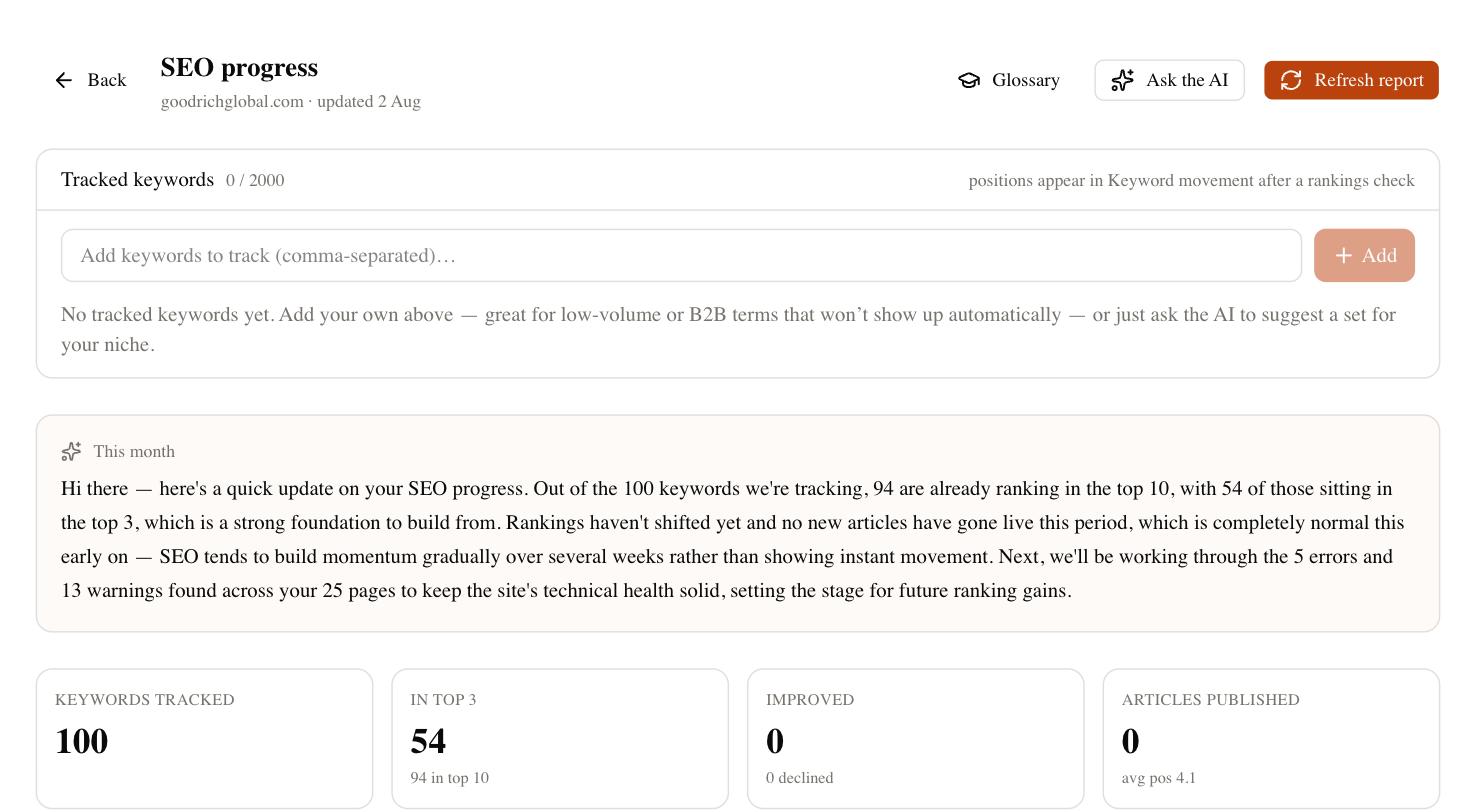
The site audit is worth running on your own portfolio first. It flags the render-blocking scripts, missing headings, and slow-loading images that designers create without realizing, so you can fix the exact issues that cost you rankings. Rank tracking then confirms whether your service-plus-city pages are climbing, and because it tracks local positions you see the ranking that actually matters rather than a national average. If you offer SEO as an add-on service — many designers do — the client dashboards let you hand a business owner a clean, white-label report without exporting a spreadsheet. Brand Radar rounds it out by showing whether AI tools like ChatGPT and Perplexity recommend you when someone asks for a designer, a search surface most of your competitors are ignoring entirely.
Where to start this week
You do not need to do everything. Work this short list in order and you will move faster than most studios in your market.
- Claim and complete your Google Business Profile — the quickest local win.
- Audit your own site for speed, headings, and readable text before touching keywords.
- Pick one vertical you enjoy and build a dedicated service page for it.
- Write one service-plus-city page for your primary location with a real case study.
- Run a competitor gap against two local rivals and steal their best keywords.
- Publish one portfolio case study a month to keep the site alive.
None of this is quick-win magic. Give a new page a full ranking cycle before you judge it, expect local positions to jitter a few spots day to day, and remember that the goal is not traffic for its own sake. The goal is that when a business owner three suburbs over decides they need a website, yours is the name search puts in front of them. Do that consistently and SEO stops being a chore you resent and becomes the channel that quietly fills your calendar.