
SEO for staffing agencies has a problem most guides ignore: your website serves two completely different audiences who search in opposite ways. Job seekers type one thing, hiring managers type another, and only one of those groups pays your invoices. Get that distinction wrong and you can rank well, get traffic, and still not book a single new client.
This guide is specific to how staffing and recruitment firms actually get found. SEO for staffing agencies works when you build for the employer’s search — the operations director who needs 15 warehouse temps by Monday, or the clinic manager short two nurses — not just the candidate scrolling job boards. Here is where the money is, the highest-leverage moves, and the mistakes that keep firms stuck.
Why staffing SEO is a two-sided problem
Every staffing site has two jobs. It has to attract candidates so you have people to place, and it has to attract employers so you have places to put them. Candidates search “warehouse jobs near me” or “remote customer service jobs.” Employers search “warehouse staffing agency” or “temp agency for manufacturing.” Those are different keywords, different pages, and different intent.
Here is the honest part: candidate traffic is easy to get and usually worthless to your bottom line. Job-seeker keywords are high volume but the searcher wants a paycheck, not your placement fee. Employer keywords are lower volume and far more competitive, but a single one can be worth a five-figure contract. Most agencies pour effort into the candidate side because the traffic numbers look good, then wonder why the pipeline stays dry.
The money keywords sit on the employer side
Your commercial keywords almost always combine three things: an industry or role, the word “staffing” or “agency” or “recruiter,” and often a location. That specificity is your friend. “Staffing agency” alone is brutally competitive and half the searchers are job seekers. “IT staffing agency Austin” or “light industrial staffing agency” is narrower, cheaper to rank for, and pulls in people ready to sign.
| Example keyword | Who’s searching | Intent | Priority |
|---|---|---|---|
| healthcare staffing agency Dallas | Clinic / hospital manager | Ready to hire | High |
| temp agency for warehouse workers | Operations lead | Ready to hire | High |
| IT staffing agency near me | Hiring manager | Ready to hire | High |
| staffing agency cost per hire | Employer researching | Comparison | Medium |
| how do staffing agencies work | First-time employer | Informational | Medium |
| warehouse jobs near me | Candidate | Job seeker | Low (fills roster, not pipeline) |
Notice the pattern. The high-priority terms name an industry and a buying signal. Build your keyword list by crossing every industry you staff against every service term and every city you cover, then check real search volume before committing. Many of these have modest volume, but the searcher is worth more than a hundred job seekers.
Build location and specialty pages that earn their place
The highest-leverage structural move is a set of dedicated pages: one per industry you specialize in, and one per market you serve. A general “we do staffing” homepage cannot rank for “medical staffing agency Phoenix” and “manufacturing recruiter Cleveland” at once. Google needs a distinct, substantial page for each intent.
The trap is thin, templated pages. Swapping the city name into the same 200 words across 40 pages used to work and now gets you filtered out. Each page needs real substance: the roles you fill in that industry, typical time-to-fill, local market context, client types, and genuine proof. A staffing firm that writes one strong page about placing CDL drivers will beat a competitor with fifty identical city stubs. Depth per page beats page count.
Get your Google Business Profile pulling weight
If you serve a defined region, local search is where employers find you fast. When someone searches “staffing agency near me,” Google shows the map pack before the regular results, and those three listings soak up most of the clicks. A complete, active Google Business Profile — correct category, service areas, real photos, and a steady flow of client reviews — is often the single fastest win available to a regional agency.
Reviews do double duty here. They lift your local ranking and they reassure a hiring manager who is about to trust you with a workforce gap. Ask every satisfied client for one, and make the ask part of your offboarding routine so it actually happens. Keep your name, address, and phone number identical across your site, your profile, and any directory listing — inconsistent details quietly drag down local rankings and confuse the people trying to call you.
The mistakes staffing agencies keep making
A few errors show up over and over. Firms optimize entirely for candidates, then can’t understand why traffic doesn’t convert. They publish one bland services page and expect it to rank for every industry and city. They ignore the “how do staffing agencies work” and “staffing agency vs direct hire” questions that first-time employers actually search before they ever look for a vendor.
Another quiet killer is neglecting the competitor gap. Your rivals are ranking for specific industry-plus-city terms you have never targeted, and each one is a booked client you are missing. And too many agencies chase rankings without tracking whether positions turn into inbound leads. Rankings jitter a few spots day to day; what matters is the trend and whether the phone rings.
How SEO Rocket fits a staffing workflow
SEO Rocket is built to run this exact playbook without a wall of dashboards. You ask in plain language — “what staffing keywords does this competitor rank for that I don’t” — and it runs the gap analysis on real, Ahrefs-grade data, then helps you draft the industry and location pages to close it. Rank tracking watches your money keywords, and Brand Radar shows whether AI tools like ChatGPT recommend your firm when someone asks for a recruiter in your niche, since more hiring managers now start there.
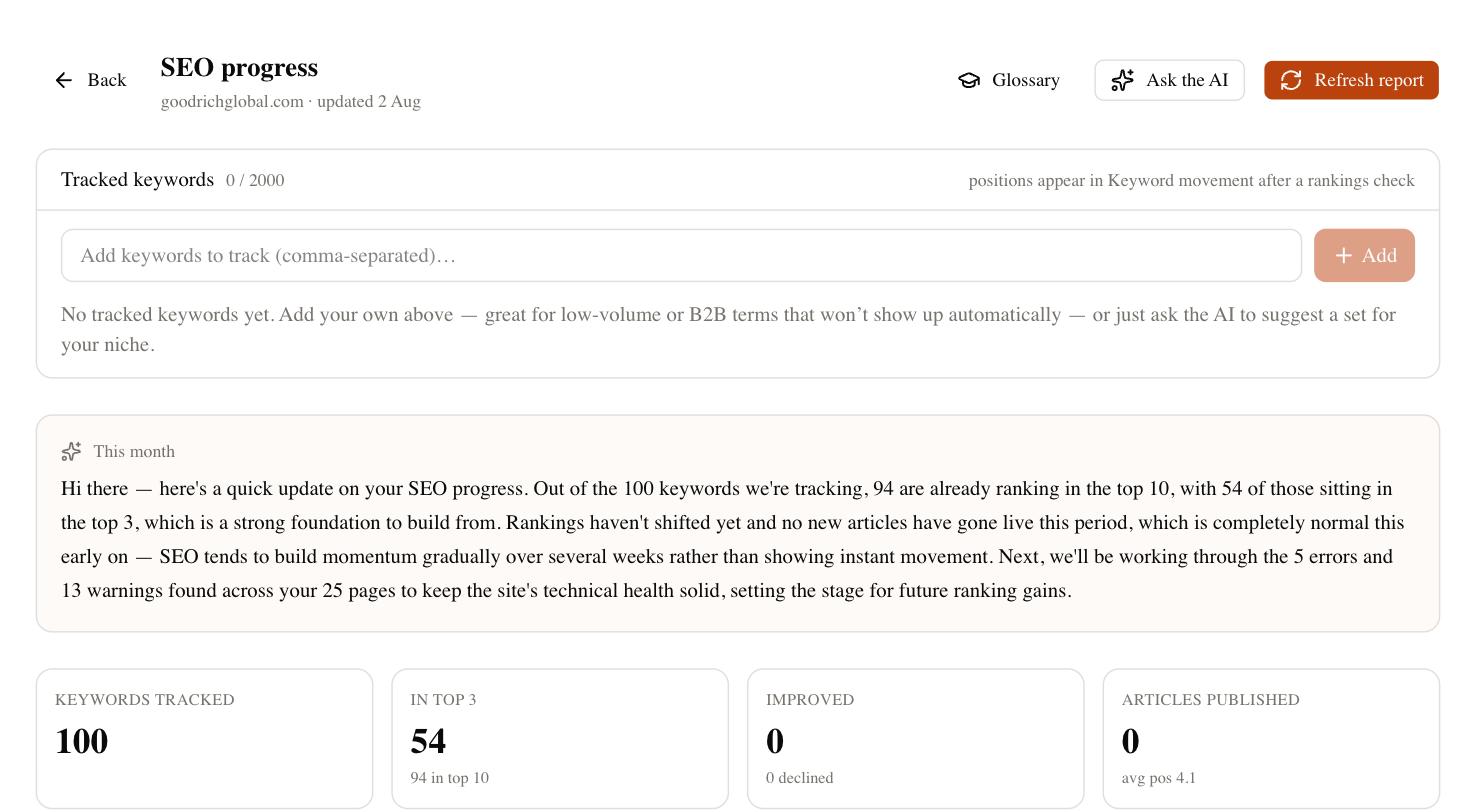
The client-dashboard side matters if you also do fractional or ongoing work. You can hand a stakeholder a clean, read-only report showing exactly which employer searches you are winning, without exporting spreadsheets. It keeps the story simple: here are the terms buyers use, here is where we rank, here is what it brought in.
A priority checklist to start this week
Do not try to do everything. Work in this order, and give any change a full ranking cycle before you judge it.
- List every industry you staff and every city you serve, then build your keyword grid from the crossover.
- Check real search volume and pick 8–12 employer-intent terms to target first.
- Write one substantial page per top industry and per top market — depth over templates.
- Complete and actively maintain your Google Business Profile; start a review routine.
- Run a competitor gap to find employer keywords your rivals rank for and you don’t.
- Track those money keywords and the leads they produce, not vanity candidate traffic.
Staffing is a relationship business, but the relationship starts with being found at the moment a hiring manager has an urgent gap. Point your effort at that searcher, build real pages for their exact need, and let the candidate traffic follow as a bonus rather than the goal. None of this pays off overnight — expect a few months before new pages settle and leads become steady — but it compounds. Every industry page and every review you bank keeps working long after you publish it, which is more than you can say for the ad spend most agencies lean on instead.