Most advice on SEO for podcasts quietly assumes an episode behaves like a web page. It doesn’t. SEO for podcasts is really two jobs stacked on top of each other — being discoverable inside Apple Podcasts and Spotify, and ranking in Google — and each one plays by rules you barely control. Treating them as one problem is why so much podcast promotion disappears into nothing.
The core constraint is simple: search engines can’t listen. A crawler sees your MP3 as an opaque file. Everything a machine understands about your show — the topic, the guest, the takeaways — comes from the text wrapped around that audio. So podcast SEO is less about audio and more about how well you turn sound into words that title fields, show notes, and transcripts can carry.
Why podcasts play by different rules
On a normal website you own the URL, the title tag, the meta description, the internal links, the page speed, the structured data, and the redirects. On the two platforms where most listening happens, you own almost none of that. Your episode lives on Apple’s or Spotify’s domain, on their template, at a URL you didn’t choose and can’t customize. You cannot add a canonical tag, you cannot 301 an old episode to a new one, and you cannot touch how fast their app renders.
What you do control flows through one pipe: your RSS feed. Your show title, author name, category, episode titles, episode descriptions, and cover art all come from that feed and get read by every directory that ingests it. That’s the whole surface area. It’s narrow, and it’s shared across platforms, so a keyword-stuffed title that helps nothing on Google can actively hurt you in Apple’s cleaner search.
What you can and can’t control
Be clear-eyed about the surface you’re working with before you spend an hour “optimizing” something the platform ignores.
| SEO lever | Your own website | Apple / Spotify episode |
|---|---|---|
| Custom URL / slug | Yes | No |
| Title tag & meta description | Yes | Feed title/description only |
| Structured data (schema) | Yes | No |
| Redirects / canonicals | Yes | No |
| Page speed & rendering | Yes | No |
| Internal links | Yes | No |
| Full searchable transcript | Yes | Partial (auto-generated) |
| Category / show metadata | n/a | Via RSS feed |
The pattern is obvious once you see it: nearly every real ranking lever lives on your own site, not on the directories. The directories are distribution. Your website is where you win Google.
Transcripts are your highest-leverage move
If you do one thing, publish full transcripts. A 40-minute episode is roughly 6,000 words of long-tail language — questions, product names, objections, the exact phrasing your audience uses — and none of it is indexable until it’s text. Spotify and Apple have both rolled out auto-transcription inside their apps, which helps in-app discovery, but that text lives on their platform and does nothing for your Google rankings.
Put the transcript on your own episode page and it becomes crawlable content you own. Clean it up, add speaker labels and timestamps, and break it with subheadings so it reads like an article rather than a wall of speech. Raw auto-generated text works, but ten minutes of light editing to fix names and punctuation makes it far more readable — and readable pages hold rankings longer. This is also the layer AI search reads: when someone asks ChatGPT or Perplexity a question your guest answered, a transcript is what makes your show quotable. Audio alone never gets cited, no matter how good the conversation was.
Titles and show notes that get found
Episode titles carry more weight than anything else in directory search, so front-load the words people actually type. “How to price freelance work” beats “Episode 47: Money Talk” every time, because Apple’s search leans heavily on title and author fields and no one searches for your episode numbers. Keep the clever hook if you must, but put it after the searchable phrase, not before it.
Show notes are your description real estate. Write a genuine 100-to-200-word summary — not a link dump — that states what the episode covers and names the guest and their company. Add timestamps for the segments, because both listeners and platforms use them, and keep your most important sentence first since apps truncate descriptions aggressively. Write these notes for a human skimming their podcast app, and the search benefit follows on its own; write them purely for a crawler and you get a paragraph no one finishes reading.
Build real pages on your own domain
Every episode deserves a page on a domain you control. That page is where you get the URL, the title tag, the internal links to related episodes, and the PodcastEpisode structured data that directory listings can’t offer. Embed the player, publish the transcript beneath it, and link the page from your homepage so it isn’t an orphan.
This is also where video matters. YouTube has quietly become one of the largest podcast platforms, and a video version gives you a second search engine plus a second transcript surface. If recording video is realistic for you, it roughly doubles your discoverable footprint for the same conversation.
The mistakes that waste the most effort
The biggest one is treating Apple and Spotify as your SEO home. They’re rented land — you can’t customize the URL, you can’t add schema, and you inherit their limitations. Build on your own domain and syndicate out, not the reverse.
The other common traps are quieter. Clever titles no one searches. No transcript, so 6,000 words of content stay invisible. Miscategorizing the show in the wrong Apple category, which buries you against the wrong competition. And chasing broad head terms like “marketing” when your realistic wins are specific, lower-competition questions your episodes already answer.
Where SEO Rocket fits
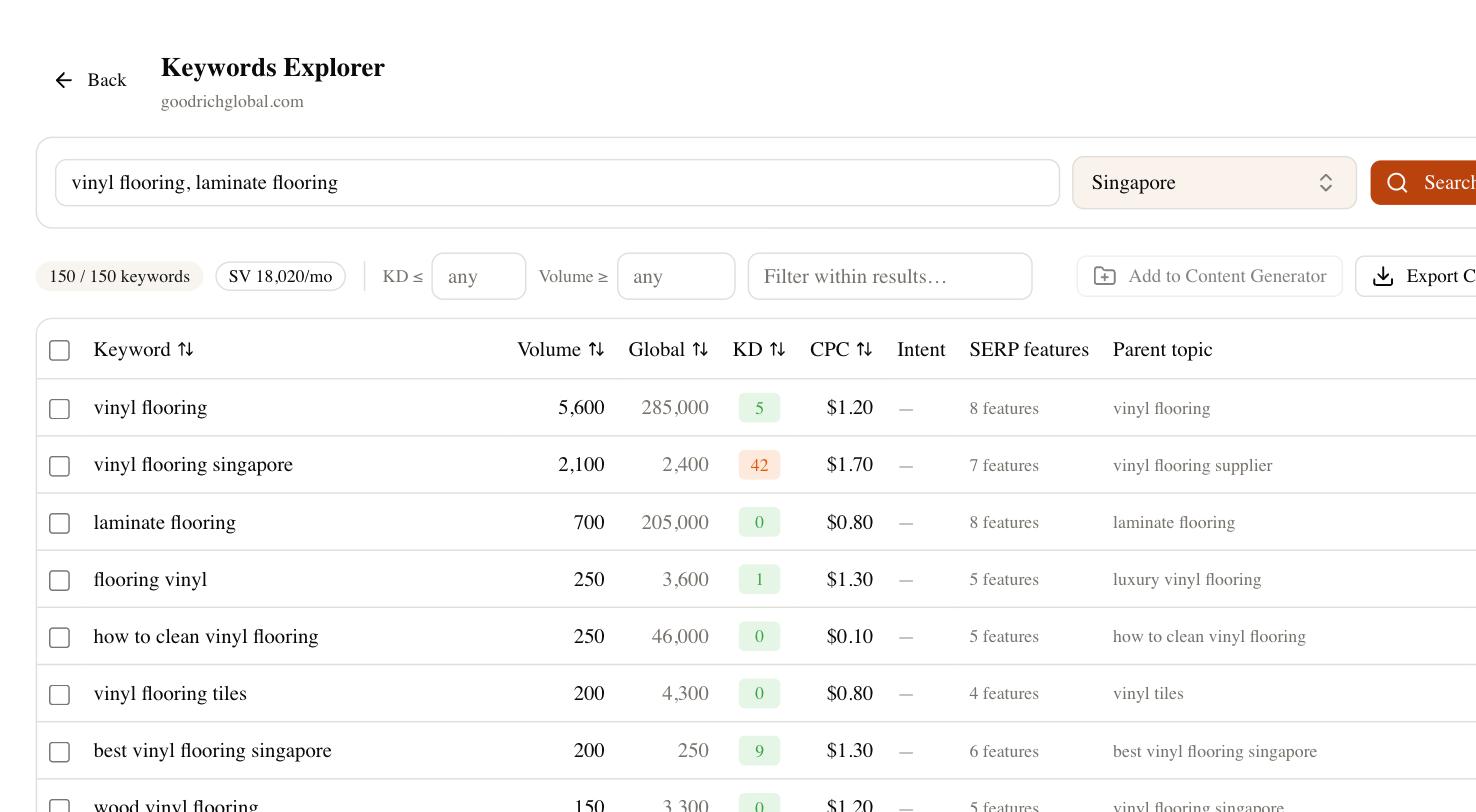
The tooling maps cleanly onto the work. Use Keywords Explorer to find the questions worth building episodes and pages around — you want terms with real volume and beatable difficulty, not vanity phrases. Run a competitor gap analysis against other shows in your niche to see which topics they rank for and you don’t. Point rank tracking at your episode pages so you know whether the transcript and schema are actually earning positions, and lean on the site audit to catch the technical issues — slow pages, broken internal links, missing metadata — that quietly hold a podcast site back.
Then there’s the newer surface: Brand Radar shows whether your show gets mentioned in AI answers on ChatGPT, Perplexity, and Google’s AI Overviews. For a podcast, that’s often where a well-transcribed, quotable episode pays off first. Good seo for podcasts isn’t a directory trick — it’s turning conversations into text that both Google and AI search can find, on pages you own.