
A thin content penalty is what happens when Google decides that some or all of a site’s pages provide too little unique value to be worth ranking — and unlike more dramatic spam penalties, it usually shows up as a slow, confusing decline rather than a sudden crash, which makes it one of the harder problems to diagnose correctly. Thin content isn’t always intentional or malicious; it’s often just old pages that were fine five years ago, product pages with nothing but a spec sheet, or an over-eager content push that prioritized volume over depth. This guide is a practical diagnose-and-fix walkthrough: how to tell if thin content is actually your problem, how to identify which pages are affected, and how to fix it in a way that holds up.
What “Thin” Actually Means to Google
Thin content isn’t strictly a word-count problem, even though word count is often the easiest symptom to spot. Google’s own quality guidance describes thin content as pages that provide little or no added value relative to other pages already available for the same query — that can mean a page that’s short but also a page that’s long yet padded, repetitive, or entirely derivative of other sources without adding anything distinct. The categories that most often get flagged are auto-generated pages with no editorial input, thin affiliate pages that mostly just link out to a merchant with minimal original commentary, doorway-style pages with near-duplicate content across many URLs, and scraped or lightly reworded content pulled from other sites. The common thread isn’t length — it’s the absence of anything a reader couldn’t get equally well, or better, somewhere else.
How to Tell If Thin Content Is Actually Your Problem
Before treating every short page as guilty, confirm the diagnosis. Pull up Google Search Console‘s Performance report and look for a gradual decline in impressions and clicks across a broad set of pages, rather than a sharp cliff on one specific date — sharp cliffs usually point to an algorithm update or manual action affecting something else, while gradual erosion is more consistent with a widening thin-content problem. Cross-check the Coverage/Indexing report for pages marked “Crawled – currently not indexed” or “Discovered – currently not indexed,” since these statuses are one of Google’s clearest signals that it evaluated a page and decided it wasn’t worth adding to the index — thin content is one of the most common reasons for that exact status. Finally, sample a handful of your lowest-traffic indexed pages and read them as a stranger would: would this genuinely answer the query better than, or as well as, the top three results currently ranking for it? If not, you likely have a thin content problem, and the Search Console data is telling you where.
Diagnosing Which Pages Are Affected
A practical audit works best in three passes. First, export your full URL list with organic traffic and word count from your CMS or a crawler, and sort for pages with meaningful indexation but near-zero traffic over the past six to twelve months — these are your prime suspects. Second, group pages by template or type (product pages, location pages, old blog posts, tag/category pages) since thin content problems are usually systemic to a page type rather than randomly scattered, which also tells you where a fix will have the most leverage. Third, check for internal duplication by comparing content across pages within the same template — if fifty product pages share 80% of their copy with only the product name changed, that’s a thin-and-duplicate combination that compounds the problem rather than two separate issues.
| Symptom | What to check | Fix |
|---|---|---|
| Gradual traffic decline across many pages | GSC Performance report, trend over 6-12 months | Content depth audit by page template |
| “Crawled – currently not indexed” status | GSC Coverage/Indexing report | Expand content or consolidate with a related page |
| Pages ranking below competitors with similar or lower word count | Manual SERP comparison against top 3 results | Add unique value: data, examples, original analysis |
| High template-level duplication | Cross-page content similarity check within a page type | Differentiate each page with genuinely unique detail, or merge into fewer, stronger pages |
| Old content, never updated, declining relevance | Publish/last-modified dates vs. topic freshness needs | Refresh with current information, re-publish with updated date |
Fixing Thin Content: Expand, Consolidate, or Remove
Once you’ve identified the affected pages, each one generally falls into one of three fixes. Expand is right for pages covering a genuinely worthwhile topic that’s just underdeveloped — add real depth: original examples, data, images, FAQs that address actual user questions, and enough substance that the page would hold up against the current top-ranking results for that query. Consolidate is right when you have multiple thin pages competing for the same or very similar intent — merge them into one comprehensive page and 301-redirect the others, which concentrates whatever link equity and relevance signals existed across the set instead of splitting them thin. Remove (or noindex) is right for pages that serve no real purpose anymore — outdated promotions, duplicate tag/category archive pages, or auto-generated pages with no realistic path to being genuinely useful; pruning these can actually improve a site’s overall quality signals rather than just cutting dead weight.
Preventing It From Coming Back
The recurring cause of thin content problems is almost always a content strategy optimized for coverage over depth — publishing to hit a keyword list rather than to genuinely serve a topic. The fix at the process level is to set a real minimum bar before anything gets published: does this page say something a reader can’t get equally well from the top three current results? If the honest answer is no, it needs more work before it goes live, not after Search Console flags it six months later. It also helps to build a light content-quality review into your publishing calendar — revisiting older pages annually to check whether they still hold up against current competition, since a page that was sufficiently deep two years ago can become thin by comparison as the competitive bar rises.
Where AI Tools Fit In (and Where They Don’t)
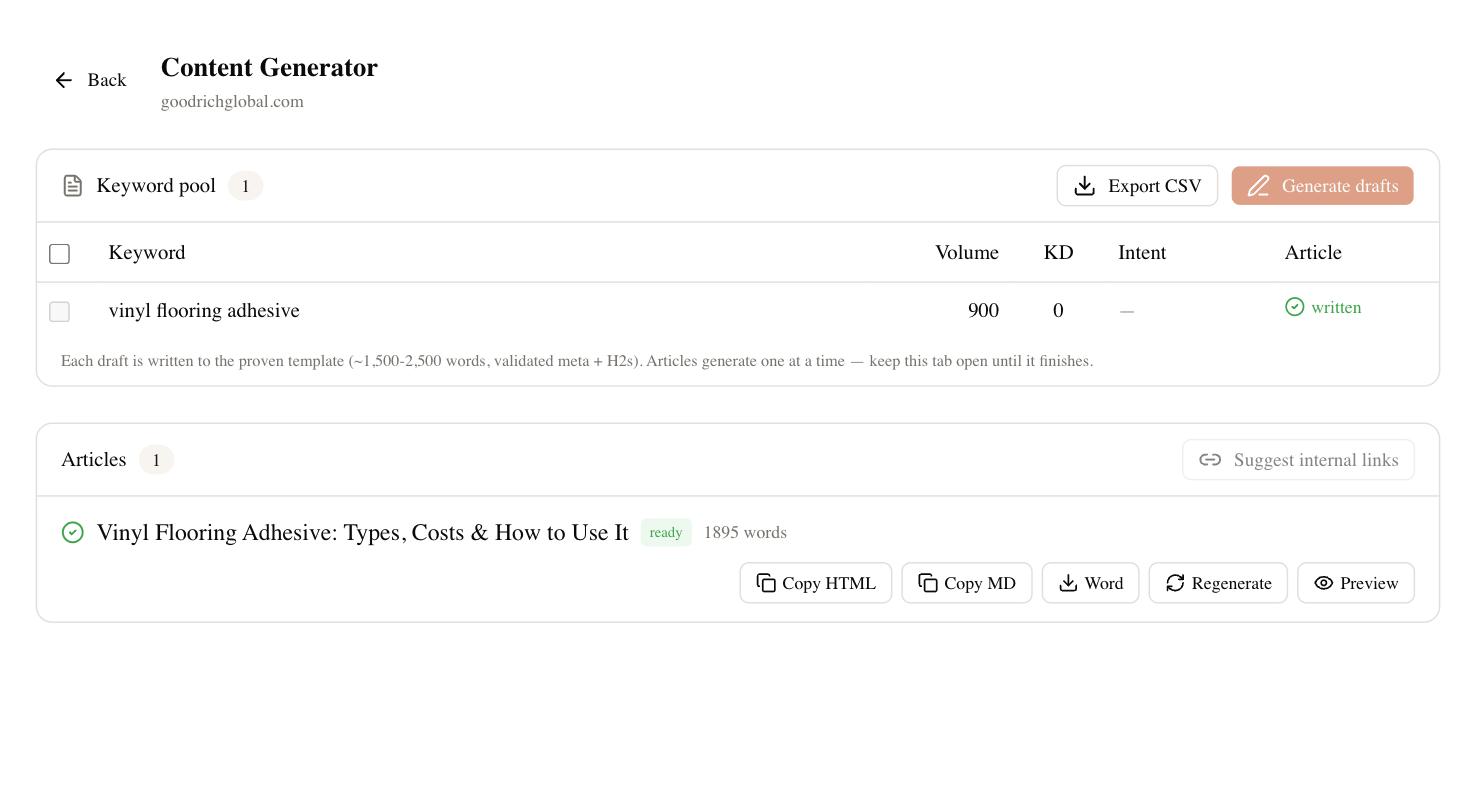
AI-assisted writing gets unfairly blamed for thin content, but the tool isn’t the problem — undirected, low-effort prompting is. Content generated from a vague one-line prompt with no research grounding tends to be generic and thin regardless of word count, which is exactly the pattern Google’s helpful content systems are built to catch. Used properly, AI content tools can actually reduce thin-content risk rather than cause it: SEO Rocket’s Content Generator builds articles from real keyword and Content Gap data pulled from Ahrefs, meaning each page is scoped around what’s genuinely missing from the current search results rather than a generic rewrite of the topic. Running a Content Gap analysis before writing anything also directly surfaces which of your existing pages are thin relative to what’s actually ranking, turning the audit and the fix into the same workflow instead of two separate projects.
Frequently Asked Questions
Is there a minimum word count that avoids a thin content penalty?
No official minimum exists. A 300-word page can be perfectly sufficient if it fully answers a narrow query, and a 2,000-word page can still be thin if it’s padded and repetitive. Depth relative to the query matters more than a specific count.
How long does it take to recover after fixing thin content?
It varies, but expect weeks rather than days — Google needs to recrawl and re-evaluate the updated pages, and algorithmic quality reassessments generally aren’t instant. Consolidated pages with 301 redirects tend to recover faster than pages left in place and merely expanded.
Can thin content on a few pages hurt the whole site?
It can contribute to a broader quality perception, especially if thin pages make up a large share of the site’s indexed URLs, though a small number of thin pages on an otherwise strong site is a much lower risk.
Should I noindex thin pages instead of fixing them?
Only if the page genuinely has no path to being useful. If the topic has real search demand, expanding or consolidating is usually the better long-term move than removing the page from the index entirely.
If you want to know exactly which of your pages are thin relative to what’s actually ranking, SEO Rocket’s Content Gap analysis and Technical Audit tools run on real Ahrefs data to show you where the gaps are — and the Content Generator helps you fix them with original, SEO-validated content. Start free at app.seorocket.ai.