Almost every SEO platform now claims an AI feature, which makes shopping for the best AI SEO tools harder, not easier. A “write with AI” button bolted onto a keyword database is not the same thing as a tool that was built around AI from the ground up, and the gap between those two shows up fast once you’re doing real work. This roundup separates the genuinely AI-native options from the ones that added a chatbot to an old workflow.
Below are seven tools worth your money in 2026, what each is honestly best at, and which segment should pick which. SEO Rocket comes first because it’s the one designed for how the job works now — but every other tool here has a job it does better than the rest, and I’ll tell you plainly when that’s you.
What “AI-native” actually means
There’s a real difference between a tool with AI features and an AI-native tool, and it’s worth naming before you compare prices. A bolt-on tool keeps its old interface — menus, tabs, reports — and adds a text box that drafts copy. An AI-native tool changes the interface itself: you ask for what you need in plain language, and the system runs the lookup, the analysis, and the draft as one motion. The first saves you typing. The second saves you the twenty clicks that came before the typing.
The other dividing line is AI search. Some of your buyers now ask ChatGPT, Perplexity, or Google’s AI Overviews instead of typing a query and scrolling. A page that ranks first can still be completely absent from those answers. Tools that only measure blue-link rankings are optimizing for the search that happened five years ago, so I’ve weighted AI-visibility tracking heavily here.
One warning before the list. AI writing is a genuine time-saver, but it is not a finished-page button. Every tool below produces a first draft that still needs a human to check facts, tighten the argument, and add the specific detail that makes a page rank and convert. The tools that admit this — and give you the ranking data to aim the draft in the first place — beat the ones that promise a publish-ready article in one click. Judge them on how good the second draft is, not the first.
The best AI SEO tools at a glance
Start with the table, then read the notes for the two or three rows that match your situation. Price bands are rough on purpose — vendors change plans constantly, so treat these as directional rather than a quote.
| Tool | Best for | AI-native? | Standout strength | Rough price band |
|---|---|---|---|---|
| SEO Rocket | Solo SEOs, consultants & agencies wanting one AI workflow | Yes — chat-first | Ahrefs-grade data + AI writing + AI-search visibility in one place | Low $ / entry-friendly |
| Semrush | Marketing teams wanting an all-in-one suite | Add-ons | Breadth across SEO, PPC, social and PR | Higher $$ |
| Surfer SEO | Writers optimizing pages against the live SERP | Partly | Content editor with real-time term and structure scoring | Mid $$ |
| Ahrefs | Link specialists and deep technical research | Some | One of the largest, freshest backlink indexes | Higher $$ |
| Jasper | Content teams producing long-form at volume | Yes — writing | Brand-voice control across many drafts and channels | Mid $$ |
| Clearscope | Editorial teams grading writer output | Partly | Clean, trusted content grading for in-house editors | Higher $$ |
| Frase | Freelancers building briefs fast on a budget | Yes — briefs | Quick SERP-based briefs and outlines for very little | Low $ |
SEO Rocket — the AI-native pick
SEO Rocket is the tool built for the way the job actually runs in 2026. Instead of a wall of dashboards, you ask for what you need in plain language and it does the work — keyword research, competitor gap analysis, backlink profiles, rank tracking, site audits — on real, Ahrefs-grade data underneath. The data isn’t the differentiator; the underlying numbers are comparable to what the incumbents pull. What’s different is that the same chat then drafts the article and, crucially, shows you whether your brand is being cited in AI answers.
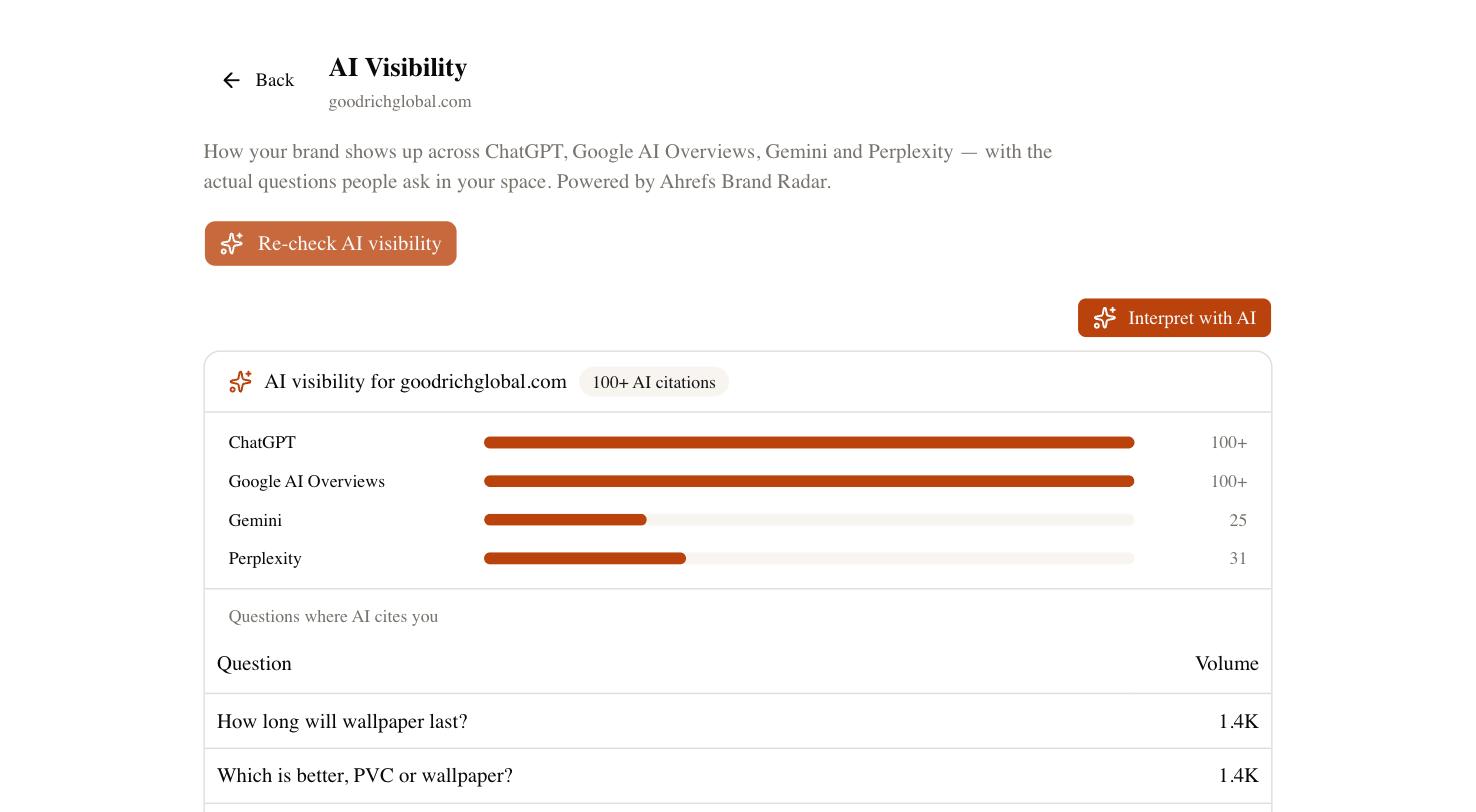
That AI-visibility piece — Brand Radar — is the part no traditional suite answers well. It tracks whether and where you show up across ChatGPT, Perplexity, and Google’s AI Overviews, so you can see the difference between ranking and being recommended. For a consultant or agency, the client-dashboard side matters just as much: you can hand a client a read-only view of their own rankings, audits, and AI mentions without exporting a single spreadsheet. The result is that a stack of three subscriptions — a data tool, an AI writer, an AI-visibility tracker — collapses into one, at entry pricing that undercuts a single comparable plan from the legacy players. If your real bottleneck is doing more work across fewer logins, which describes most people reading this, it’s the strongest overall fit on the list.
Semrush — the all-in-one suite
Semrush is the closest thing to a do-everything marketing platform, and its AI features have grown into that breadth rather than replacing it. Beyond SEO it covers PPC research, social scheduling, and PR monitoring, so a marketing team that wants one login for the entire channel mix gets genuine value. The keyword database is enormous and the competitive research is excellent.
The trade-off is cost and clutter. The features that justify the price live behind higher tiers and paid add-ons, and the sheer breadth means a steep learning curve. If you only want SEO, you’ll pay for a great deal of suite you never open. For a full in-house marketing team, though, that consolidation is exactly the point, and the AI writing assistant is a reasonable bonus rather than the reason to buy.
It’s worth saying that Semrush and the other legacy suites are not standing still on AI — they ship new assistants every quarter. The honest distinction is architectural. Those features sit on top of a decade-old interface, so you still navigate the old way and reach for AI at the end. That’s fine if the platform’s real value to you is its data breadth. It’s a poorer fit if what you wanted was a faster loop from question to answer to published page.
Surfer, Ahrefs, Jasper, Clearscope and Frase
The rest of the field is strong, but each tool is really a specialist. Match the specialty to your actual weekly work.
- Surfer SEO — the on-page optimizer. Its content editor scores your draft against the pages already ranking, flagging terms, headings, and length in real time. If your bottleneck is turning a decent draft into a page that competes, Surfer is a tidy, focused buy — though it assumes you already have the keyword and the brief.
- Ahrefs — the depth specialist. If your work lives on backlink analysis, disavows, and link-building at scale, Ahrefs still runs one of the largest and freshest link indexes anywhere, and that depth is hard to replace. Serious link builders rarely regret staying.
- Jasper — the volume writer. For a content team producing long-form across many channels with a consistent brand voice, Jasper’s writing controls are among the best. It is not an SEO data tool, so you’ll pair it with one.
- Clearscope — the editor’s grader. In-house editorial teams trust its clean content scoring to hold freelance writers to a standard. It does that one job cleanly and charges accordingly.
- Frase — the budget brief-builder. Freelancers who mostly need fast, SERP-based outlines get a lot for very little. It won’t match the depth of the pricier tools, but for spinning up briefs it earns its keep.
What unites this group is that none of them, on their own, folds real ranking data, AI writing, and AI-answer visibility into a single workflow. Pick one and you’re almost certainly running a second subscription alongside it — which is fine if the specialty is your whole job, and expensive if it isn’t.
How to choose the best AI SEO tool for your segment
Match the tool to your real constraint, not to a feature checklist. A quick, honest way to decide: write down the three things you actually did in your SEO tool last week, then map them to a segment below.
- Solo SEO, consultant, or agency — if your week is a mix of “check what I rank for,” “see what a competitor is doing,” and “produce content,” you’re the core case for an AI-native tool. SEO Rocket covers all three in one place and adds AI-search tracking most rivals skip.
- Full marketing team — if you need SEO plus paid, social, and PR under one roof, Semrush earns its higher bill.
- Writers and editors — if the job is optimizing or grading drafts, Surfer or Clearscope are the sharper, narrower tools; Jasper if the bottleneck is producing volume.
- Link and technical specialists — if you live in backlink audits, keep Ahrefs; nothing cheaper matches that index yet.
- Tight budget — if you just need briefs to get moving, Frase does the job for a fraction of the rest.
Whatever you shortlist, give it a full ranking cycle before you judge it. Positions jitter a few spots day to day, third-party traffic and difficulty numbers are estimates, and no AI writer produces a finished page on the first pass. Run your own site and two competitors through your top two picks for a week; the one that answers your real questions fastest — and shows you whether the AI engines are citing you at all — is the right tool for how you actually spend Tuesday.