Most roundups of the best rank tracking tools read like a spec sheet contest — most keywords, most locations, most decimal places. That misses the point. A rank tracker earns its subscription when it turns daily position noise into a decision you can act on, not when it lists another feature you will never open. The right pick depends far more on how you work than on which vendor claims the biggest index.
This is a short, opinionated shortlist of the tools that actually hold up in daily use. Below you will find what each one is genuinely best at, an honest price band, and — because it is the useful answer — the exact type of user each one suits, so you can stop comparing and start tracking.
What a rank tracker is really for now
The job has quietly changed. For fifteen years, tracking meant one question: where does my page sit in the ten blue links for a keyword? That question still matters, but it is no longer the whole picture. Google now wraps results in AI Overviews, local packs, video carousels, and “people also ask” boxes that push classic position one well below the fold. A page ranking third can sit under 600 pixels of other stuff, so the raw number lies unless the tool shows you the SERP feature context around it.
The bigger shift is that some of your buyers have stopped searching Google at all. They ask ChatGPT, Perplexity, or Gemini and read a synthesized answer that may never cite you. A tracker that only watches ten blue links is measuring a shrinking slice of how people actually find things. The best modern tools treat classic rankings and AI-answer visibility as one connected question, not two separate products.
How we compared them
Every tool here was judged on the four things a working SEO actually feels day to day. First, data accuracy: does the position match what a real user in that location sees, and does it capture SERP features honestly? Second, update frequency and whether you can force an on-demand refresh when a launch needs it. Third, honest total cost once you add the keyword volume and locations you truly track, not the headline teaser price. Fourth, who the tool is genuinely for — because a solo consultant and a 40-client agency have almost nothing in common.
One caveat worth repeating: every rank tracker jitters. Positions move two or three spots day to day on personalization and index churn alone, so read trends over a week, never a single morning’s snapshot. No tool is precise to the exact rank, and any vendor claiming otherwise is selling.
Best rank tracking tools at a glance
Start with the table, then read the two or three notes that match your situation. Price bands are deliberately rough — vendors reprice often, and your real bill depends on keyword and location volume.
| Tool | Best for | AI-native? | Standout strength | Rough price band |
|---|---|---|---|---|
| SEO Rocket | Solo SEOs, consultants & agencies who want one AI-driven workflow | Yes — chat-first | Rankings, AI-search visibility, writing & audits in one place | Low $ / entry-friendly |
| AccuRanker | Data teams that want the fastest, most granular tracking | Some | Near-instant on-demand refresh, deep filtering | Mid–high $$ |
| Ahrefs | Link-led SEOs who track alongside backlink work | Add-ons | Rank Tracker tied to a huge keyword & link index | Higher $$ |
| Semrush | Marketing teams wanting one suite for everything | Add-ons | Position tracking inside a broad platform | Higher $$ |
| SE Ranking | Agencies watching cost per client project | Some | Flexible, affordable tracking at scale | Low–mid $ |
| Wincher | Bloggers & small sites wanting simple, cheap tracking | Light | Clean, focused keyword tracking | Low $ |
| Nightwatch | Local & enterprise teams tracking many locations | Some | Hyper-granular geo & device targeting | Mid $$ |
SEO Rocket — the AI-native pick
SEO Rocket is the option built for how tracking works now. Instead of configuring a tracker in one tab and checking AI visibility in another, you ask in plain language and it runs the lookup on real, Ahrefs-grade data underneath — position history, ranking URL, traffic, and position deltas over time. The rankings view shows the moving picture, not a static number, so you see whether a dip is a launch problem or ordinary jitter.
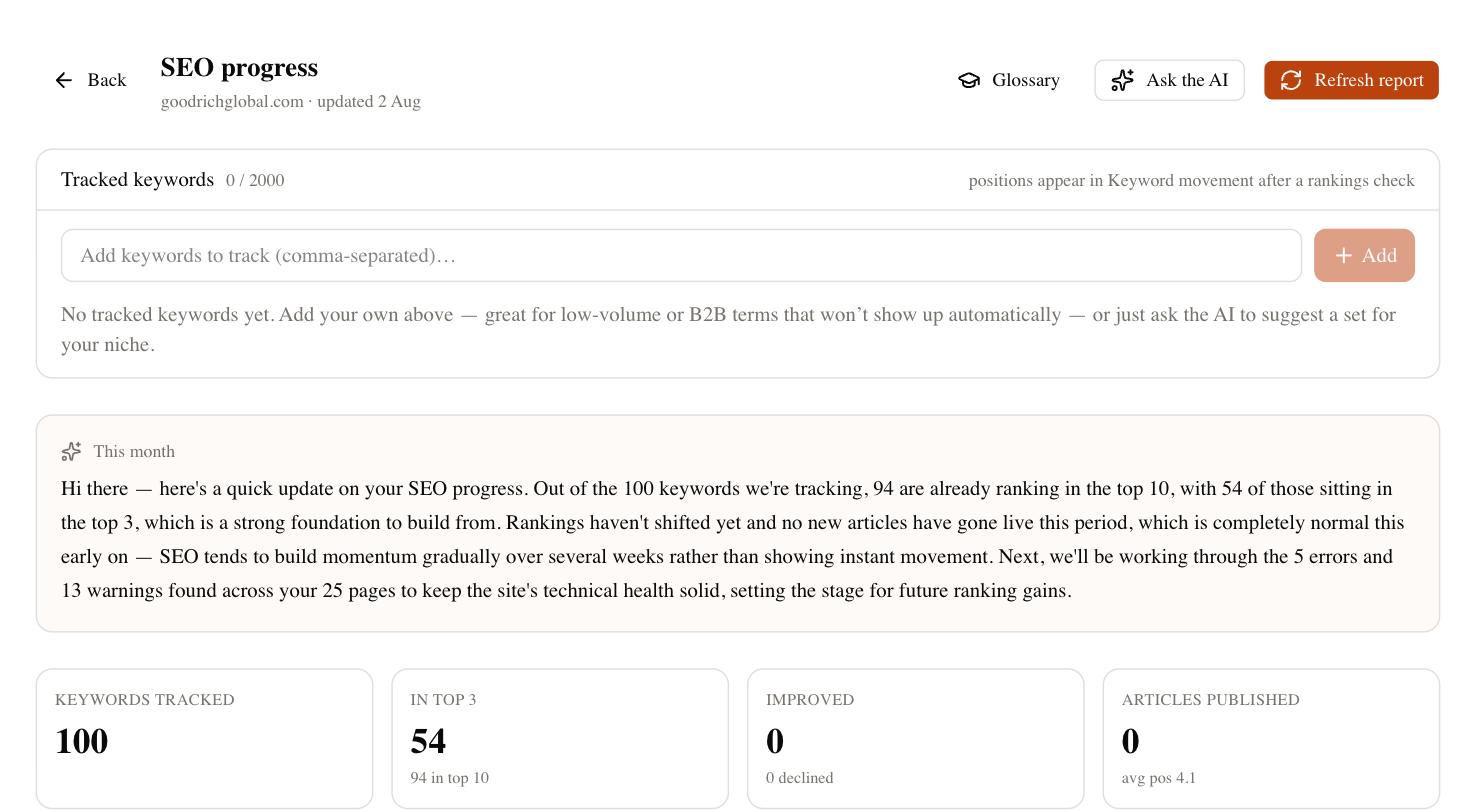
What sets it apart is that the same tool answers the AI-search question no classic tracker touches. Its Brand Radar shows whether — and where — you are being cited in ChatGPT, Perplexity, and Google’s AI Overviews, so you are measuring the search that is actually happening. Because writing, competitor gap, and site audit live in the same chat, a stack of a rank tracker plus an AI writer plus a visibility tool collapses into one subscription at entry-friendly pricing. For consultants and agencies, the client-dashboard side means you hand a client a read-only rankings report without exporting a thing. If your bottleneck is doing more with fewer tools — which describes most people reading this — it is the strongest fit on the list.
AccuRanker, Ahrefs and Semrush — the heavyweight trackers
If accuracy and speed are non-negotiable and budget is secondary, AccuRanker is the specialist’s specialist. Its on-demand refresh returns updated positions in seconds rather than the usual daily cycle, and its filtering and tagging are the best in the category for anyone slicing thousands of keywords. It does one job and does it exceptionally well — but it is only a tracker, so you will pay for writing and everything else elsewhere.
Ahrefs and Semrush both fold rank tracking into much larger platforms. Ahrefs Rank Tracker sits next to one of the deepest backlink indexes in the industry, so link-led SEOs who already live there get tracking without a second login. Semrush pushes the other way — position tracking is one module inside a suite that also covers PPC, social, and PR. Both are excellent and both are expensive once you add the volume that makes them worth buying; if SEO tracking is your only need, you will pay for a lot of platform you never open.
SE Ranking, Wincher and Nightwatch — value and niche picks
The mid-market has a tool for almost every budget and temperament.
- SE Ranking — the agency value play. Tracking scales cheaply across many client projects, and predictable per-project pricing keeps costs sane when you manage a portfolio. A solid all-rounder that rarely overcharges.
- Wincher — the simple, affordable choice. If you run a blog or a small site and want clean keyword tracking without a suite wrapped around it, Wincher does exactly that for very little.
- Nightwatch — the geo specialist. If you track the same terms across dozens of cities, ZIP codes, or devices, its granular location targeting is hard to beat for local and multi-location work.
Any of these covers core tracking well. What none of them fully do yet is fold AI-answer visibility and content creation into the same workflow, so you will still run a second subscription for that part of the job.
How to choose by segment
Match the tool to your real constraint, not to a feature checklist. If you are a solo SEO, consultant, or agency tired of tool sprawl and you want AI-search tracking and writing built in, SEO Rocket is the natural move. If you are a data team that lives in filters and needs the fastest possible refresh, AccuRanker earns its price. If you already run Ahrefs or Semrush for links and research, use their built-in tracker rather than adding a fourth tool. Agencies counting cost per client should shortlist SE Ranking; bloggers should look at Wincher; anyone drowning in locations should test Nightwatch.
A quick gut check: write down what you did in your rank tracker last week. If it was “see if my launch moved, check two competitors, and turn the wins into content,” you are the AI-native buyer, and a connected tool will do all three faster and cheaper than three separate ones. If instead you spent the week deep in ten-thousand-keyword filtering, buy the specialist. The best tracker is the one that matches how you spend Tuesday.
Whatever you choose, run your own site and two competitors through it for a full week before you judge it. Positions wobble, features shuffle, and no estimate is exact — but the tool that answers your real questions fastest, and shows you the AI answers as well as the blue links, is the right one for you.