
SEO for affiliate sites is the same game as regular SEO right up until the moment it isn’t. You are ranking pages whose whole purpose is to send a visitor somewhere else, and that single fact changes how Google treats you, what you can mark up, and where your rankings quietly break. SEO for affiliate sites rewards the same fundamentals as any site — intent, content, links — but the constraints around them are specific, and pretending they aren’t is how affiliate projects stall at page two.
This guide is about what is genuinely different, the real limits you work inside, and the highest-leverage moves that hold up after a core update instead of collapsing with one.
What makes an affiliate site different in Google’s eyes
An affiliate page monetizes by referral, not by fulfilling the transaction itself. Google knows this, and its guidance is explicit: affiliate content has to earn its ranking through original value, not by restating a merchant’s product description with a tracking link bolted on. That is the core tension. Your commercial incentive pulls you toward thin, templated “best X” pages, and Google’s Reviews system — the update line that used to be called the Product Reviews Update — is tuned specifically to demote exactly that.
So the bar is higher for you than for the merchant you link to. A store can rank a product page with stock copy because it owns the transaction. You cannot. You need evidence of real use, real comparison, and a reason your page exists beyond the commission.
Two other structural facts shape everything downstream. Affiliate sites are usually link-poor — few people naturally link to a “best budget blender” roundup — so you rarely win on backlink authority alone. And your traffic skews to a handful of high-intent money pages, which means a single algorithm shift can move a big share of revenue at once. Both push you toward the same answer: depth and durability over reach.
The link constraints you can’t ignore
Affiliate links are the one place where affiliate SEO has hard, non-negotiable rules. Every outbound affiliate link must carry rel="sponsored" (or at minimum nofollow). Skipping this is a link-scheme violation, not a style choice, and it is the most common technical mistake on affiliate sites.
Most operators also cloak links through a redirect folder — /go/ or /recommends/ — so the visible URL is clean and the network tracking sits behind a 301 or 302. That is fine when done right, but two things trip people up. First, block that redirect folder in robots.txt so crawlers don’t chase every affiliate hop. Second, keep the redirect count to one; chained redirects add latency and occasionally leak into how the destination is attributed.
- Tag every affiliate link
rel="sponsored nofollow"— no exceptions. - Disallow your link-cloaking folder in
robots.txt. - Add a visible affiliate disclosure near the top of the page (an FTC requirement, and users trust it more).
- Keep redirects to a single hop.
Where structured data stops being useful
This is the limitation nobody warns you about. You do not sell the products, so you cannot legitimately use merchant Product markup — Google reserves that for pages where the buyer can purchase directly. Self-serving review-snippet markup for products you resell is also off the table; Google stopped honoring it years ago. In practice your usable schema shrinks to Article, BreadcrumbList, and the occasional FAQPage, and FAQ rich results have largely been pulled from search anyway.
The honest takeaway: rich-result real estate is thin for affiliate content. Don’t spend a week engineering schema that will never render a star rating. Spend it on the content and the internal linking instead — that is where the returns actually are.
Content is the ranking lever, and duplication is the trap
The single biggest technical risk on an affiliate site is duplicate and near-duplicate content. Pull the manufacturer’s blurb, run twenty “top 10” pages off the same template, syndicate a data feed — and you have built a site Google’s helpful-content signals were designed to bury. Original testing, original photography, original comparison tables, and a clear point of view are what separate the affiliate pages that survive updates from the ones that vanish.
Rendering matters here too. If your comparison tables or “best pick” widgets load through JavaScript from an affiliate network, confirm Google actually renders them — inspect the URL in Search Console and read the rendered HTML, not your source. A table the crawler never sees is a table that never helps you rank. Those same third-party scripts are usually the reason affiliate pages fail Core Web Vitals, so lazy-load them and defer anything below the fold.
The highest-leverage moves
Affiliate SEO rewards depth over sprawl. The winning pattern is a tight topical cluster: one strong pillar page for a buying category, supported by genuinely useful comparison and single-product reviews that all link back to the pillar and to each other. That internal structure is your strongest asset, because you can control it completely — unlike backlinks, where affiliate sites are structurally link-poor.
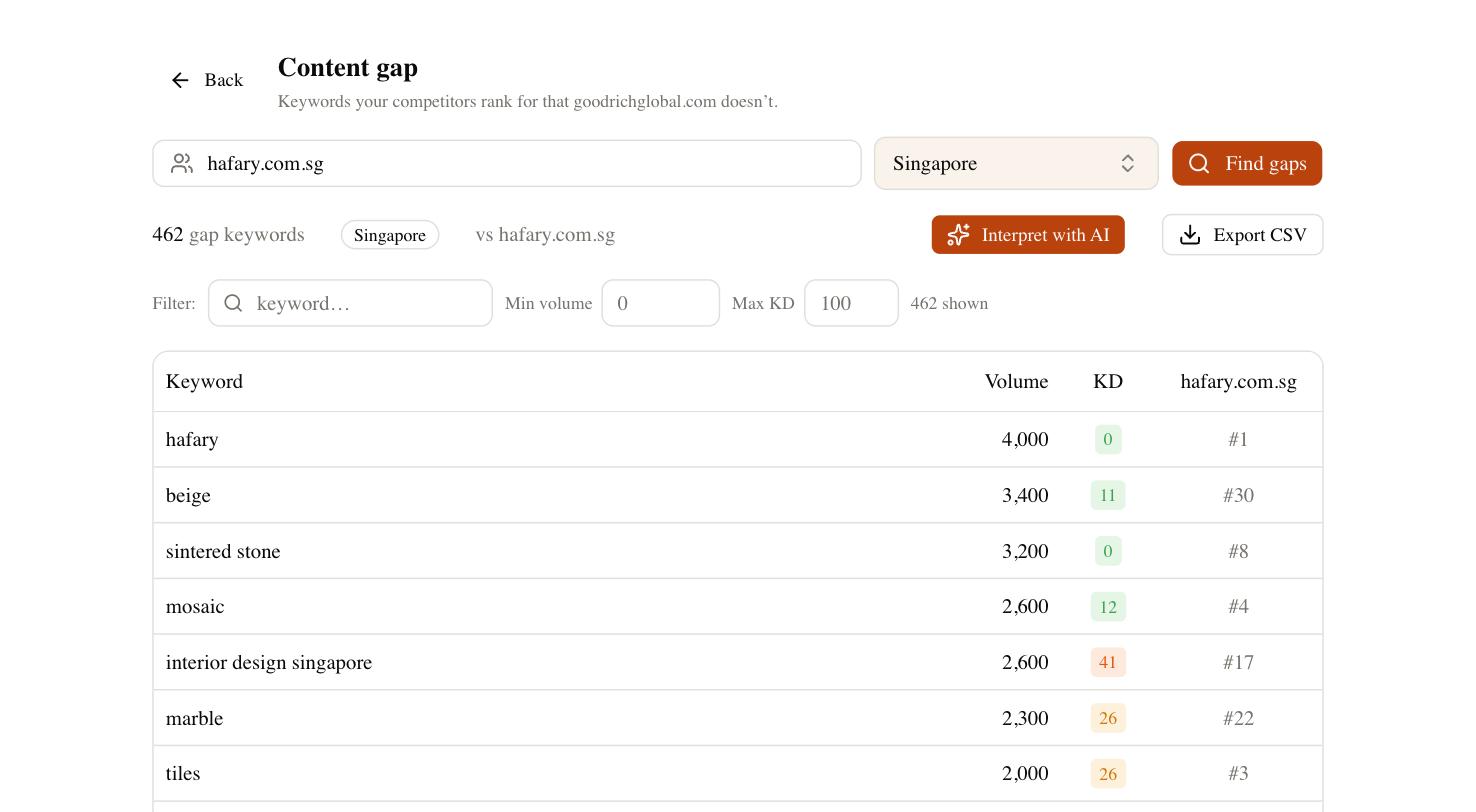
Prioritize commercial-intent and comparison keywords where a person is close to buying — “best,” “vs,” “alternatives,” “for [use case].” These convert, and they are where an in-depth affiliate page can out-help a thin retailer result. Find them by looking at what your competitors already rank for that you don’t.
Then write the page to actually answer the query — pros and cons you’d only know from use, who each option is wrong for, real prices at time of writing, and a recommendation you’d stand behind. That is the content the Reviews system is built to reward. It is also the format AI assistants quote from, because a clear “best for X, avoid if Y” line is exactly what they extract into an answer.
Don’t neglect the small on-page controls you fully own, either. You control your titles, meta descriptions, heading structure, image alt text, and canonical tags — so use canonicals to consolidate near-duplicate comparison variants instead of letting them compete, and write titles around the buying modifier rather than the bare product name. These are unglamorous, but on an affiliate site where authority is scarce, on-page precision is one of the few levers entirely in your hands.
Mistakes that quietly sink affiliate sites
Most affiliate SEO failures aren’t dramatic. They are slow leaks that show up two updates later.
- Chasing volume over depth. Two hundred thin pages lose to twenty deep ones, every time.
- Forgetting the sponsored attribute. A single unmarked money link across a large site reads as a paid-link pattern.
- Copying merchant descriptions. Duplicate content plus commercial intent is the exact profile the Reviews system targets.
- No first-hand signal. No original photos, no hands-on notes, nothing that proves you touched the product.
- Ignoring AI search. Buyers increasingly ask ChatGPT and Google’s AI Overviews for recommendations, and affiliate pages that never get cited lose that traffic silently.
Where SEO Rocket fits an affiliate workflow
The affiliate job is mostly research and content, and that is where the tooling earns its keep. Use the Content Gap tool to see the commercial keywords your competitors rank for and you don’t — that list is your content roadmap. Rank tracking tells you which review pages are moving; the site audit flags duplicate content and slow pages before an update does. Competitor gap analysis shows which reviews and comparisons are missing from your cluster.
The piece traditional affiliate playbooks miss is AI visibility. Brand Radar tracks whether your site gets cited when someone asks an AI assistant for a recommendation — a channel where affiliate content can win by being genuinely comparative. And because you can draft the actual review or comparison with Claude inside the same workflow, the loop from “gap found” to “page published” stays in one place. Give any new affiliate page a full ranking cycle before you judge it; positions on commercial terms jitter, and the pages that hold are the ones with something real to say.