
SEO for marketplaces is a different sport from ranking your own website, and the fastest way to waste a month is to treat it like the same game. On a marketplace like Amazon, Etsy, eBay, or Walmart, you are a tenant, not a landlord — the platform owns the URLs, the page template, the rendering, and most of the technical levers you would normally reach for. SEO for marketplaces is really about winning two different search boxes at once: the marketplace’s own internal search, and Google’s index of those listing pages.
Get clear on which levers you actually hold, and the work gets simple. Reach for the ones you don’t, and you burn time on things the platform will never let you change.
What makes marketplace SEO different
Traditional SEO assumes you can edit anything: the URL slug, the title tag, the meta description, the schema markup, the page speed, the redirects. On a marketplace, almost none of that is yours. You get a set of listing fields — title, bullets, description, attributes, images, category — and the platform turns those into a page using its own template. Your job is not to build a page. It is to feed the fields that the page and the ranking algorithm read.
The bigger difference is what ranking rewards. Google ranks pages largely on relevance and links. Marketplace search ranks listings on relevance plus commercial performance — conversion rate, sales velocity, reviews, price, and stock. A listing that sells well climbs; one that gets clicks but no orders slides. That single fact reshapes the whole strategy.
There is also no link building to speak of. Backlinks barely register inside a marketplace, so the off-page tactics that dominate website SEO simply do not apply. In their place sits a tighter, more commercial feedback loop: the platform watches how shoppers respond to your listing in real time and adjusts your position accordingly. That makes the work faster to measure but harder to fake — you are optimizing for buyer behavior, not for a crawler.
What you actually control (and what you don’t)
Before optimizing anything, be honest about the boundaries. Here is where the real control sits on a typical marketplace listing.
| SEO lever | On your own site | On a marketplace |
|---|---|---|
| URL / slug | Full control | None — auto-generated from a product ID (ASIN, item number) |
| Title tag & meta description | Full control | Indirect — you write the product title; the platform builds the HTML tags |
| Structured data / schema | Full control | None — the platform injects its own product schema |
| Page speed & rendering | Full control | None — shared template, often heavy JavaScript |
| Redirects & canonicals | Full control | None — the platform collapses and canonicalizes duplicates its way |
| Listing copy & keywords | Full control | Full control — your real playing field |
| Backend / hidden search terms | N/A | Full control — a genuine advantage most sellers ignore |
| Images & attributes | Full control | Full control within field limits |
Read that table as a to-do list. Everything in the last three rows is where your effort pays off. Everything above it is the platform’s problem, and no amount of clever work will change it.
How marketplace search really ranks listings
Amazon’s search, Etsy’s relevancy sort, and eBay’s Best Match all share the same logic under different names. First they match your listing to the query using the title, attributes, category, and any backend keyword fields. Then they rank the matches by how well each listing converts browsers into buyers. Recent sales velocity, click-through rate, review count and rating, price competitiveness, and full stock all feed that second stage.
This is why a keyword-perfect listing with no sales stays buried. The algorithm treats orders as the strongest relevance signal it has. You cannot title-tag your way past a listing that is selling ten units a day while yours sells one. That means conversion work — better main image, sharper first bullet, honest pricing, more reviews — is SEO work here, not a separate task.
It also means new listings face a cold start. With no sales history, the platform has little to rank you on, so early velocity matters more than it will later. Getting those first orders — through outside traffic, a launch promotion, or a competitive introductory price — is what tells the algorithm your listing converts. Skip that step and even a well-built listing can sit on page five for weeks, waiting for a signal that never arrives.
The highest-leverage moves that actually work
Concentrate on the fields the algorithm reads and the signals it rewards. A short list beats a long one.
- Front-load the title with real search terms. Lead with the words buyers type, then brand and specifics. Match how people actually search, not internal product names.
- Fill every backend and attribute field. Hidden search terms, material, color, size, and use-case fields are pure ranking fuel that costs nothing and that most competitors leave half-empty.
- Pick the tightest correct category. Category placement is a hard relevance filter — the wrong one keeps you out of results no keyword can rescue.
- Engineer conversion. A clean main image and a benefit-led first bullet lift click-through and order rate, which the ranking stage reads directly.
- Earn reviews and keep stock. Review volume and in-stock status are ranking inputs, not just trust signals. A listing that goes out of stock loses its position and has to climb back.
- Drive outside traffic to hot listings. Sales from your email list, ads, or social feed the velocity signal and pull the listing up in organic marketplace search.
The platform-specific mistakes people make
The most common error is importing habits from website SEO. Keyword-stuffing a title with every variation used to work; today it reads as spam to shoppers, tanks conversion, and often breaks the platform’s title rules. Repeating a keyword in the title, the backend field, and every bullet does nothing — the algorithm counts a term once.
The second mistake is pasting the manufacturer’s stock description into every channel. Identical copy across a hundred sellers gives you no edge inside the marketplace and creates duplicate-content problems when Google tries to index the listing. The third is ignoring the backend keyword fields entirely, which is like leaving free ranking signal on the table. And the quiet one: building your whole business on a listing you rent. If the platform suspends the account or delists the product, the URL dies and there is no redirect to save the traffic.
Don’t skip Google — the second search box
Marketplace listings also rank in Google, and that is a second stream of buyers most sellers never optimize for. You cannot touch the technical SEO of the page, but you can win the parts you feed: a unique, keyword-aware description and title give the listing a fighting chance in Google where duplicated copy would not. The catch is that the platform, not you, usually outranks its own sellers for the head terms — so the durable play is to own a real domain alongside your marketplace presence and rank that for the searches the platform will never hand you. Think of the marketplace listing as a bonus impression in Google, not a foundation you can build on.
Where SEO Rocket fits
The research half of marketplace SEO — finding the exact terms buyers use and seeing what rival listings win on — is the same demand data whether you sell on a marketplace or your own site. SEO Rocket runs on Ahrefs-grade data, so you can pull real search volume and keyword difficulty for your product terms in plain language, then feed the winners into your titles, attributes, and backend fields instead of guessing.
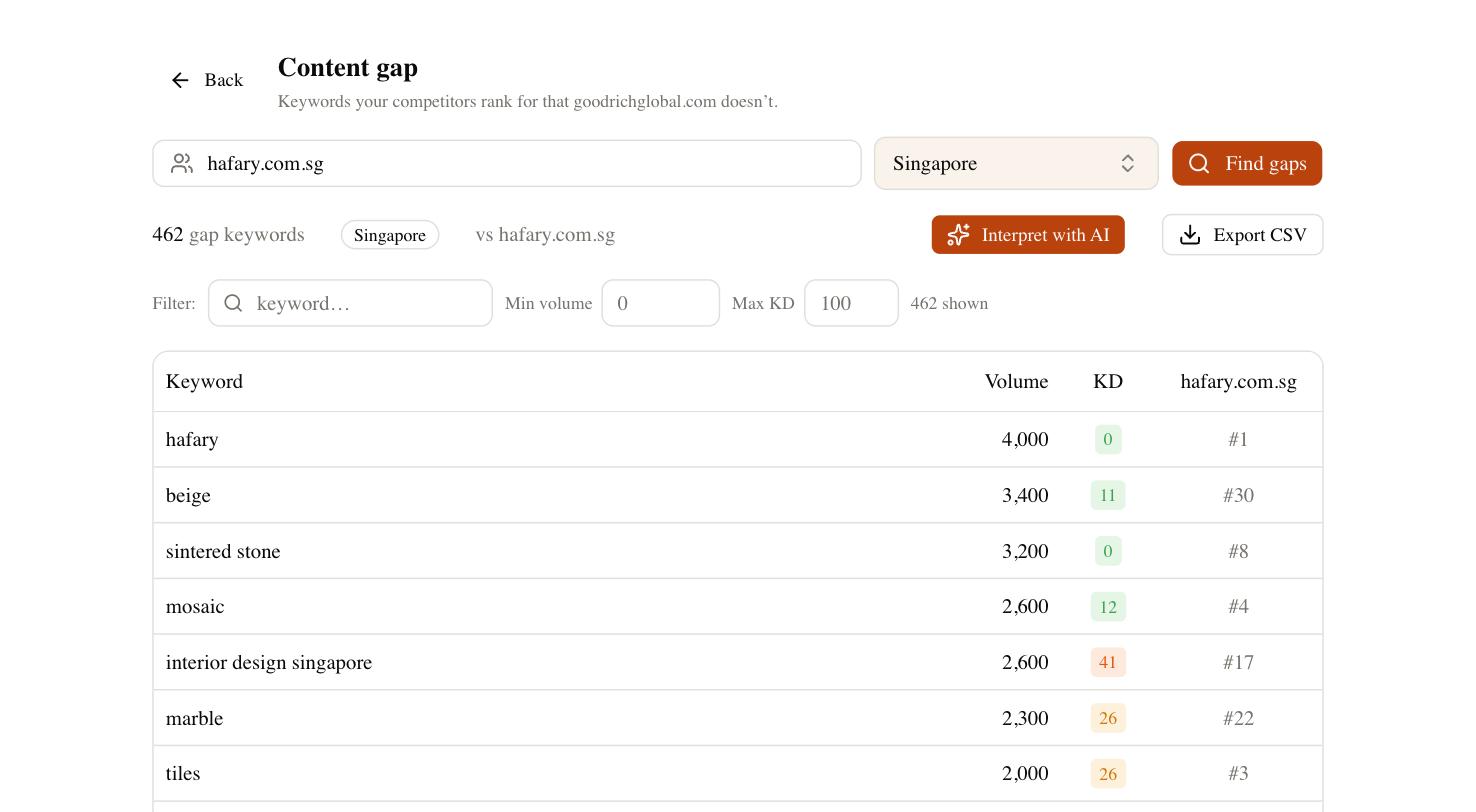
The competitor gap tool shows the terms other listings and stores capture that you miss, which maps neatly onto the attribute and long-tail fields you have been leaving blank. Brand Radar tracks whether your brand and products get named inside ChatGPT, Perplexity, and Google’s AI answers — increasingly where product research starts before anyone reaches a marketplace at all. And when you build that owned domain to escape platform dependence, the same tool drafts the content and tracks its rank. Use the marketplace for reach; use your own site to keep the traffic when the platform changes its mind.