
SEO for membership sites breaks the usual playbook because your best content is the content Google can’t see. Everything valuable sits behind a login, so the search engine only ever meets your sales page, a thin preview, and a checkout screen. SEO for membership sites is really the art of deciding what to expose, what to hide, and how to make the exposed layer earn the signups that fund the rest.
This guide is specific to gated sites — course platforms, paid communities, subscription libraries, coaching portals — whether you run WordPress with MemberPress or Paid Memberships Pro, or a hosted platform like Kajabi, Circle, or Mighty Networks. The constraints are real, some platforms make them worse, and no amount of keyword research fixes a site that hides everything from the crawler.
Why membership sites are a different SEO problem
On a normal site, the page that ranks is the page that sells. On a membership site those are two different pages. The lesson, the community thread, the downloadable template — the things people pay for — are login-gated, so Googlebot hits a redirect or a “please sign in” wall and indexes nothing useful. Your rankable surface area shrinks to the public marketing layer: a blog, free sample lessons, a pricing page, maybe a resource hub.
That single fact drives every decision below. You are not optimizing one site. You are optimizing a small public front door that has to rank, convince, and convert, while a large private back room stays deliberately invisible. Traffic reports make this obvious the first time you look: a mature membership site often has hundreds of pages and only a handful that a search engine can index. The winners aren’t the sites with the most content — they’re the ones that turned a slice of it into public assets good enough to earn the click.
What you can and can’t control by platform
Before you plan anything, know your ceiling. Self-hosted WordPress gives you near-total control but hands you a caching problem. Hosted community platforms give you speed and simplicity but quietly take away the levers SEO depends on.
| Control | WordPress + membership plugin | Hosted platform (Kajabi, Circle, Mighty Networks) |
|---|---|---|
| Custom URLs / slugs | Full | Often limited; sometimes on a subdomain you don’t own |
| Title tags & meta descriptions | Full (via SEO plugin) | Partial — templated, sometimes no per-page control |
| robots.txt & noindex | Full | Restricted or global-only |
| Structured data | Full | Rare; usually none for paywalled content |
| Redirects (301) | Full | Limited; login redirects are often 302 |
| Page speed for logged-out visitors | Yours to fix | Fixed by the vendor |
| Server-rendered content | Yes | Community feeds are often JavaScript-rendered |
If you’re on a hosted platform, read that column honestly. When the member area lives on community.yoursite.com and the vendor renders threads in JavaScript with no per-page titles, that content was never going to rank — plan your public layer on a domain and CMS where you hold the controls.
The paywall problem: indexing gated content without cloaking
The tempting shortcut is to show Google the full lesson while showing visitors a paywall. That’s cloaking, and it’s a guideline violation that can get pages demoted. The legitimate version is Google’s paywalled-content structured data: mark the gated sections with CreativeWork plus isAccessibleForFree: false and a hasPart block naming the CSS selector of the locked content. That tells Google the section is intentionally gated, lets it index the page without treating the paywall as a trick, and keeps you inside the rules.
Most membership plugins won’t add this markup for you, and most hosted platforms can’t. If indexing a portion of gated content matters to you, that markup is the only clean route — and it only works when the page still ships some server-rendered text, not a bare login screen.
The highest-leverage move: a real public content layer
The reliable growth engine for a gated site is a genuine free layer that ranks and funnels. Publish full articles that solve the problems your paid content goes deeper on. Ungate two or three sample lessons per course and let them be indexed. Turn your best community answers into public guides. This is where nearly all of your organic traffic will come from, so treat it as a first-class site, not a marketing afterthought. Good seo for membership sites is mostly this: building free content that stands on its own, not teaser stubs that exist only to nag people toward a paywall.
Free doesn’t mean thin. A sample lesson that ranks is a full lesson — it just happens to sit outside the wall. The internal link from that lesson to a paid module is what turns a reader into a trial. Think of every public page as both a ranking asset and a conversion path, and write it so a stranger who never signs up still got real value. That reputation is what makes the eventual pitch land.
Then keep the noise out of the index. Login, register, account, checkout, password-reset, and “content locked” pages should carry noindex, and your sitemap should list only the public URLs you actually want ranked. On membership sites these utility pages breed fast, and a crawl full of near-identical “please log in” URLs dilutes everything.
Speed, rendering, and the platform mistakes people make
Logged-in pages can’t be cached the way anonymous pages can — a session cookie forces the server to build each view fresh, so membership plugins routinely make the site slow for members. Your public pages, though, should be aggressively cached at the CDN, because those are the ones Google grades for Core Web Vitals. Serve the marketing layer to logged-out visitors as static and fast as you can.
The recurring mistakes are predictable. People gate everything and leave the crawler nothing to rank. They let login and account URLs flood the index. They build the whole thing on a vendor subdomain and split their authority in two. They rely on a JavaScript-rendered community for content that Google never reliably renders. And they let a “members only” redirect fire before the page renders any indexable text. Each one is fixable — but only if you know your platform allows the fix.
Where SEO Rocket fits
Because the public layer carries the whole load, topic selection is where the leverage is. Ask SEO Rocket’s Keywords Explorer for the questions your prospective members search before they buy, and it returns real search volume and keyword difficulty so you build the free layer around terms you can actually win.
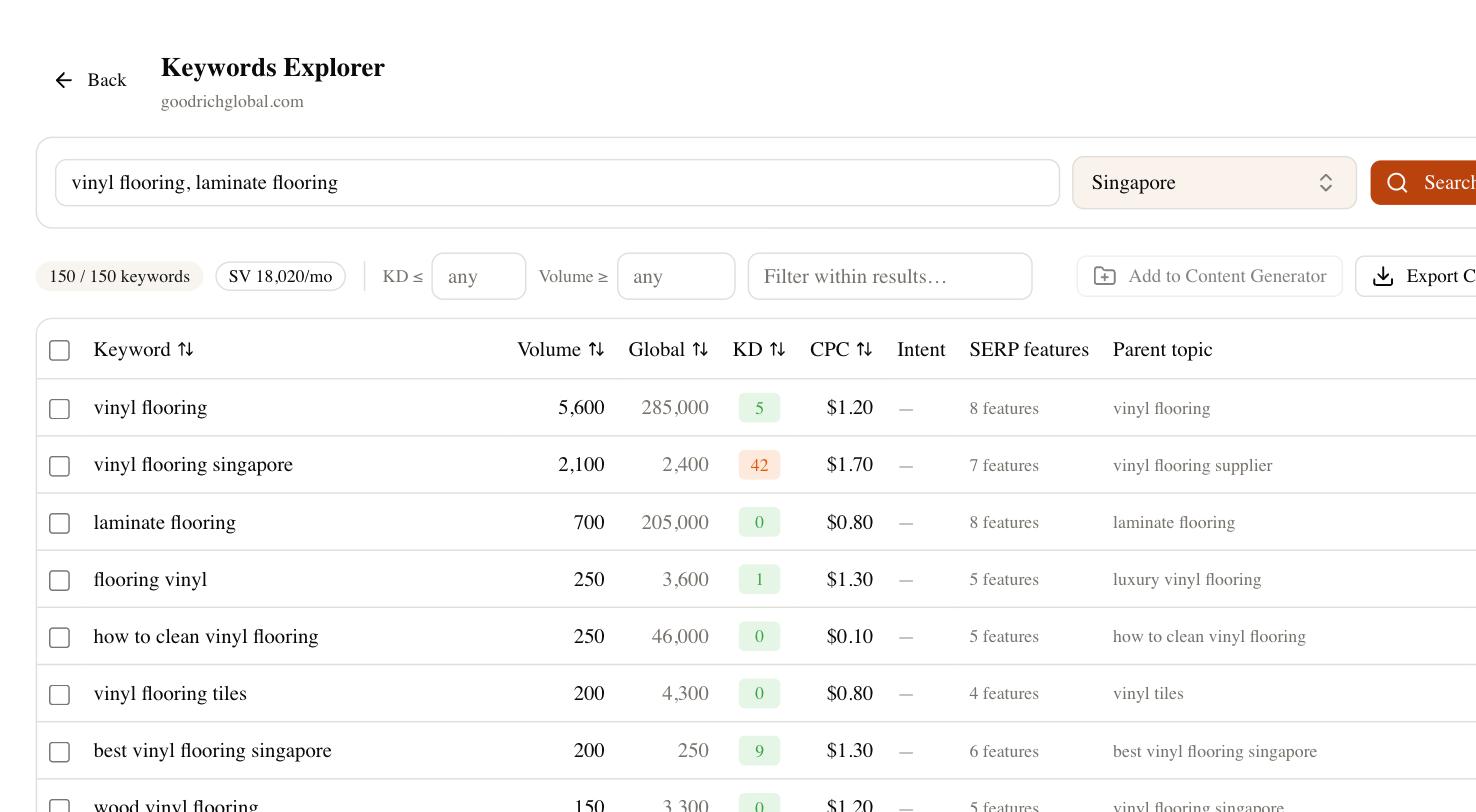
The competitor gap tool shows what rival membership sites rank for on their public pages, which is the fastest way to see which free lessons and guides pull traffic in your niche. The site audit flags the exact problems above — indexed login pages, thin previews, missing titles, redirect chains — so you catch them before they cost you. Rank tracking watches the public terms over time, and Brand Radar shows whether AI search surfaces cite your free content when someone asks about your topic. You can also draft the public articles inside the same workflow.
A short pre-launch checklist
Run this before you chase rankings, because most membership SEO wins come from not sabotaging yourself.
- Public blog and two to three ungated sample lessons per course, indexable and server-rendered.
- Login, account, checkout, and “locked” pages set to
noindex. - Sitemap listing only public URLs.
- Paywalled-content structured data on any gated page you want indexed — never cloaking.
- Public pages cached at the CDN and fast for logged-out visitors.
- Member area on your own domain, not a split-authority subdomain, wherever the platform allows it.
Get those six right and the free layer does its job: it ranks, it earns trust, and it sends qualified people to the paywall. That’s what good SEO for a membership site looks like — not more gated pages, but a sharper front door.