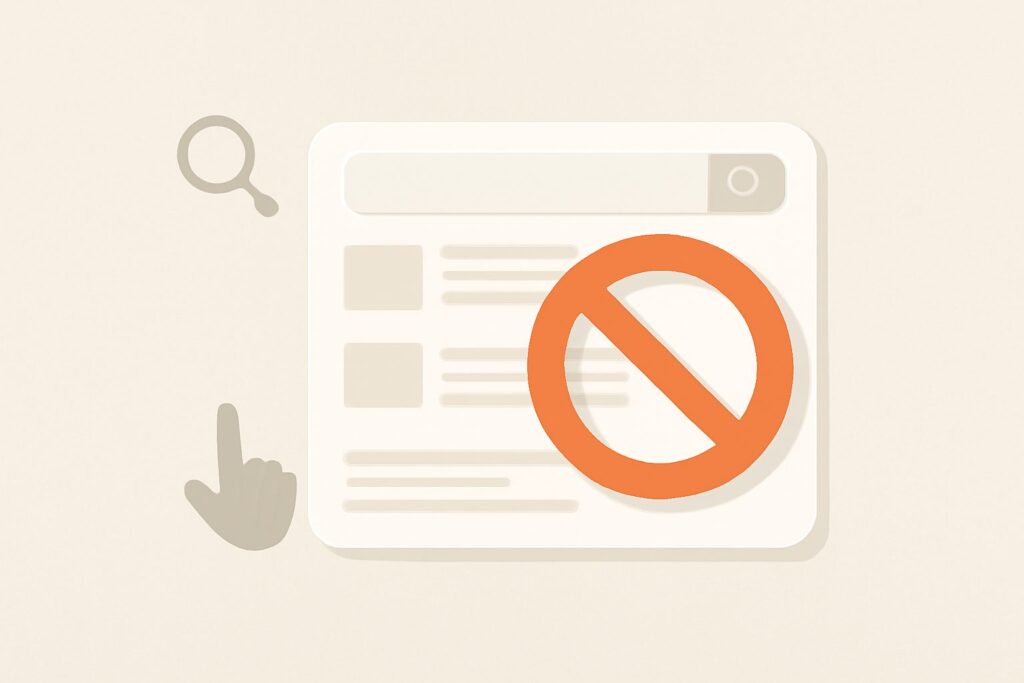
Most people hear about zero-click searches and panic that Google is stealing their traffic. That framing is half wrong. A zero-click search is any query that Google answers directly on the results page, so the user never clicks through to a website. The share of searches ending this way is now well over half on desktop and higher on mobile — but the queries you’re losing were mostly never worth a visit in the first place. The real question isn’t how to fight the trend. It’s which searches you can still convert into clicks, and which you should aim to win directly on the SERP.
What Is a Zero-Click Search, Really
So what is a zero-click search in plain terms? It’s a search that gets resolved without the searcher visiting any external page. Someone types “what time is it in Tokyo,” “convert 5kg to pounds,” or “weather Singapore,” and Google shows the answer in a box at the top. No click needed, no website visited. The searcher got what they wanted, and Google kept them on the page.
These aren’t new. Google has answered simple factual queries for over a decade. What changed is the sheer breadth of what now triggers a zero-click result — definitions, quick facts, sports scores, business hours, currency conversions, song lyrics, and increasingly, AI-generated summaries that stitch together an answer from multiple sources. The category quietly ate a huge slice of informational search volume, and most site owners only noticed when their impressions kept climbing while their clicks flatlined.
Why Google Wants the Click to Stay Home
Google’s incentive is simple: keep users on Google. Every second a searcher spends comparing ten blue links is a second they might bounce to a competitor or abandon the search. Answering the query instantly makes Google feel faster and smarter, which keeps people searching there instead of asking a chatbot or going straight to a marketplace.
Features that drive zero click results include featured snippets, knowledge panels, the “People Also Ask” accordion, local packs with hours and directions, and the newer AI Overviews that summarize an answer above the organic listings. Each one is designed to satisfy intent on the spot. For informational queries with a single correct answer, that’s often genuinely useful to the searcher — and genuinely bad for anyone whose business model depended on that click.
The Traffic You’re Losing Was Mostly Low-Value
Here’s the part the doom headlines skip. The queries most likely to become zero-click searches are the ones least likely to convert. “What is a zero click search” is a definitional query — the person asking it wants a two-sentence answer, not a sales page. If they land on your site, they read one paragraph and leave. That’s a high bounce, near-zero conversion visit that inflated your traffic numbers and did nothing for revenue.
The searches that still drive clicks are the ones that can’t be answered in a box: comparisons (“best CRM for small agencies”), commercial research (“Ahrefs vs Semrush pricing”), how-to guides with real depth, and anything requiring a decision. Google can’t summarize a genuine buying decision into a snippet without sending the user somewhere to act. That’s where your effort belongs — and where tracking which of your keywords sit in a zero-click SERP versus a clickable one changes what you choose to write next.
How to Tell if a Keyword Is a Zero-Click Trap
Before you write a single article, look at what the SERP already does with that query. If page one is dominated by a featured snippet, an AI Overview, and a “People Also Ask” block, the click-through rate for the organic results below is going to be brutal — often under 20% split across ten listings. If the SERP shows ten competing commercial pages and no answer box, clicks are still up for grabs.
- High zero-click risk: definitions, unit conversions, factual lookups, “what is,” “how old is,” “when did”
- Low zero-click risk: “best,” “vs,” “how to [complex task],” “pricing,” “review,” “for [specific use case]”
- Mixed: informational queries deep enough that the snippet only scratches the surface and the searcher clicks for the full method
This is exactly the kind of triage SEO Rocket’s AI keyword research is built for. Instead of chasing raw search volume, you can pull 100 to 150 keyword ideas per seed term with volume, difficulty, and intent signals, then prioritize the commercial and comparison queries that Google still has to send clicks for. Volume on a zero-click query is a vanity metric; volume on a clickable one is a pipeline.
Winning the Zero-Click SERP Itself
When a query is unavoidably zero-click, the goal shifts from earning the click to owning the answer. Being the source Google pulls into the featured snippet or AI Overview builds brand visibility even without a visit — your name sits above every organic result, and a meaningful share of searchers still click through when the snippet whets their appetite rather than fully satisfying it.
To win the snippet, structure content the way Google likes to lift it: answer the question directly in the first 40 to 55 words of a section, use a clear H2 that matches the query phrasing, and format lists and steps as actual lists. A concise definition followed by depth tends to get pulled more often than a rambling intro. You’re writing for two readers at once — the human who needs the full answer, and the algorithm deciding which paragraph to quote.
Measuring Impact Without Fooling Yourself
Rank position alone lies to you in a zero-click world. You can rank number one and still lose traffic if a featured snippet or AI Overview sits above you. The honest metric is clicks and impressions from Google Search Console, read together: rising impressions with flat clicks is the signature of a query drifting toward zero-click. Falling impressions is a ranking problem; falling click-through at stable impressions is a SERP-feature problem, and the fixes are completely different.
SEO Rocket’s rank tracking uses top-100 snapshots rather than single-day spot checks, and cross-checks against Search Console as ground truth, so you see the trend instead of daily jitter. Pairing position data with real click data is the only way to know whether a page is quietly being cannibalized by the SERP itself — and whether the answer is to fight for the snippet or to redeploy that effort onto a keyword that still pays in clicks.
The AI Overview Wrinkle
AI Overviews raise the stakes because they don’t just answer simple facts — they synthesize multi-source summaries for genuinely complex queries that used to reliably drive clicks. Early data suggests they can cut organic click-through on affected queries substantially. But they also cite sources, and being one of those cited sources is the new snippet. Content that’s well-structured, factually tight, and clearly the authoritative answer is more likely to be pulled and attributed.
This is why AI-visibility tracking now matters alongside classic rank tracking. Knowing whether your brand appears inside AI-generated answers — not just in the ten blue links — is becoming its own discipline. SEO Rocket tracks that surface too, so you can see where you’re being cited by AI answers and where a competitor owns that space instead.
The Bottom Line
Zero-click searches aren’t the death of SEO — they’re a filter. They strip away the low-intent, non-converting traffic that made vanity dashboards look healthy and force you to compete where clicks still exist and still convert. Audit your target keywords for zero-click risk before you write, structure content to win the snippet when the query is unavoidably answered on-page, and measure clicks and impressions together instead of trusting rank position alone. The traffic that survives this shift is worth more than the traffic you lost, and the playbook proven across 1,000,000+ ranking pages says the same thing it always did: build for intent, not for volume.