Most roundups of the best content optimization tools read like a list of everything with a subscription page. This one is shorter and more useful: seven tools that genuinely earn their place, what each is actually best at, and where you should send your money depending on the work you do. If you write and rank content for a living, the right tool is the one that fits your Tuesday, not the one with the longest feature list.
Content optimization has also changed shape. Five years ago it meant matching a term-frequency target and hitting a word count. Now it has to account for AI writing that produces drafts in seconds and AI search that decides whether ChatGPT or Google’s AI Overviews ever mention you at all. The tools below are graded on how well they handle both jobs, not just the old one.
What a content optimization tool actually does
Strip away the marketing and these tools do three things. They tell you what a page needs to compete — the subtopics, entities, and questions the current top results cover that you don’t. They score a draft against that target as you write, so you can close gaps before you publish rather than after. And the better ones now help produce the draft itself, either by outlining or by writing full sections you then edit.
Where they diverge is depth and data. A lightweight optimizer scrapes the top ten results and counts terms. A serious one sits on a real keyword and backlink index, understands search intent, and connects the brief to how the page will actually perform once it is live. That difference is why price bands vary so widely, and why the cheapest option is rarely the cheapest outcome.
How we compared them
Every tool here was judged on four things a working content team cares about: the quality of the underlying data behind the recommendations, whether AI writing is built in or bolted on, the honest total cost rather than the headline number, and who the tool genuinely suits. Optimization scores are directional, not gospel — two tools will grade the same draft differently, and neither number is a ranking guarantee. Treat them as a checklist, not a verdict.
One more filter matters: what you are optimizing against. A weak page-one result on a mid-competition term is a beatable target, and most tools will get you past it. Where they separate is on the harder queries, where you need accurate intent signals and a real sense of what the top pages cover — not just a term list scraped from ten URLs. Judge each tool on the recommendations it makes for a query you already understand. If the brief matches your own instinct on a topic you know cold, trust it on the ones you don’t.
The best content optimization tools at a glance
Start with the table, then read the notes on the two or three that match your situation. Price bands are rough and change often, so use them to sort the options, not to budget to the dollar.
| Tool | Best for | AI-native? | Standout strength | Rough price band |
|---|---|---|---|---|
| SEO Rocket | Solo SEOs, consultants & agencies wanting one AI workflow | Yes — chat-first | Real Ahrefs-grade data + AI writing + AI-search visibility together | Low $ / entry-friendly |
| Surfer SEO | Writers who want a clear on-page score | Add-on | Fast, visual content editor with a live grade | Mid $$ |
| Clearscope | Editorial teams who value clean briefs | No | Accurate, readable term coverage reports | Higher $$ |
| Frase | Small teams optimizing on a budget | Yes | Fast SERP research plus outline drafting | Low–mid $ |
| MarketMuse | Publishers planning topic clusters | Some | Content strategy and topical authority modeling | Higher $$ |
| Semrush | Marketing teams wanting one suite | Add-ons | Optimization inside a full marketing platform | Higher $$ |
| Jasper | Teams whose bottleneck is drafting volume | Yes | Flexible long-form AI writing at scale | Mid $$ |
SEO Rocket — the AI-native pick
SEO Rocket is built for how content work runs now. Instead of jumping between a keyword tool, a brief generator, and a separate writer, you ask for what you need in plain language and it runs the research on real, Ahrefs-grade data underneath — search volumes, competitor gaps, and the subtopics your page is missing. It then drafts the article against that brief, so the optimization and the writing happen in one place rather than three tabs and two invoices.
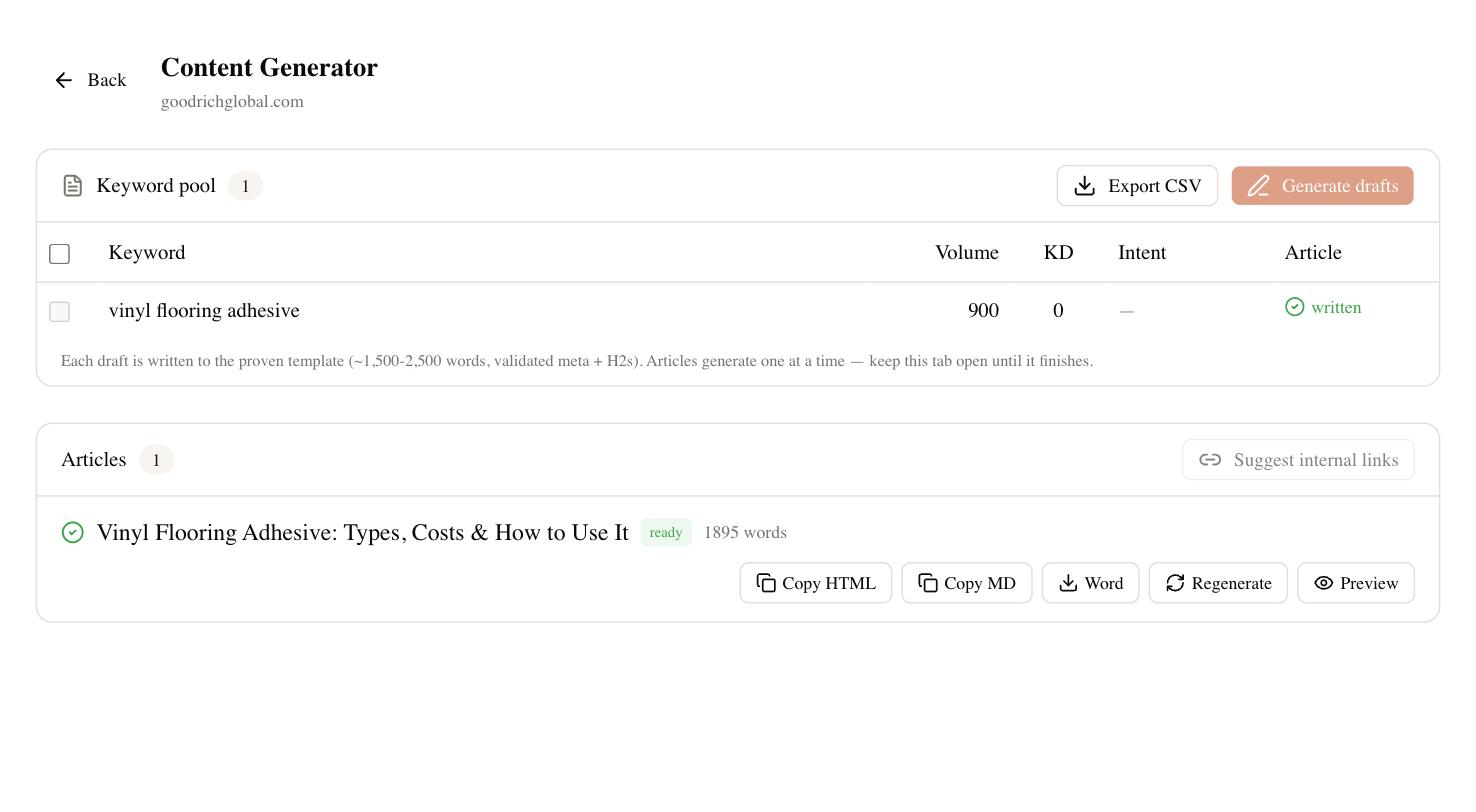
The part no traditional optimizer answers is AI-search visibility. A page can hit every on-page target and still never surface in an AI answer. SEO Rocket’s Brand Radar tracks whether you are being cited across ChatGPT, Perplexity, and Google’s AI Overviews, which is increasingly where buyers start. For a consultant or agency, the client-dashboard side means you hand over a read-only report without exporting anything. If your real constraint is doing more with fewer tools, this is the strongest fit on the list — and the entry pricing undercuts a comparable stack by a wide margin.
Surfer SEO, Clearscope and Frase — the dedicated optimizers
These three are the specialists most writers reach for, and each has a clear temperament.
- Surfer SEO is the visual choice. Its content editor gives you a live score as you type, with term suggestions in a side panel, and it is genuinely fast to learn. If you want an at-a-glance grade to write toward, Surfer is the friendliest on-ramp.
- Clearscope is the editor’s pick. It does fewer things but does them cleanly — its term reports are accurate and readable, which is why agencies hand them to freelance writers as briefs. It costs more and has no built-in writer, so you pay for polish, not breadth.
- Frase is the budget-conscious all-rounder. It pulls SERP research quickly, builds outlines, and includes AI drafting at a lower price than the other two. The data is shallower, but for a small team it covers the core loop well.
Any of the three will improve a draft. What none of them do is connect that draft to live rank tracking or AI-answer visibility — you will still run a second subscription for the parts that happen after you hit publish.
MarketMuse, Semrush and Jasper — depth, breadth and drafting
The other end of the market solves different problems. MarketMuse is the strategist’s tool: rather than optimizing one page, it models topical authority across a whole site and tells you which clusters to build to own a subject. Publishers planning months of content get real value; a solo writer optimizing a single post will find it heavier than they need.
Semrush folds optimization into a sprawling marketing suite, so a team that already lives there for keyword and competitor research gets a capable writing assistant without adding a login. You pay suite prices for it, and if SEO is your only use case, most of that suite goes untouched. Jasper comes at content from the writing side — it is an AI drafting engine first, strong on volume and tone, with optimization guidance layered on top. If your bottleneck is producing enough copy rather than tuning each piece, Jasper earns its place, though you will want a real data source alongside it because the drafting is only as good as the brief you feed it.
How to choose by segment
Match the tool to your actual constraint. If you are a solo SEO, consultant, or agency tired of stitching a keyword tool, a writer, and a rank tracker together, SEO Rocket collapses that stack into one AI-native workflow and tracks AI search on top. If you are a writer who just wants a clear on-page score, Surfer is the easiest start; if you run an editorial team that values clean briefs, Clearscope is worth the premium; and if budget is tight, Frase covers the same loop for less.
For planning at scale, MarketMuse maps the territory; for teams already inside a marketing suite, Semrush avoids another tool; and when raw drafting speed is the problem, Jasper is the writing engine. Whatever you pick, run one real article through it end to end before you commit — outline, draft, optimize, publish — and judge it on how fast it answered your questions, not on the score it printed. The best content optimization tool is the one that fits the work you actually do next week.