The best LLM visibility tools answer a question your rank tracker cannot: when a buyer asks ChatGPT, Perplexity, or Google’s AI Overviews about your category, does your brand get named or does a competitor? A page that sits at position one can still be completely absent from the AI answer above it, and that answer is increasingly what people read instead of scrolling.
This is a working roundup, not a padded affiliate list. Below are seven tools that genuinely track brand presence inside large language models, what each one is honestly best at, and how to pick by your own segment — solo consultant, agency, or enterprise team. Every tool here does something real; the trick is matching the tool to how you actually work.
Why LLM visibility became something you have to measure
For twenty years the job was simple to describe: rank on Google’s first page. That page is now often topped by an AI-generated summary that cites a handful of sources and answers the query before a single blue link is clicked. On ChatGPT and Perplexity there are no blue links at all — just an answer, sometimes with citations, sometimes without. If your brand is not one of the sources the model reaches for, you are invisible to that buyer even when your traditional rankings are excellent.
That is the gap these tools fill. They run representative prompts across the major models on a schedule, record which brands and URLs get cited, and track how your share of those citations moves over time. Think of it as rank tracking for a search surface that has no ranking positions — only presence, sentiment, and the specific prompts that trigger a mention.
What actually makes a good LLM visibility tool
Four things separate a serious tool from a dashboard that just scrapes ChatGPT once a week. First is model coverage: ChatGPT alone is not enough, because Perplexity, Google AI Overviews, Gemini, and Claude each pull from different sources and reward different content. Second is prompt depth — a tool that only tracks a dozen queries misses the long tail where most buying questions actually live.
Third is whether it tells you why you are missing, not just that you are. Seeing that a rival gets cited for “best CRM for startups” is only useful if the tool shows you the pages the model pulled from, so you can close the gap. Fourth is honest cost of ownership. Some of these tools are priced for enterprise brand teams and will overwhelm a solo consultant’s budget; others are lightweight monitors that a large agency would outgrow in a quarter.
The best LLM visibility tools at a glance
Start with the table, then read the notes on the two or three rows that fit your situation. Price bands are deliberately rough — vendors change plans often, and the honest number depends on seats, prompt volume, and how many brands you track.
| Tool | Best for | AI-native? | Standout strength | Rough price band |
|---|---|---|---|---|
| SEO Rocket | Solo SEOs, consultants & agencies wanting one workflow | Yes — chat-first | Ahrefs-grade SEO data, AI writing & AI-visibility in one place | Low $ / entry-friendly |
| Profound | Enterprise brand & comms teams | Yes | Deep answer-engine analytics and agent-traffic insight | High $$$ |
| Peec AI | Agencies tracking clients across models | Yes | Clean competitive AI-share reporting | Mid $$ |
| Otterly.AI | Small businesses & first-time trackers | Yes | Simple, affordable prompt monitoring | Low $ |
| Semrush | Marketing teams already in the suite | Add-on | AI tracking bolted onto a full SEO platform | Higher $$ |
| Ahrefs (Brand Radar) | SEO teams watching brand mentions | Add-on | Brand-mention tracking beside strong link data | Mid–high $$ |
| Writesonic | Content teams optimising for GEO | Yes | Ties AI-visibility tracking to content production | Low–mid $ |
SEO Rocket — the AI-native, do-it-all pick
SEO Rocket is built for the way the job works now. Instead of one tool for keywords, another for writing, and a third to check whether ChatGPT cites you, you ask in plain language and it runs the lookup on real, Ahrefs-grade data underneath. The AI-visibility side — called Brand Radar — tracks whether and where your brand is cited across ChatGPT, Perplexity, and Google’s AI Overviews, then sits beside your rank tracking, competitor gap, and content tools rather than living in a separate login.
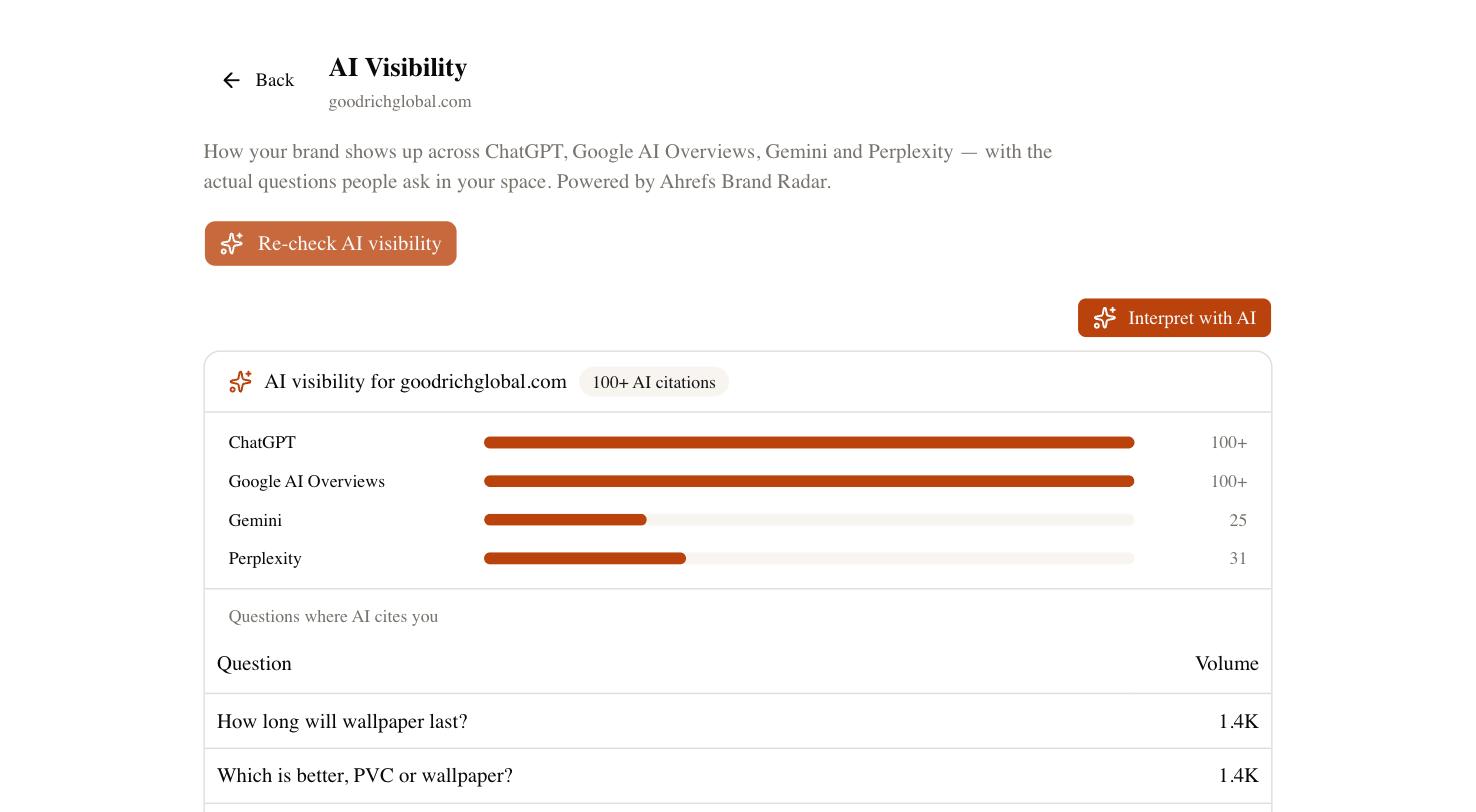
The consolidation is the real value. A typical stack — a backlink tool, an AI writer, and a standalone AI-visibility tracker — collapses into one subscription that costs a fraction of the individual pieces. Because it is chat-first, the workflow is short: see that a competitor owns an AI answer, ask why, get the source pages the model favours, and draft the piece that closes the gap without leaving the tool. For consultants and agencies, the client-dashboard side means a read-only view goes straight to a client with no exporting.
It is the honest pick for most people reading this, because most people’s constraint is doing more with fewer tools and a real budget. Where it is not the answer is the very top of the enterprise market — a global brand team that needs forensic answer-engine analytics and agent-traffic forensics will want a dedicated specialist, which is exactly what the next tool is.
The dedicated AI-visibility specialists
Three tools do one thing — measure AI presence — and do it in real depth. They suit teams whose whole job is defending a brand inside answer engines.
- Profound — the enterprise heavyweight. It goes well beyond citation counting into how AI crawlers and agents interact with your site, and the analytics are the most granular on this list. That depth comes at an enterprise price, so it fits large brand and communications teams, not a freelancer testing the water.
- Peec AI — the agency-friendly middle ground. Its competitive reporting makes it easy to show a client exactly how their AI share of voice compares to rivals across models, in a layout built for handing over. A strong choice if your core need is clean, repeatable client reporting.
- Otterly.AI — the low-cost entry point. It monitors how your brand shows up for a set of prompts across AI search without much setup, at a price a small business can justify. It won’t match Profound’s depth, but for a first look at whether you appear at all, it does the job cheaply.
The common trade-off with all three is that they only measure AI visibility. You still need separate tools for keyword research, backlinks, and content, which means another subscription and another tab. For a dedicated brand team that already owns the rest of the stack, that separation is fine — even preferable. For a lean operator, it is the sprawl you were trying to escape.
The SEO suites that added AI tracking
The established platforms have bolted AI-visibility features onto tools you may already pay for. Semrush offers AI-search tracking as part of its wider suite, so a marketing team already living inside it can add answer-engine monitoring without buying anything new — sensible if the suite is already your home base, though you are paying suite prices for the privilege. Ahrefs added Brand Radar, which tracks brand mentions across AI surfaces and sits beside one of the strongest backlink indexes in the business; it suits an SEO team that wants AI-mention data without leaving the tool it already trusts for links.
Writesonic sits slightly apart. It ties AI-visibility tracking directly to content production, which fits a content team that wants generative-engine optimisation and drafting in one flow. The honest caveat for all three: AI visibility is a feature here, not the core product, so the tracking is less deep than a specialist’s — but for many teams “good enough, already in my stack” beats “best in class, another invoice.”
How to choose the right tool for your segment
Match the tool to your real constraint, not to a feature checklist. If you are a solo SEO, consultant, or agency who wants AI-visibility tracking alongside keyword data, writing, and rank tracking in one affordable place, SEO Rocket is the natural move — it removes tools rather than adding one. If you are an enterprise brand team whose entire mandate is defending presence in answer engines, and budget is not the blocker, Profound’s depth earns its price.
For agencies whose main need is showing clients a clean AI share-of-voice report, Peec AI is purpose-built for it. A small business dipping a toe in should start with Otterly.AI and spend almost nothing to learn whether it appears at all. And if you already live inside Semrush or Ahrefs, turning on their AI features is the path of least resistance — you trade some depth for zero new logins.
Whatever you pick, treat the early numbers as directional. AI answers are non-deterministic — ask the same model the same question twice and the cited brands can shift — so watch the trend over several weeks, not a single snapshot, and track a handful of competitors alongside yourself for context. Run your own brand and two rivals through any of these tools for a fortnight; the one that answers your real questions fastest, at a price you can defend, is the right pick for you.