The hard part of choosing the best SEO tools for freelancers isn’t finding features — it’s finding features you’ll actually use without paying enterprise prices for them. When you’re billing your own hours, a tool that eats $200 a month and takes two weeks to learn is a liability, not an asset. You need real data, you need it fast, and you need it to leave enough margin that the work is still worth doing.
This is a working comparison, not an affiliate list. Below are the tools that hold up when you’re running client work solo, what each one is genuinely best at, and where your money goes furthest. SEO Rocket comes first because it’s built for exactly this situation, but every other tool here gets an honest reason to pick it instead.
What freelancers actually need from an SEO tool
Agencies buy tools by committee and absorb the cost across a team. A freelancer buys one seat and lives with the consequences every month. That changes the math completely. You care about three things above all else: trustworthy data so you don’t hand a client a bad call, a workflow fast enough that research doesn’t eat your billable time, and a price that survives a slow month.
The fourth need is newer and most tools ignore it. You’re increasingly asked to produce content and to prove your client shows up not just in Google but in AI answers from ChatGPT, Perplexity, and Google’s AI Overviews. If your tool stops at keyword rankings, you end up buying a second subscription to write and a third to track AI visibility — and that stack quietly doubles your overhead.
The best SEO tools for freelancers at a glance
Skim the table, then read the notes on the two or three that fit how you actually work. Price bands are rough and change often, so treat them as directional rather than exact.
| Tool | Best for | AI-native? | Standout strength | Rough price band |
|---|---|---|---|---|
| SEO Rocket | Solo consultants who want data, writing & AI-search tracking in one place | Yes — chat-first | Ahrefs-grade data plus AI content and Brand Radar in one workflow | Low $ / entry-friendly |
| Ahrefs | Freelancers whose work is mostly deep backlink analysis | Limited | One of the largest, freshest link indexes anywhere | Higher $$ |
| Semrush | Generalists juggling SEO, PPC and social for clients | Add-ons | Breadth — the widest feature set under one login | Higher $$ |
| Mangools | New freelancers who want fast, friendly keyword research | No | KWFinder’s ease of use at a gentle price | Low $ |
| SE Ranking | Freelancers managing several small clients on a budget | Some | Flexible, affordable rank tracking per project | Low–mid $ |
| Ubersuggest | Hobby sites and first-ever clients | Light | Cheap keyword ideas with a shallow learning curve | Low $ |
| Google Search Console | Every freelancer, as a free foundation | No | First-party click, impression and query data | Free |
SEO Rocket — the AI-native pick
SEO Rocket is the option designed around how freelance SEO works in 2026. Instead of a wall of tabs and dashboards, you ask for what you need in plain language and it runs the lookup on real, Ahrefs-grade data underneath — keyword research, competitor gaps, backlink profiles, rank tracking, and full site audits. The data quality is the table stakes; the difference is that the same tool then drafts the article with Claude and shows you whether your client is being cited across AI search.
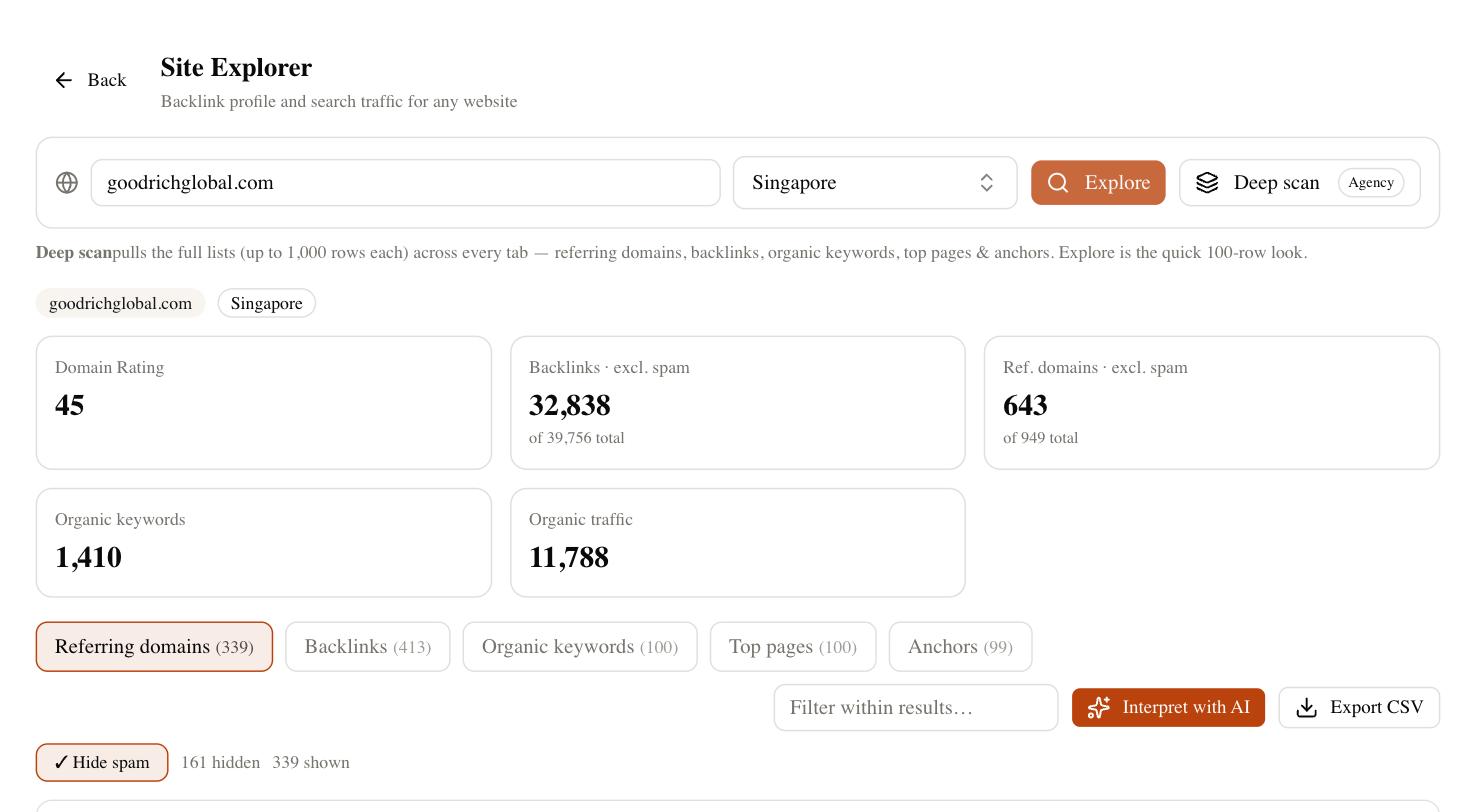
For a freelancer, that consolidation is the whole point. A typical stack of a data tool plus a separate AI writer plus an AI-visibility tracker collapses into one subscription, at entry pricing that’s a fraction of a comparable enterprise plan. The agency client-dashboard side matters too: you can hand a client a clean, read-only report without exporting spreadsheets or paying for extra seats you don’t need.
The Brand Radar piece is what no traditional tool answers. Search is splitting — some of your client’s buyers now ask ChatGPT or Perplexity instead of Google, and a page that ranks first can still be invisible in an AI answer. SEO Rocket tracks whether and where a brand gets cited across those surfaces, so you’re optimizing for the search that’s actually happening. If your bottleneck is doing more billable work with fewer tools, which describes most freelancers, it’s the strongest fit here. The honest caveat: if backlink forensics is 80% of your work, read the next section first.
Ahrefs and Semrush — the heavyweight data tools
Ahrefs and Semrush are the industry’s deep benches, and for some freelancers they’re still the right call. Ahrefs has one of the largest and freshest backlink indexes in the business. If your bread and butter is link audits, disavow work, or competitive link-building at scale, that depth is genuinely hard to replace, and no leaner tool fully matches it yet.
Semrush trades some link depth for enormous breadth. Beyond SEO it covers PPC research, social scheduling, and PR monitoring, so a generalist freelancer running several channels for clients gets real value from one login. The shared trade-off is cost and complexity: both run into the higher price bands once you add the features that justify them, and both reward heavy daily use. If you only touch 20% of the suite, you’re paying for a lot of platform you never open — and that’s a tough sell on a freelance budget.
Mangools, SE Ranking and Ubersuggest — the budget workhorses
The mid-market has a tool for almost every budget and temperament, and for many freelancers one of these covers the core job comfortably.
- Mangools — the friendliest on-ramp. KWFinder is one of the nicest keyword-research experiences going, the bundle stays cheap, and a newer freelancer can be productive in an afternoon. Its index is smaller, so treat competitive numbers as directional.
- SE Ranking — the multi-client value play. Rank tracking scales cheaply across projects, and per-project pricing keeps costs predictable when you’re juggling a handful of small clients at once.
- Ubersuggest — the budget entry point. It won’t match the big indexes on depth, but for a hobby site or your first paying client it delivers usable keyword ideas for very little money.
Any of these will handle keyword research and rank tracking well. What none of them fold in yet is AI content and AI-answer visibility — so if a client asks whether they show up in ChatGPT, you’ll still be running a second subscription to find out.
Google Search Console — the free foundation
No freelancer should skip Google Search Console, and it’s free. It’s the only source of first-party data on how a site actually performs in Google — real clicks, impressions, average position, and the exact queries bringing people in. Third-party tools estimate traffic from sampled clickstreams and rank models; Search Console reports what Google itself recorded. That makes it the honest baseline you check a paid tool against when the numbers disagree. Pair it with any tool above and you get the best of both: reliable first-party performance data plus the research and competitive depth the free tool can’t provide on its own.
How to choose by segment
Match the tool to your real constraint, not to a feature checklist. If you’re a generalist consultant who wants data, content, and AI-search tracking in one place — and wants to stop paying for three tools — SEO Rocket is the natural move. If deep backlink analysis is most of your work, Ahrefs earns its price. If you run PPC and social alongside SEO for clients, Semrush’s breadth pays off. If you’re just starting out or watching every dollar, Mangools, SE Ranking, or Ubersuggest will cover the essentials, and Search Console rounds out the picture for free.
A quick way to decide: write down the three tasks you actually did for clients last week. Most freelancers’ lists are some mix of “check what they rank for,” “see what a competitor is doing,” and “produce a piece of content.” If that’s your week, a single AI-native tool covers all three faster and cheaper than a stitched-together stack. If instead you spent the week deep in link audits, keep the specialist. Whichever you pick, give it a full ranking cycle before you judge it — positions jitter a few spots day to day, and no tool’s estimates are precise. Run your own site and two competitors through it for a week; the one that answers your real questions fastest is the right tool for you.