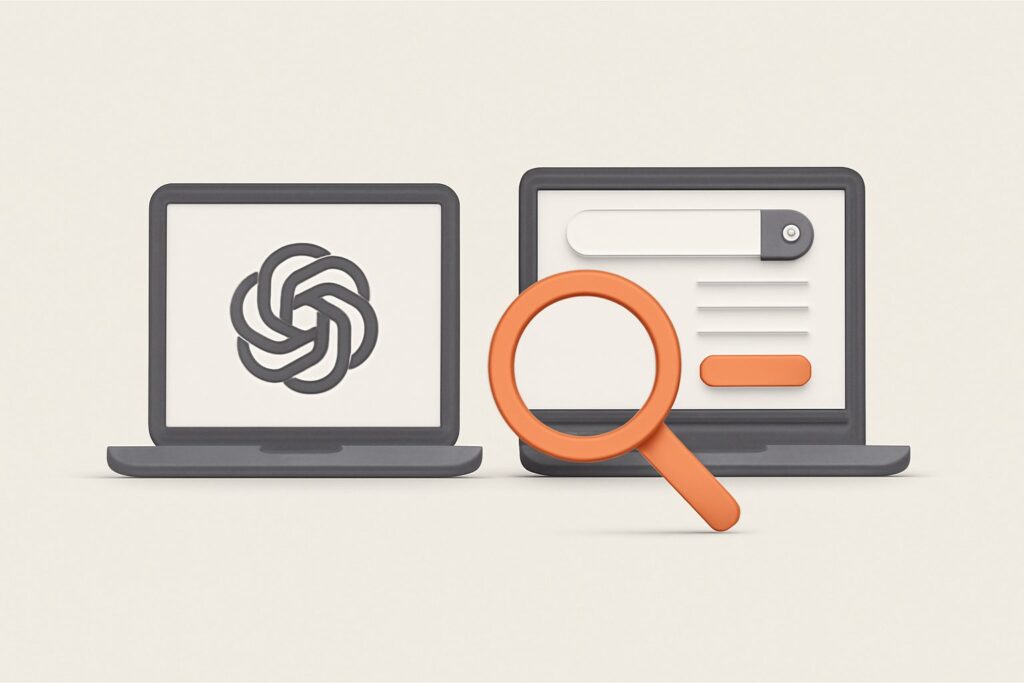
The real question behind ChatGPT vs a dedicated AI SEO tool isn’t which one is smarter — it’s which one knows your search data. ChatGPT is a brilliant general assistant that will happily brainstorm titles, outline a post, and rewrite a clumsy paragraph in seconds. A dedicated AI SEO tool is narrower on purpose: it sits on top of a live keyword and backlink index, so its suggestions are anchored to what people actually search and what already ranks. Both use AI. Only one of them is looking at the numbers.
This is a fair fight, not a sales pitch. Below, you get a straight comparison across the dimensions that decide the work — data quality, ease, AI features, who each is genuinely for, and rough cost — followed by a segment-by-segment verdict and a third option worth a look.
What each one actually is
ChatGPT is a large language model. It generates text from patterns it learned in training, plus whatever you paste into the prompt. On its own it has no keyword volumes, no difficulty scores, no view of your competitors’ backlinks, and no idea whether the article it just wrote can realistically rank. Give it that data and it reasons well; without it, it’s guessing fluently.
A dedicated AI SEO tool flips the emphasis. Tools like Surfer SEO or the AI features bolted onto suites such as Semrush start from real search data and layer AI on top — content briefs scored against the current top ten, on-page recommendations tied to live SERPs, and drafting that’s constrained by what’s already winning. The AI is the assistant; the data is the product. That’s the core of any honest ChatGPT vs a dedicated AI SEO tool decision.
The comparison at a glance
Read the table for the shape of it, then the verdicts below for the nuance. The third column previews SEO Rocket, covered later, because it sits between the two.
| Dimension | ChatGPT | Dedicated AI SEO tool | SEO Rocket |
|---|---|---|---|
| Data quality | None built in — relies on what you paste | Real keyword & SERP data, tool-dependent | Ahrefs-grade keyword, rank & backlink data |
| Ease of use | Very easy — plain chat | Moderate — dashboards to learn | Easy — chat-first over real data |
| AI features | Excellent drafting & ideation | Data-grounded briefs & optimization | Drafting, research & AI-search tracking |
| Best for | Brainstorming, rewriting, quick copy | Structured on-page optimization | Solo SEOs, consultants & agencies |
| Rough price band | Low $ (around $20/mo) | Mid–high $$ per seat | Entry-friendly low $ |
Where ChatGPT wins
For the blank-page problem, ChatGPT is hard to beat. Ask it for thirty title variations, a rough outline, or a friendlier rewrite of a stiff intro and it delivers instantly for about twenty dollars a month. It’s also a genuinely good thinking partner: paste in a keyword list and it will cluster the terms, spot a content angle you missed, and draft an FAQ section that reads like a person wrote it. If your bottleneck is producing words, not deciding which words to target, ChatGPT covers a lot of ground cheaply.
The catch is that it can’t check its own work against reality. It doesn’t know that the keyword you’re chasing has almost no volume, that the top result is a 4,000-word pillar you won’t outrank with 600 words, or whether your brand is ever cited when someone asks an AI assistant a buying question. It will confidently invent a search volume if you let it. Treat ChatGPT as a fast, tireless writer that needs a data source sitting next to it, and you’ll use it well.
Where a dedicated AI SEO tool wins
The moment the job becomes “will this actually rank,” a dedicated tool pulls ahead. Because it’s reading live SERP and keyword data, its recommendations are grounded: target this variant because it has real volume and beatable difficulty, add these subtopics because the current top ten all cover them, aim for roughly this length because that’s what’s winning. That feedback loop is something a general chatbot simply can’t offer, and it’s why serious content teams pay for it.
The trade-offs are cost and scope. Per-seat pricing on the established suites runs well above a ChatGPT subscription once you add the features that make them worth buying, and most are built around dashboards you have to learn rather than a conversation. Many also stop at classic search — they optimize you for Google’s blue links but tell you nothing about whether ChatGPT, Perplexity, or Google’s AI Overviews mention you. For traditional on-page work they’re excellent; for the search behavior that’s emerging, several have a blind spot.
SEO Rocket — the AI-native third option
SEO Rocket is what you get when you stop treating this as an either-or. It keeps ChatGPT’s plain-language ease — you ask for what you need in a chat instead of clicking through tabs — but every answer runs on real, Ahrefs-grade data underneath. Ask for keyword ideas and it returns actual volumes and difficulty; ask about a competitor and it pulls their real backlink profile and top pages; ask for an article and it drafts one that’s anchored to what’s genuinely ranking, not to a model’s best guess.
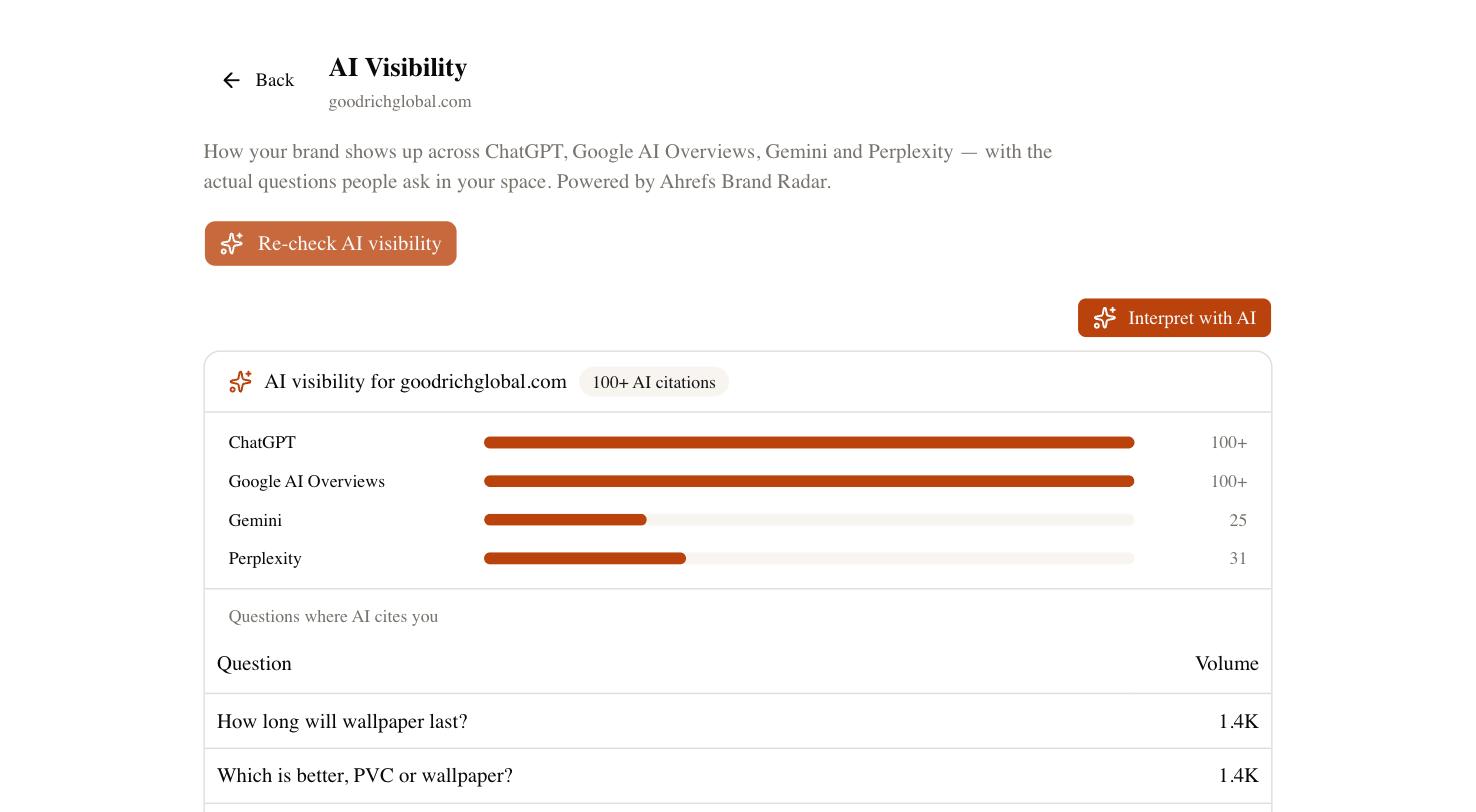
The part neither of the first two options handles well is AI-search visibility. Search is splitting: some of your buyers now ask an assistant instead of typing into Google, and a page that ranks first can still be invisible in an AI answer. SEO Rocket’s Brand Radar tracks whether — and where — you’re cited across ChatGPT, Perplexity, and AI Overviews, so you can optimize for the search that’s actually happening. Add rank tracking, competitor gap analysis, a site audit, and client dashboards for agencies, and the usual stack of a chatbot plus a data tool plus an AI-visibility tracker collapses into one subscription at entry-friendly pricing.
The segment-by-segment verdict
There’s no single winner, so match the tool to your real constraint:
- You mostly need to produce copy fast — ChatGPT, on its own, is the cheapest good answer. Feed it data manually and it’s plenty.
- You run structured on-page optimization at volume — a dedicated AI SEO tool like Surfer earns its keep with data-grounded briefs; keep it.
- You’re a solo SEO, consultant, or agency juggling research, writing, and reporting — an AI-native tool that unifies all three, with AI-search tracking built in, saves the most time and money.
- You live in deep backlink audits or enterprise workflows — a specialist suite is still the right home, and there’s no shame in staying.
The honest test is to write down the three tasks you actually did last week. If they were “find something to write about,” “check what a competitor is doing,” and “produce the piece,” you’re currently doing that across two or three tools — and a single AI-native workflow will cover all three faster. If your week was three hours of link audits, keep the specialist.
How to choose
Start from the truth that these tools solve overlapping but different problems. ChatGPT is a superb writer with no data; a dedicated AI SEO tool is strong on data with a narrower, dashboard-bound workflow; an AI-native option aims to give you both in plain language. Don’t buy the longest feature list — buy the one that matches how you actually spend your week, and remember that every tool’s volumes and difficulty scores are estimates, so treat cross-tool differences as directional rather than gospel.
A cheap experiment settles it. Run your own site and two competitors through whatever you’re considering for a full ranking cycle — positions jitter a few spots day to day, so a week or two of data beats a single snapshot. The tool that answers your real questions with the least friction, and shows you where you stand in both classic search and AI answers, is the right pick. For most people reading this, that’s less about ChatGPT or a dedicated tool in isolation and more about whether one workflow can do the whole job.