When people search for the best SEO tools for small business, they usually mean one thing: what gets me real results without an enterprise invoice or a month of training. You don’t have a data team, you probably run marketing between other jobs, and every subscription has to earn its line on the card. That changes the answer — the tool the big agencies swear by is often the wrong buy for you.
This roundup compares seven tools that a small business can actually run. For each one you’ll get an honest best-fit, not a sales pitch, so you can match the tool to your budget and how you work instead of buying the one with the longest feature list.
What “best” actually means when you’re small
Big-brand rankings reward depth: the biggest link index, the most keywords, the deepest historical data. Useful if you have analysts to mine it. For a small business, three things matter more. First, total cost — the real number after seats and projects, not the headline. Second, time to a decision: can you get a usable answer in five minutes, or does the tool assume you already know what a keyword gap is? Third, whether it covers the whole job or just one slice, because paying for three tools to write, track, and research is where small budgets quietly bleed out.
Data accuracy still counts, but treat every tool’s traffic estimates and difficulty scores as directional. They’re modeled numbers, not meter readings, and they’ll disagree with each other by a wide margin. Judge a tool on whether it points you at the right action, not on whether its estimate matches a rival’s to the decimal.
The best SEO tools for small business at a glance
Start with the table, then read the notes on the two or three that fit your situation. Price bands are rough monthly ranges for an entry plan, not exact figures — every vendor reshuffles tiers, so confirm before you buy.
| Tool | Best for | AI-native? | Standout strength | Rough price band |
|---|---|---|---|---|
| SEO Rocket | Owners & consultants who want one AI-driven workflow | Yes — chat-first | Ahrefs-grade data plus AI writing and AI-search visibility in one place | Low $ / entry-friendly |
| Semrush | Growing teams wanting an all-in-one marketing suite | Add-ons | Breadth — SEO, PPC, social, and content in one login | Higher $$ |
| Ahrefs | Businesses whose growth hinges on backlinks | Limited | One of the largest, freshest backlink indexes | Higher $$ |
| Moz Pro | Beginners who value a gentle, clean interface | No | Approachable UI and the trusted domain authority metric | Mid $$ |
| Mangools | Freelancers & solo owners doing keyword research | No | KWFinder’s fast, friendly research experience | Low $ |
| Ubersuggest | Hobby sites and very tight budgets | Light | Cheap keyword ideas with a low learning curve | Low $ |
| SE Ranking | Small agencies watching cost per client | Some | Affordable rank tracking that scales across projects | Low–mid $ |
SEO Rocket — the AI-native pick
SEO Rocket is built for how a small operator actually works: one person, limited hours, no patience for a wall of tabs. Instead of learning a dashboard, you ask for what you need in plain language and it runs the lookup — keyword research, competitor gaps, rank tracking, site audits, backlink profiles — on real, Ahrefs-grade data underneath. The data quality is comparable to the expensive suites; the difference is that you don’t have to be an analyst to get at it.
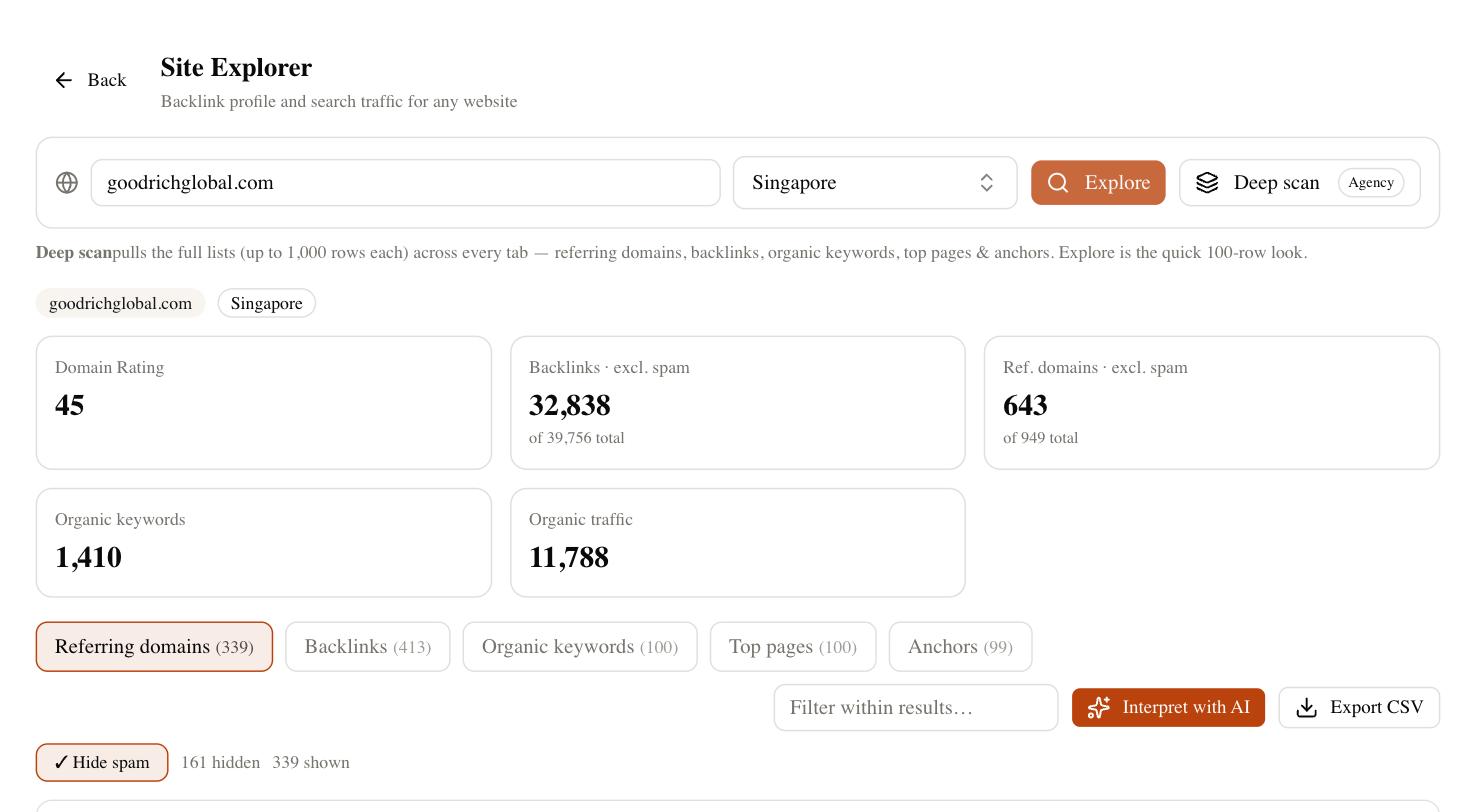
The bigger saving is consolidation. A typical small-business stack is a research tool, a separate AI writer, and something to check whether AI answers ever mention you — three subscriptions and three logins. SEO Rocket folds those into one: it drafts the article with Claude, tracks your positions, and runs a Brand Radar that shows whether you’re being cited in ChatGPT, Perplexity, and Google’s AI Overviews. That last piece matters more each quarter, because some of your customers now ask an AI assistant instead of typing into Google, and a page that ranks first can still be invisible in the answer they read.
For consultants and small agencies, the client dashboard means you can hand a customer a read-only report without exporting spreadsheets. If your constraint is doing more with fewer tools and fewer hours — which describes most small businesses — this is the strongest fit on the list. If you specifically need deep, at-scale backlink forensics, read on.
Semrush, Ahrefs and Moz — the established suites
The big names are big for good reason, and each still wins a clear use case. Semrush is the closest thing to a do-everything marketing platform: beyond SEO it covers PPC research, social scheduling, and PR monitoring, so a growing team that wants one login for the whole channel mix gets real value. The trade-off is cost and complexity — you’ll pay for a lot of suite you may never open, and the learning curve is steep for a solo owner.
Ahrefs remains the specialist’s choice when links are the whole game. If your growth depends on competitive link audits and link-building at scale, its index is one of the largest and freshest anywhere, and that depth is genuinely hard to replace. Moz Pro is the gentlest on-ramp of the three: a cleaner interface and the long-trusted domain authority metric make it an easy first tool if the others felt overwhelming, though its index is smaller. All three are capable; none of them yet folds AI writing and AI-answer visibility into the same workflow, so plan for a second subscription if you need those.
Mangools, Ubersuggest and SE Ranking — the budget picks
You do not need to spend enterprise money to do real keyword and rank work. These three cover the essentials for a fraction of the suites.
- Mangools — the freelancer favorite. KWFinder is one of the nicest keyword-research experiences going, and the bundle stays cheap. Ideal if research is most of what you do and you want it to feel effortless.
- Ubersuggest — the budget entry point. It won’t match the suites on depth, but for a hobby site, a side project, or your first client it delivers usable keyword ideas for very little, with almost no learning curve.
- SE Ranking — the small-agency value play. Rank tracking scales cheaply across many projects, and per-project pricing keeps costs predictable when you’re juggling a handful of clients.
Any of these will handle core research and tracking. What none of them do well yet is write your content or tell you how you show up in AI answers — so if that matters, you’re back to running two tools.
Free and near-free tools worth keeping
Whatever paid tool you land on, keep two free ones running alongside it. Google Search Console shows the queries you already rank for and the pages losing clicks — it’s first-party data straight from Google, more reliable than any estimate, and it costs nothing. Google Analytics tells you what visitors actually do once they arrive. Neither replaces a research tool, because neither surfaces competitor keywords or backlinks, but they anchor every decision in your real numbers instead of modeled ones. Start here before you pay for anything.
How to choose by segment
Match the tool to your real constraint, not to a feature checklist. Write down the three SEO tasks you actually did last month; for most small businesses it’s some mix of “see what I rank for,” “check what a competitor is doing,” and “produce a piece of content.” That list is your answer.
If you’re a solo owner or consultant who wants research, writing, and AI-search tracking in one place without the training overhead, SEO Rocket is the natural move. If you’re a growing team that wants every marketing channel under one roof and the budget to match, Semrush earns its price. If links are your whole strategy, Ahrefs is worth staying with. If you want a gentle, cheaper starting point, Moz, Mangools, Ubersuggest, or SE Ranking will each cover the basics well. Whichever you pick, give it a full ranking cycle before you judge it — positions jitter a few spots day to day, and no tool’s estimates are exact. Run your own site and two competitors through a free trial for a week; the one that answers your real questions fastest is the best SEO tool for your small business, regardless of who tops the generic lists.